Erupções cutâneas
Revisado por Dr Colin Tidy, MRCGPÚltima atualização por Dr Hayley Willacy, FRCGP Última atualização 14 Fev 2024
Atende aos diretrizes editoriais
- BaixarBaixar
- Compartilhar
- Language
- Discussão
- Versão em Áudio
- Adicionar às fontes preferidas no Google
There are many different types of skin rashes and many different causes of skin rashes. Although most skin rashes are harmless, some do need treatment (which may be tablets, creams or ointments) from your doctor or pharmacist.
Some rashes (especially dark red or purple rashes that don't fade when you press them) may even need urgent medical treatment as they can be associated with meningitis and blood infection (septicaemia).
Em resumo
Skin rashes can be described by their appearance, such as redness or blisters.
Rashes can be flat (macules), raised solid areas (papules, nodules, plaques), or fluid-filled (blisters, pustules).
Some dark red or purple rashes that do not fade with pressure are called purpura.
Common causes of rashes include infections, allergic reactions, and certain medical conditions.
Itchy skin rashes can be caused by dry skin, eczema, or psoriasis.
Seek urgent medical advice if a rash does not disappear quickly, if you feel unwell, or if it does not fade with pressure.
This leaflet is a guide but if you have any concerns, you must seek urgent clinical assessment if:
The rash doesn't quickly disappear.
Você se sente mal.
The rash does not fade with pressure (the best way to test this is to press a glass gently against the rash to see if it fades).
How are skin rashes described?
Skin rashes can be described in the following way:
Redness of the skin (called eritema).
Flat abnormally coloured areas of skin (called macules). Macules are often either red, dark red or purple, brown or white.
Solid raised areas which are up to half a centimetre across (called papules).
Solid raised areas which are more than half a centimetre across (called nodules).
Areas of red raised skin (called plaques) e scales, which have a flaky silvery-white appearance.
Reddish-purple lesions which do not fade with pressure (called purpura):
If less than one centimetre across then these are called petéquias.
If more than one centimetre across then they are called ecchymoses.
Blisters: these are swellings of the skin containing fluid:
If a blister is less than half a centimetre across then it is called a vesicle. If filled with yellow fluid (pus) then it is called a pustule.
If a blister is larger than half a centimetre across it is called a bulla (plural is bullae).
What skin conditions cause itching?
Skin disorders that can cause itching include (please click the links to separate leaflets which provide further information):
Pele seca.
What causes skin rashes?
Please click the links to separate leaflets which provide further information:
Red (erythema) but not scaly skin rash
A skin infection called celulite.
An allergic reaction called urticária.
Reaction to a medicine you are taking.
Erupções virais - eg, sarampo ou rubéola (sarampo alemão).
Vasculitis. This is a condition involving inflammation of blood vessels, which may occur with various illnesses, including artrite reumatoide.
Eritema nodoso. This is a condition which causes red rounded lumps (nodules), most commonly on the shins.
Redness on the palms of your hands may be caused by liver disease, pregnancy or an glândula tireoide hiperativa (hipertireoidismo).
A red rash may occasionally be due to an inflammatory condition called lúpus eritematoso sistêmico, especially if it is on the cheeks.
Red (erythema) and scaly skin rash
Psoríase. This is a condition where there is inflammation of the skin.
Eczema. This is sometimes called dermatitis and also involves inflammation of the skin. It may be caused by an allergy and is then called atopic dermatitis/eczema. This may happen in response to some plants - eg, poison oak or ivy.
Dermatite seborreica (in adults). This is a type of skin rash sometimes called seborrhoeic eczema. In babies it is known as cradle cap.
Fungal (or 'yeast') skin infection, such as pé de atleta, groin infection (tinea cruris), ringworm, scalp ringworm or infection with candida.
Pitiríase rósea. This condition is described as 'self-limiting' and the rash will clear itself naturally.
Pitiríase versicolor. This is a rash which is caused by a yeast-like germ.
Líquen plano. This condition mainly affects the skin and causes an itchy rash.
Macules
Red macules may be due to a reaction to a medicine or a viral rash - such as sarampo ou rubéola - as well as other causes.
A brown macule may be a mole but check with your doctor if a mole changes or you are concerned it might be a melanoma.
A white macule may be due to a condition which causes pale patches of skin (called vitiligo) or a skin complaint with flaky discoloured areas (called pitiríase versicolor).
If a macule is dark red or purple and does not fade when you put pressure on it then it is a purpura (see below) and you need to see a doctor urgently. This is because it could be a sign of meningite or blood infection (septicemia).
Papules
Common causes of papules include cicatrizes de acne, viral wart, seborrhoeic wart, molusco contagioso, sarna, picadas de insetos and skin tags.
Other causes include psoríase.
Purpura and petechiae
These are dark red or purple and don't fade when you press them. You need to see a doctor urgently because there may be a serious cause that needs urgent treatment, such as infecção meningocócica.
However, common causes include injury to the skin or repeated coughing. More serious common causes include liver disease such as cirrose.
Less common causes include vasculitis (eg, Púrpura de Henoch-Schönlein) or a low level of platelets in your blood (eg, púrpura trombocitopênica trombótica).
Vasculite
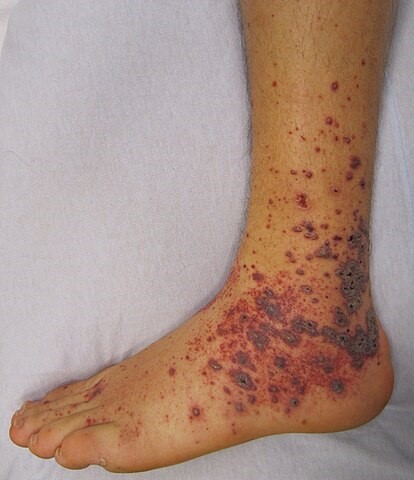
© James Heilman, MD, CC BY-SA 3.0, via Wikimedia Commons
Nodules
Common causes of a nodule include a sebaceous cyst, lipoma, câncer de pele, or a wart.
Other causes include rheumatoid nodules (associated with artrite reumatoide) and Heberden's nodes (associated with osteoartrite).
Blisters
Skin inflammation, including reactions to medicines, dermatite de contato, eczema. Eczema on your legs may be caused by varicose veins (eczema varicoso).
Diseases of your immune system - eg, pemphigoide bolhosa.
Viral infections - eg, catapora, doença mão-pé-boca.
Skin infection: a germ (bacterial) infection with impetigo or viral infection with herpes simplex (herpes labial ou herpes genital) or with herpes zoster (shingles).
Rarer causes include pênfigo e pemphigoid.
Pustules
Skin infection by a virus (eg, herpes labial due to herpes simplex virus) or bacterial germs (impetigo).
Inflammation - eg psoríase.
Pustular skin reaction to medicine you are taking.
Pustules on your face may be acne or rosacea.
Úlceras
Ulcers may be due to venous leg ulcers, úlceras de pressão, diabetes skin ulcers ou cancerous (malignant) skin ulcers.
This leaflet is a guide but if you have any concerns, you must telephone or see your GP, especially if:
The rash doesn't quickly disappear.
Você se sente mal.
The rash does not fade with pressure (the best way to test this is to press a glass gently against the rash to see if it fades).
You are not sure what has caused the rash or have any other concerns.
Escolhas do paciente para Erupções cutâneas

Saúde da pele, unhas e cabelos
Pitiríase rósea
Pitiríase rósea é uma erupção autolimitada, ou seja, desaparece por conta própria sem qualquer tratamento. Embora a erupção possa ser bastante dramática, a doença é muito leve. Afeta mais comumente jovens adultos, mas pode afetar todas as idades.
por Dra. Hayley Willacy, FRCGP

Saúde da pele, unhas e cabelos
Eritema polimorfo à luz
Eritema polimórfico é uma erupção cutânea que pode ocorrer quando você sai ao sol.
por Dra. Hayley Willacy, FRCGP
Perguntas frequentes
What is the difference between a macule that is dark red or purple and purpura?
A dark red or purple macule is a flat, abnormally coloured area of skin. If it does not fade when you put pressure on it, it is classified as a purpura. Purpura indicates a potential seriousness, such as meningitis or blood infection, and requires urgent medical attention.
Can rashes on the palms of my hands indicate a serious condition?
Yes, redness appearing on the palms of your hands can be a sign of certain underlying health issues such as liver disease, pregnancy, or an overactive thyroid gland (hyperthyroidism). If you notice this, it is important to consult a doctor.
What is the distinction between a vesicle, a pustule, and a bulla?
These terms all describe blisters, which are swellings of the skin containing fluid. A vesicle is a small blister, less than half a centimetre across. If this small blister is filled with yellow fluid (pus), it is called a pustule. A bulla is a larger blister, more than half a centimetre across.
What specifically is a 'self-limiting' rash like Pityriasis rosea?
A 'self-limiting' rash, such as Pityriasis rosea, means that the rash will clear up on its own naturally without specific medical treatment. It resolves over time without intervention.
Are all brown macules a type of mole?
While a brown macule may be a mole, it's important to be aware that not all brown macules are. You should check with your doctor if a mole changes in appearance or if you have any concerns that it might be a melanoma, which is a type of skin cancer.
When should I be concerned if a macule is dark red or purple?
If a macule is dark red or purple and doesn't fade when pressure is applied, it's called a purpura. In this situation, you need to see a doctor urgently, as it could signal serious conditions like meningitis or a blood infection (septicaemia).
Leitura adicional e referências
- Imagens de erupção cutânea por infecção meningocócica; DermNet NZ
- DermIS - Dermatology Information System
- Assadura de fralda; NICE CKS, outubro de 2023 (acesso apenas no Reino Unido)
Sobre o autorVer biografia completa

Dr Hayley Willacy, FRCGP
Médico Generalista, Autor Médico
MBChB (1992), DRCOG, DFFP, MRCOG (Part 1) MRCGP (2007), DFSRH (2013), MSc - medical education (2020)
A Dra. Hayley Willacy era uma médica do NHS atuando no noroeste da Inglaterra, que se aposentou da prática clínica em 2022 após 30 anos.
Sobre o revisorVer biografia completa

Dr Colin Tidy, MRCGP
Médico Generalista, Autor Médico
MBBS, MRCGP, MRCP (Paediatrics), DCH
Dr Colin Tidy é um médico do NHS, baseado em Oxfordshire.
Histórico do artigo
As informações nesta página são escritas e revisadas por clínicos qualificados.
Artigo também disponível em Inglês, Alemão, Espanhol, Francês, Italiano, Português, Hindi, Hebraico, Árabe, e Sueco.
Próxima revisão agendada: 12 de fev de 2029
14 Fev 2024 | Última versão

Pergunte, compartilhe, conecte-se.
Navegue por discussões, faça perguntas e compartilhe experiências em centenas de tópicos de saúde.

Sentindo-se mal?
Avalie seus sintomas online gratuitamente
Inscreva-se no boletim informativo do Patient
Sua dose semanal de conselhos de saúde claros e confiáveis - escritos para ajudá-lo a se sentir informado, confiante e no controle.
Ao se inscrever, você aceita nossos Política de Privacidade. Você pode cancelar a inscrição a qualquer momento. Nunca vendemos seus dados.