Folliculitis
Peer reviewed by Dr Doug McKechnie, MRCGPLast updated by Dr Philippa Vincent, MRCGPLast updated 15 Sept 2024
Meets Patient’s editorial guidelines
- DownloadDownload
- Share
- Language
- Discussion
- Audio Version
- Add to preferred sources on Google
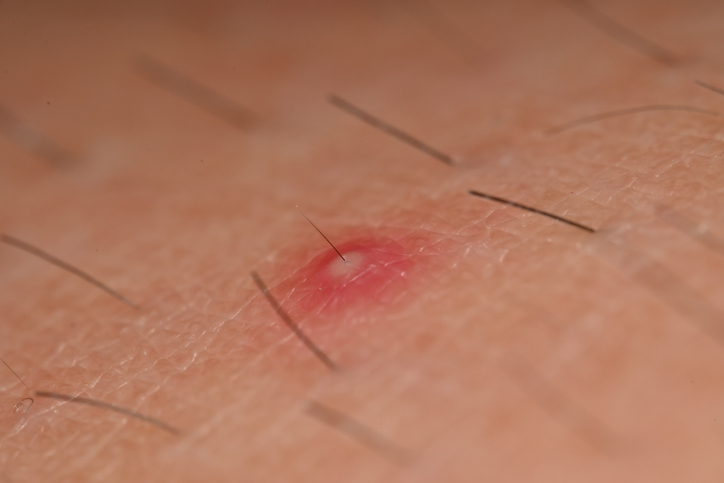
Folliculitis means inflammation of the hair follicles of the skin. Most of the skin is covered with tiny hairs which grow out of hair follicles. In folliculitis, many hair follicles in one area of the skin are affected.
At a glance
Folliculitis is pain and inflammation of the hair follicles.
Infected follicles can swell, forming red bumps or pus-filled spots that may crust over.
It commonly appears on the buttocks, legs, back, chest, face, and scalp.
Most cases are mild and resolve without treatment within 7-10 days.
Seek medical advice if simple measures don't help or if the infection spreads deeper.
What is folliculitis?
Folliculitis means inflammation of the hair follicles. Folliculitis can be a mild, short-lived condition or a severe long-term problem. Folliculitis can occur anywhere on hair-bearing skin. There are a number of causes of inflammation which can result in folliculitis.
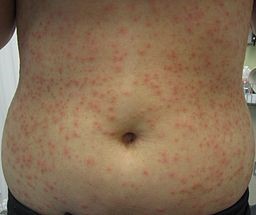
Rash of folliculitis
Folliculitis symptoms
When hair follicles become infected or inflamed they swell causing a red bump on the skin.
Sometimes the affected follicles fill with pus, covering the affected skin with small, rounded, yellow-red spots (pustules).
Affected skin may develop a crust, which can be yellow or golden coloured due to infection.
The affected skin can feel painful, hot and may be itchy.
Folliculitis locations
Folliculitis can be found everywhere where hair grows but the following areas are particularly common:
Buttocks.
Legs.
Back.
Chest.
Face.
Scalp.
Types of folliculitis
Bacterial folliculitis
This is the commonest type of folliculitis and usually arises from the typical bacteria which normally live on the skin causing an infection in the hair follicles. It is very common and easily treated with antibiotics if it is significant enough to need treatment. Often it will settle on its own without treatment.
There are a few specific types of folliculitis:
Sycosis barbae
This is the medical name for a long-term (chronic) folliculitis in the beard area of the face. The skin is painful and crusted, with burning and itching on shaving. Numerous pustules develop in the hair follicles. It can be difficult to treat and some men grow a beard to solve the problem.
Hot tub folliculitis
As the name suggests, this tends to affect people after using a hot tub. The hot water encourages a bacteria called Pseudomonas aeruginosa to grow (particularly if there is not enough chlorine in the water to keep it clean). This type of folliculitis is generally harmless and is prevented by proper maintenance of hot tubs. Showering after using the hot tub does not seem to reduce the chance of folliculitis. Antibiotics are not needed for hot tub folliculitis; it usually settles within 2 weeks.
Gram-negative folliculitis
This is a type of folliculitis that may occur after acne has been treated with long-term antibiotics. Gram-negative refers to a type of stain that is used in a laboratory to identify different types of bacteria.
Pseudo-folliculitis
Also known as "razor bumps", this is caused by inflammation from shaving and ingrowing hairs. Pseudo-folliculitis is more common in people with curly or Afro-Caribbean hair, as these hairs are more likely to curl back and grow into the skin. Ingrowing hairs can also be caused by dead skin cells blocking the hair follicle so the hair cannot exit the follicle.
Malassezia folliculitis
Also known as pityrosporum folliculitis, this is caused by yeasts which normally live on the skin but occasionally cause inflammation. Malassezia folliculitis is more common in adolescent boys and young men and is also more common in hot humid climates. Other things that make malassezia folliculitis more common are frequent use of sunscreen, excessive sweating, antibiotic use and the immune system being impaired.
Folliculitis
Eosinophilic folliculitis
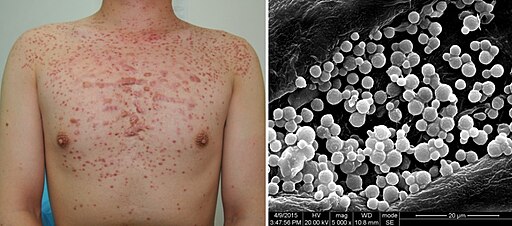
This rare form of folliculitis is also known as eosinophilic pustular folliculitis or Ofuji disease. It causes itchy pustules and is more common in men than women. The pustules are usually seen on the head, neck and trunk and can persist for weeks or months. It may look like acne. It is associated with HIV but also occurs in people without HIV. Simple anti-inflammatory drugs have been reported to help in up to 7 out of 10 people with eosinophilic folliculitis. Antibiotics may also help.
Carbuncles
A carbuncle is a group of inflamed follicles close together which then join together into one hot red lump with pus coming out of several points. This can be very painful and antibiotics are often needed. Warm compresses may help avoid the need for antibiotics.
Furuncles (boils)
This is an infection deeper in the hair follicle which causes a small abscess just under the skin. It is hot and red. Antibiotics may be needed but warm compresses can often help.
Causes of folliculitis
Folliculitis occurs at sites where hair follicles are inflamed. There are a number of causes:
Infection. Most folliculitis infections are caused by a bacteria called Staphylococcus aureus (S. aureus), which usually lives harmlessly on the skin. Occasionally other bacteria, fungi (Pityrosporum or Candida albicans) or parasites are the cause.
Physical irritation caused by shaving or friction.
Chemical irritation caused by chemicals applied to the skin.
Blockage of the hair follicle eg, by dead skin cells or thick creams.
Excessive sweating (hyperhidrosis) due to overactivity of the sweat glands.
Steroid creams.
Inflammatory skin conditions are an uncommon cause.
Complications of folliculitis
Most cases of folliculitis get better without any complications. Occasionally the following can occur:
Scarring of the skin.
Darkening of the affected skin (hyperpigmentation).
Hair loss at the affected site due to scarring of the skin.
Deep folliculitis. This occurs if the infection spreads deeper into the follicles causing a boil.
Cellulitis. This is when infection spreads into the surrounding skin, making it hot and red.
Medical advice should be sought if there is an infection which is spreading deeper or onto surrounding skin.
Diagnosing folliculitis
There are no specific tests for folliculitis. Normally the diagnosis is obvious from the type of rash.
Occasionally a swab might help if there is discharge from the pustules.
Folliculitis treatment
Identifying the cause of the folliculitis will help decide what will help. General measures include:
Avoiding things that aggravate the condition.
Taking a break from hair removal until the folliculitis has settled down.
Avoiding wearing tight clothes over the affected area, particularly if it causing sweating.
Keeping cool and keeping folliculitis exposed to the fresh air.
Not sharing towels, flannels or razors.
Applying an antibacterial moisturiser (emollient) and soap substitute. See below for more information.
Mild cases
Most cases of folliculitis are mild and do not need any treatment. It often clears without any treatment within 7-10 days.
It may be helpful to use:
A moisturiser (emollient) which contains an antibacterial agent - for example, Dermol® cream.
Lotion or Emulsiderm®.
These may help the folliculitis to clear more quickly and reduce the risk of it becoming worse. You can use one of these emollients as a soap substitute until the folliculitis has cleared (and long-term if needed). These can also be added to the bath or shower - specific bath or shower products are not needed.
If simple measures over a few days do not result in improvement of the folliculitis, medical advice should be sought for further advice and treatment.
Localised folliculitis
For localised areas of folliculitis, an antibiotic cream may be useful. Fusidic acid is a suitable antibiotic cream that can be applied 3-4 times per day to affected areas. If the folliculitis is thought to be fungal, a different treatment may be used.
More severe cases
If the folliculitis is more severe or widespread then a course of oral antibiotic tablets may be needed.
Recurrent or long-term (chronic) folliculitis
Recurrent folliculitis occurs when the infection keeps coming back, although it disappears with treatment. The gaps between episodes may get shorter and, eventually, chronic folliculitis is the result.
In these cases, a clinician may take a sample (swab) from the skin where the folliculitis is. This swab can show if an infection is responsible and identify which type of infection it is. The correct medication can then be used to try and eradicate the bacteria from the skin.
Preventing folliculitis
To try and prevent folliculitis, the following actions may help:
Keeping skin clean, dry and free from abrasions or irritations.
Keeping skin well-moisturised.
Using clean, sharp razors and shaving in the direction of hair growth, or using an electric razor.
Using a shaving soap, gel or foam to lubricate the blades across the skin to help prevent nicks and cuts.
Using hair removal methods other than shaving.
Avoiding chemicals or items which irritate the skin.
Exfoliating regularly to remove dead skin cells.
Using antiseptic washes routinely is not generally recommended as they can make the skin sore and dry.
Is folliculitis contagious?
Folliculitis itself is not contagious. In hot-tub folliculitis, other people who have been exposed to the same hot tub are likely to develop folliculitis as well.
Patient picks for Hair and scalp conditions

Skin, nail and hair health
Male pattern baldness
Male pattern baldness is the common type of hair loss that develops in most men at some stage. The medical term for this is androgenetic alopecia. It usually takes 15-25 years to go bald, but can be quicker. Typically, at first the hair begins to thin (recede) at the sides (temples). At the same time, the hair usually becomes thin on the top of the head. A bald patch gradually develops in the middle of the scalp. The receding sides and the bald patch on the top (the crown) gradually enlarge and join together, leaving a patch at the front. The patch at the front eventually thins as well. A rim of hair is often left around the back and sides of the scalp. In some men, this rim of hair also thins and goes, leaving a completely bald scalp.
by Dr Toni Hazell, FRCGP

Skin, nail and hair health
Alopecia areata
Alopecia areata is a condition where patches of hair loss develop, usually on the head. In some cases, total baldness develops. Usually the hair regrows after several months. In some cases, the hair loss is permanent. Treatments to promote hair regrowth work in some cases, but often the hair regrows of its own accord.
by Dr Philippa Vincent, MRCGP
Frequently asked questions
Can folliculitis spread from one area of my body to another?
While the inflammation itself is not contagious from person to person, if the folliculitis is caused by an infection, the bacteria or fungi can potentially spread to other hair follicles on your own body, especially if you scratch the affected area or if conditions like excessive sweating are present.
Does folliculitis usually come back after it clears up?
Folliculitis can sometimes be a recurring problem, even after treatment. If the underlying cause, such as certain bacteria or irritation, is not fully addressed or re-emerges, new episodes of folliculitis may occur. This is known as recurrent folliculitis, where the infection keeps coming back. In some cases, it can even become a long-term (chronic) issue.
If I have folliculitis, should I avoid using public hot tubs in the future?
If you have experienced hot tub folliculitis, it's a good idea to consider the maintenance of public hot tubs. This type of folliculitis is linked to a bacteria that thrives in warm water, especially if there isn't enough chlorine to keep the water clean. Ensuring proper maintenance of hot tubs you use is the key to preventing it.
Are there specific types of cream that can help with the itchiness from folliculitis?
While the article mentions antibacterial moisturisers (emollients) like Dermol cream to help clear folliculitis and reduce the risk of it worsening, it doesn't specifically recommend creams for itchiness. However, these emollients can also be used as soap substitutes and might offer some relief as they help soothe the skin.
Further reading and references
- Folliculitis; DermNet NZ
- Folliculitis and boils (furuncles/carbuncles), Primary Care Dermatology Society (PCDS), 2016
- Winters RD, Mitchell M; Folliculitis. StatPearls, September 2019.
- Eosinophilic Pustular Folliculitis; DermNet
About the authorView full bio
Updated by

Dr Philippa Vincent, MRCGP
General Practitioner, Medical Author
MB BS, Bsc, MRCGP (2000), DCH, DFSRH, DRCOG
Dr Philippa Vincent is an NHS GP working in North London.
About the reviewerView full bio

Dr Doug McKechnie, MRCGP
Medical Writer
MA, MBBS, MSc, DRCOG, MRCP(UK), MRCGP(2021), FHEA
Dr Doug McKechnie is an NHS GP working in London. He works full-time clinically and is also the Deputy Lead for the Clinical and Professional Practice module at University College London Medical School.
Join the conversation
Share your thoughts or experiences with others in our patient communities.

Ask, share, connect.
Browse discussions, ask questions, and share experiences across hundreds of health topics.

Feeling unwell?
Assess your symptoms online for free
Sign up to the Patient newsletter
Your weekly dose of clear, trustworthy health advice - written to help you feel informed, confident and in control.
By subscribing you accept our Privacy Policy. You can unsubscribe at any time. We never sell your data.