Rosacea
Peer reviewed by Dr Colin Tidy, MRCGPLast updated by Dr Rosalyn Adleman, MRCGPLast updated 25 May 2023
Meets Patient’s editorial guidelines
- DownloadDownload
- Share
- Language
- Discussion
- Audio Version
- Add to preferred sources on Google
In this series:Skin rashesCellulitisErythema toxicum neonatorumFolliculitisPerioral dermatitisScabies
Rosacea is a skin condition that affects parts of your face. Symptoms can include facial flushing, facial redness, spots, thickening of your skin, and eye problems such as dry eyes and sore eyelids. Not all symptoms occur in all cases. Rosacea affects about 1 in 20 people in the UK, usually in middle age. Many cases are mild. Spots can usually be cleared with antibiotic treatment. Other treatments may be used for other symptoms. A complication that affects the front of the eye (the cornea) is uncommon but serious. See a doctor urgently if you have rosacea and develop any eye pain or visual problems.
At a glance
Rosacea is a skin condition typically affecting the face, causing flushing, redness, and spots.
Its symptoms can vary greatly among individuals and may include eye problems or skin thickening.
The exact cause of rosacea is unknown, but genetics, sun damage, and tiny mites may play a role.
Triggers like heat, alcohol, sun, and spiced foods can worsen flushing and should be avoided.
Treatments can manage symptoms, including creams, antibiotics, or laser therapy.
See a doctor urgently if you develop eye pain or vision problems.
What is rosacea?
Rosacea is a skin condition that usually affects parts of your face such as your nose, cheeks and forehead. However, other areas, such as your neck, upper chest, back and ears, can sometimes become involved, especially with flushing. Rosacea is sometimes called acne rosacea, as it can look similar to acne. However, it is a different condition to acne.
Rosacea symptoms
Symptoms of rosacea include one or more of the following:
Frequent flushing of your face, similar to blushing. This is often the first symptom and may be the only symptom for months or years before anything else develops.
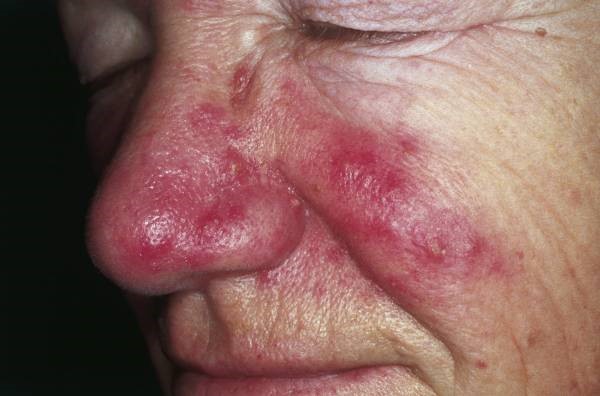
Redness (erythema) of parts of the face. This can look similar to sunburn.
Small red bumps (papules) and small cysts (pustules) on your face. The spots and cysts look similar to acne. These may come and go in some cases but, in others, remain long-term unless treated.
Tiny visible blood vessels on your face. This is also called telangiectasia. They can sometimes become quite prominent on your face.
Eye symptoms (also called ocular rosacea) occur in about half of cases but are often mild. They can include:
A feeling of something in your eye.
Burning, stinging or itchy eyes.
Dryness.
Sensitivity to light.
Eyelid problems such as cysts, styes or eyelid inflammation (blepharitis).
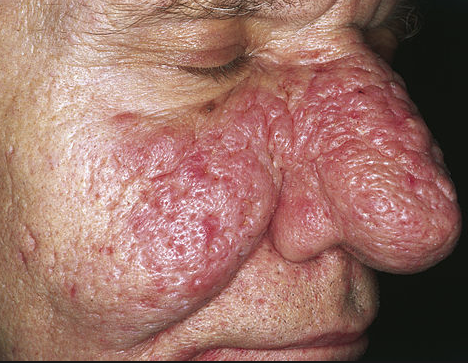
Inflammation and infection of the front of your eye (the cornea) is an uncommon but serious complication that can affect your vision. See a doctor urgently if you develop eye pain or visual problems.Thickening of the skin occurs in some cases. The most well-known example of this is an unsightly, bumpy nose (called a rhinophyma). This is uncommon and usually occurs most commonly in men.
The symptoms are usually just on the central parts of your face - on your cheeks, forehead, nose, around your mouth and chin. Skin on other parts of your head is sometimes affected. Rarely, skin on your arms or back is affected.
Rosacea is not usually painful or itchy. However, in some cases there may be a burning feeling over the affected skin. You do not usually feel ill with rosacea and serious complications are uncommon. However, rosacea can be unsightly and distressing.
The symptoms can vary from case to case - for example:
Some people only ever get one or two of the symptoms. These may be just mild and not too troublesome. For example, some people just have facial flushing and/or mild redness of the face and never develop any other symptoms.
Some people may develop several symptoms but one symptom may dominate.
Spots are a prominent feature in some cases but not in all.
A large, bumpy nose from rosacea (called rhinophyma) is uncommon but may occur even without any other symptoms.
Eye symptoms occur in some people before any skin symptoms develop.
In short, the development and severity of symptoms of rosacea can vary greatly.
Rosacea picture
Nose and cheeks displaying rosacea
© Michael Sand, Daniel Sand, Christina Thrandorf, Volker Paech, Peter Altmeyer, Falk G Bechara, CC BY 2.5, via Wikimedia Commons
Rosacea causes
The exact cause is not known. A number of factors may be involved. However, none of these factors has definitely been proven to be the cause. For example:
Tiny blood vessels under the affected skin may become abnormal or leaky.
Sun damage.
A tiny mite called Demodex folliculorum may be involved. It lives harmlessly on the skin of many people but has been found in higher numbers in those with rosacea.
Abnormal immune reactions in the skin, which lead to inflammation.
Genetics may also be involved, as rosacea may run in some families.
Long-term use of steroid creams on the face can cause a condition identical to rosacea. This used to be quite common. However, the danger of overusing steroid creams is now well known and this is now an uncommon problem.
Rosacea is not contagious and therefore cannot be spread from one person to another person.
Risk factors
Around 1 in 20 people in the UK are thought to develop rosacea. This is a lot of people but many cases are mild. Symptoms may first appear in your early 20s but the usual age that symptoms appear is in your 30s-60s. Rarely, rosacea can affect children. Women are more commonly affected than men. However, rosacea is often less severe in women than in men. Rosacea is more common in fair-skinned than in dark-skinned people.
Rosacea diagnosis
Rosacea is usually diagnosed by your typical symptoms and its typical appearance on your face. There are no specific investigations that are needed to confirm the diagnosis. However, sometimes your doctor may do a test such as a blood test to help exclude other problems that may cause redness of the skin, such as systemic lupus erythematosus. See the separate leaflet called Lupus (Systemic Lupus Erythematosus). Occasionally, if the diagnosis is uncertain a specialist may recommend a skin biopsy (a tiny sample of the skin is removed to look at under a microscope).
Rosacea treatments
There is no permanent cure for rosacea. There is nothing you can do to prevent rosacea from starting. However, treatments can ease the symptoms and can be really effective. The treatments used may vary, depending on what symptoms develop. Treatment may need to be adjusted over time, depending on your response to treatments and if you develop different symptoms.
General measures
Avoid strong sunlight to the face. Sunlight is thought to make symptoms worse. Use a sunblock cream on the face regularly, with a high protection factor (30 or higher and with ultraviolet A (UVA) and ultraviolet B (UVB) protection). It is difficult to say what is strong sunlight. Therefore, many doctors would advise that you apply sunblock every day before you go out, whatever the level of sunshine. A wide-brimmed hat will also help to protect your face from the sun.
If you have dry skin, you can try a hypoallergenic, non-perfumed and non-greasy moisturising cream. Also, you should generally avoid using any steroid creams (unless advised by your doctor) or other abrasive creams on your face. Men may also find that using an electric razor rather than shaving with a blade helps their symptoms.
Treatment for facial flushing and rosacea triggers
Some people find that certain things aggravate the skin and trigger flushing or make the flushing worse. The most common things reported that may trigger the skin to flush are:
Extremes of temperature (in particular, excessive heat).
Alcoholic drinks.
Strenuous exercise.
Stressful situations.
Sunlight.
Spicy food.
Hot drinks.
If any of these seem to trigger bouts of flushing or make the flushing worse, then avoiding them is sensible and is therefore recommended.
Some medicines used for other conditions may also trigger flushing - for example, calcium-channel blockers. If you suspect that a medicine is making the flushing worse, then discuss this with your doctor. An alternative medicine may be available.
A treatment called brimonidine gel, which is rubbed into the skin works to reduce the redness associated with rosacea. Some people find this very effective and it can work very quickly.
Treatment for rosacea red face and broken capillaries
There is little evidence that medication has any effect on clearing the visible tiny blood vessels (telangiectasia) you may have. Some treatments may work to improve the rosacea facial redness (erythema). However, a treatment for spots (listed below) may be advised to prevent spots from developing if you have persistent erythema.
Also, people with erythema often have sensitive skin which can make erythema worse. Therefore, it is best to avoid using anything that may sensitise the skin - for example:
Cleansers containing acetone or alcohol.
Abrasive or exfoliant preparations.
Oil-based or waterproof make-up.
Perfumed sunblocks or those containing insect repellents.
Camouflage creams can help to cover and conceal erythema and telangiectasia. (Changing Faces provides free skin camouflage clinics in England and Scotland. You may require a referral from your GP.)
Some people have a good response with light or laser therapy. A laser or very bright light of a certain wavelength can destroy tiny blood vessels under the skin but without damaging the nearby tissue. This can remove the telangiectasia and improve erythema. Your doctor or skin specialist will advise if this is an option for you. These treatments are not usually available under the NHS though.
Treatment for rosacea spots and cysts
Certain antibiotics are the usual treatment. They usually work well but it is not clear why they work, as there is no proven germ (bacterium) that causes rosacea. Some antibiotics reduce inflammation in the skin as well as killing bacteria and this may be why they work for rosacea. A rub-on (topical) antibiotic called metronidazole is the common treatment if you have just a few small spots (papules). If you have many spots or cysts (pustules) then antibiotic tablets such as a tetracycline, doxycycline or erythromycin may be used.
Some improvement may occur after 2-3 weeks of treatment. However, it commonly takes a 6- to 12-week course of antibiotics to clear spots and cysts. One reason why antibiotic treatment fails is that some people give up on treatment after a few weeks without completing the full course.
When a course of antibiotic treatment is finished, the spots or cysts commonly return at some point. Therefore, repeated courses of treatment may be needed from time to time. As an alternative, once the spots have cleared, some people take a regular maintenance dose of antibiotics or use a topical antibiotic (regularly or intermittently) long-term to prevent the spots and cysts from returning.
Topical azelaic acid is an alternative to topical antibiotics to treat mild-to-moderate spots. However, some people find that it can cause side-effects such as burning, stinging, itching, scaling and dry skin.
Ivermectin cream is a newer treatment for people with rosacea. It works by killing the mite Demodex folliculorum and also works to reduce some of the inflammation in your skin.
If you do not respond to any of these treatments, other therapies are sometimes given in specialist clinics. These include isotretinoin tablets.
Treatment for rosacea eye problems
Eye symptoms, if they occur, are often mild and may not need any treatment.
If dryness of the eyes is a problem then regular use of artificial tears will help. See the separate leaflet called Dry Eyes for more details.
If eyelid inflammation (blepharitis) is a problem then regular eyelid hygiene will help. See the separate leaflet called Blepharitis for more details.
If eye symptoms become troublesome, a course of antibiotic tablets (as described above) will usually settle the symptoms.
If a more serious eye problem occurs then you will need to be referred to an eye specialist for treatment. For example, steroid drops may be advised by a specialist to treat inflammation of the front of your eye (the cornea) - an uncommon complication of rosacea.
Treatment for rosacea nose
An unsightly, bumpy nose (rhinophyma) is an uncommon symptom of rosacea. If it occurs, surgical or laser treatment usually works well to trim back the thickened skin. This image shows the typical appearance of 'rosacea nose':
Rhinophyma
© M. Sand, D. Sand, C. Thrandorf, V. Paech, P. Altmeyer, F. G. Bechara, CC BY 2.0, via Wikimedia Commons
Diet and rosacea
There is no particular diet for rosacea, however, eating an anti-inflammatory diet, like a Mediterranean diet, seems to help some people who have rosacea. Others also find that hot spicy foods or certain vegetables (like tomatoes or peppers) can trigger the facial flushing. Therefore, in general it's a good idea to follow a healthy diet, not to smoke, and to drink alcohol in small quantities.
Patient picks for Skin rashes
Skin, nail and hair health
Skin rashes
There are many different types of skin rashes and many different causes of skin rashes. Although most skin rashes are harmless, some do need treatment (which may be tablets, creams or ointments) from your doctor or pharmacist. Some rashes (especially dark red or purple rashes that don't fade when you press them) may even need urgent medical treatment as they can be associated with meningitis and blood infection (septicaemia).
by Dr Hayley Willacy, FRCGP

Skin, nail and hair health
Pemphigus vulgaris
Pemphigus vulgaris is a very serious skin disease that causes blisters. It is rare. Pemphigus vulgaris is more serious than most other blistering skin conditions. Before treatment became available, most people with the condition used to die soon after the disease started. These days most cases can be controlled with treatment. Treatment is usually with steroid medicines and other medicines to suppress the immune system. A skin specialist should supervise treatment.
by Dr Oliver Starr, MRCGP
Frequently asked questions
What is the likelihood of developing rosacea?
Rosacea is a fairly common condition, thought to affect about 1 in 20 people in the UK. Many cases are mild, and symptoms often first appear between the ages of 30 and 60. While it can rarely affect children, women are more commonly affected than men, though often with less severe symptoms. It is also more prevalent in fair-skinned individuals.
How is rosacea typically diagnosed?
Diagnosis of rosacea is usually based on your characteristic symptoms and the way it appears on your face. There aren't specific tests required to confirm it. However, a doctor might sometimes perform a blood test to rule out other conditions that can cause facial redness, or in rare cases, a skin biopsy if the diagnosis is unclear.
What is the general approach to treating rosacea?
There is currently no permanent cure for rosacea, and it's not possible to prevent it from starting. However, various treatments can effectively manage and ease the symptoms. The treatment plan is often tailored to the specific symptoms you have and may need to be adjusted over time based on how you respond or if new symptoms develop.
What are some general measures I can take to help manage my rosacea?
Protecting your face from strong sunlight by regularly using a high-factor sunblock (SPF 30+ with UVA and UVB protection) and wearing a wide-brimmed hat is recommended. If you have dry skin, try a hypoallergenic, non-perfumed, and non-greasy moisturising cream. It's also generally advised to avoid steroid creams on your face unless specifically instructed by your doctor, and men might find an electric razor less irritating than a blade.
Are there specific dietary recommendations for rosacea?
There isn't a specific diet for rosacea. However, some people find that eating an anti-inflammatory diet, such as a Mediterranean diet, can be helpful. Certain hot or spicy foods, or even some vegetables like tomatoes or peppers, can sometimes trigger facial flushing in some individuals. Generally, maintaining a healthy diet, not smoking, and consuming alcohol in moderation are good practices.
Further reading and references
- Changing Faces
- Weinkle AP, Doktor V, Emer J; Update on the management of rosacea. Clin Cosmet Investig Dermatol. 2015 Apr 7;8:159-77. doi: 10.2147/CCID.S58940. eCollection 2015.
- van Zuuren EJ, Fedorowicz Z, Carter B, et al; Interventions for rosacea. Cochrane Database Syst Rev. 2015 Apr 28;4:CD003262. doi: 10.1002/14651858.CD003262.pub5.
- Rosacea; DermIS (Dermatology Information System)
- Sand M, Sand D, Thrandorf C, et al; Cutaneous lesions of the nose. Head Face Med. 2010 Jun 4;6:7. doi: 10.1186/1746-160X-6-7.
- National Rosacea Society
About the authorView full bio

Dr Rosalyn Adleman, MRCGP
MRCGP
Dr Rosalyn Adleman, is an NHS GP working in north London.
About the reviewerView full bio

Dr Colin Tidy, MRCGP
General Practitioner, Medical Author
MBBS, MRCGP, MRCP (Paediatrics), DCH
Dr Colin Tidy is an NHS Doctor, based in Oxfordshire.
Article history
Article also available in English, German, Spanish, French, Italian, Portuguese, Hindi, Hebrew, Arabic, and Swedish.
Next review due: 14 Apr 2028
25 May 2023 | Latest version
Join the conversation
Share your thoughts or experiences with others in our patient communities.

Ask, share, connect.
Browse discussions, ask questions, and share experiences across hundreds of health topics.

Feeling unwell?
Assess your symptoms online for free
Sign up to the Patient newsletter
Your weekly dose of clear, trustworthy health advice - written to help you feel informed, confident and in control.
By subscribing you accept our Privacy Policy. You can unsubscribe at any time. We never sell your data.
More in skin, nail and hair health
- Acne
- Actinic keratosis
- Alopecia areata
- Cat scratch disease
- Chilblains
- Emollients and eczema creams
- Erythema nodosum
- Folliculitis
- Hidradenitis suppurativa
- Infected wounds
- Insect bites and stings
- Melanoma skin cancer
- Perioral dermatitis
- Seborrhoeic dermatitis
- Seborrhoeic warts
- Skin cancer types
- Skin ulcers
- Telogen effluvium
- Topical steroids for eczema
- Varicose eczema