Pitiríase rósea
Revisado por Dr Colin Tidy, MRCGPÚltima atualização por Dr Hayley Willacy, FRCGP Última atualização 30 Dez 2024
Atende aos diretrizes editoriais
- BaixarBaixar
- Compartilhar
- Language
- Discussão
- Versão em Áudio
- Adicionar às fontes preferidas no Google
Nesta série:Infecções virais da peleHerpes labialInfecção primária por herpes labialMolusco contagioso
Pitiríase rósea é uma erupção autolimitada, ou seja, desaparece por conta própria sem qualquer tratamento. Embora a erupção possa ser bastante dramática, a doença é muito leve. Afeta mais comumente jovens adultos, mas pode afetar todas as idades.
Em resumo
Pityriasis rosea is a common, self-limiting skin rash found in children and young adults.
A single "herald patch" often appears first, followed by a more widespread rash.
The rash can be itchy, but there are no known remedies to clear it faster.
Simple creams, menthol, antihistamines, or steroid creams may help with itching.
Pityriasis rosea is not considered contagious.
It typically clears up within 2 to 12 weeks, but can last longer.
See your doctor if the rash lasts over three months or if itching is severe.
O que é pitiríase rósea?
Pityriasis rosea is a self-limiting rash that can occur both in adults and in children. Pityriasis rosea is more common in children and young adults. It is most common in people aged between 10 and 35 years. It is more common in the spring and autumn months. Unfortunately, having pityriasis rosea during the first 15 weeks of pregnancy is associated with miscarriage and preterm delivery.
Pityriasis rosea symptoms
Most people with pityriasis rosea feel perfectly well but are aware of a rash. The rash may be itchy but is not always. Some people may have:
A mild headache.
Uma temperatura alta (febre).
Uma sensação de enjoo (náusea).
A feeling of being more tired than usual.
Any symptoms that do occur usually start before the rash appears. Some people develop intense itching before the rash first appears.
Occasionally, some people also have affected areas in their mouths - for example, blisters or ulcers.
Pityriasis rosea treatment
Pityriasis rosea is a condition that will clear itself naturally. No treatment is needed.
Although this rash disappears without leaving a scar, some people find they have marks of discolouration on their skin for a few months.
There are no known pityriasis rosea remedies that will clear the rash more quickly than its natural course. The following may help if itching is a problem:
Avoid fragranced soaps, hot water, wool and synthetic fabrics.
As much as possible try not to scratch. It is thought that scratching can make itch worse and an itch-scratch vicious cycle may develop with regular scratching. (That is, you itch more because you scratch, so you scratch more because you itch more ... and so on.)
Simple creams (also called emollients) may be soothing to the skin and reduce the itching.
A menthol cream or ointment may be cooling and soothing.
Comprimidos de anti-histamínico may help to reduce the itching. These can be prescribed by your doctor or bought from a pharmacy.
Your doctor may prescribe a creme de esteroides if your itching is more severe.
If symptoms are very severe you may be referred to a skin specialist who may advise some ultraviolet light treatment. There is no definite evidence that this is effective; however, it is often tried. Other treatments, such as aciclovir, may also be considered.
Pityriasis rosea causes
Its exact cause is unknown. No germ (bacterium, virus, or fungus) has been found in people with the rash. However, certain types of human herpes viruses may be a part of the cause. It is not associated with food, medicines or stress. However, some medicines can cause a rash which looks similar to pityriasis rosea.
What does the rash look like in pityriasis rosea?
A 'herald patch' usually appears on the skin first. This is usually an oval- or round-shaped patch which can vary from 2-5 cm in diameter. This is usually pink/red in colour. It most commonly appears on your chest or upper back. It can sometimes appear on your tummy (abdomen), neck, back, thigh or upper arms. However, many cases do not have a herald patch or it goes unnoticed.
Around 5-15 days later a more widespread rash gradually appears over about 10 days. Most commonly this is on the back or the chest and abdomen. This rash can spread over much of your body. However, it does not usually affect your face.
The rash usually consists of oval-shaped spots 1-3 cm in diameter which are pinky in colour. These spots are smaller than the herald patch. Often the spots seem to form lines in parallel with your skin creases.
This rash may be very itchy. The rash fades in time but this may take several weeks. It leaves no marks or scarring. Second attacks are very rare but have been reported.
This description is the typical case which most people seem to have. Occasionally, the rash may just affect the arms and legs. Rarely, it can cause scaling or flaking of the skin, which can be troublesome.
Pitiríase rósea no abdômen
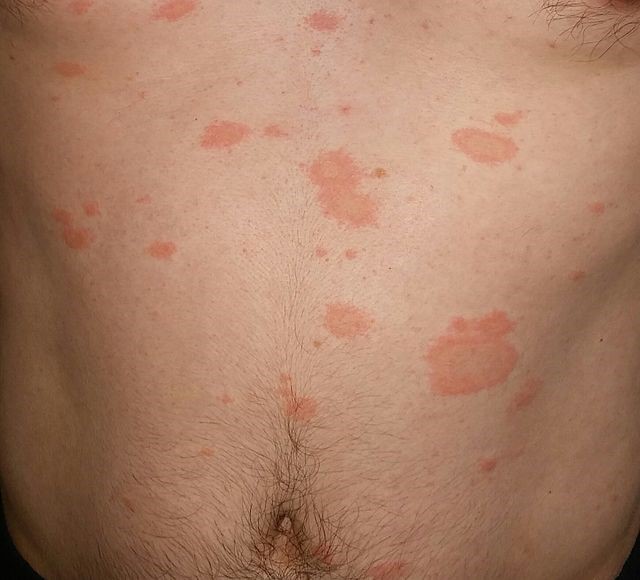
© Marekzerzan, CC BY-SA 4.0, via Wikimedia Commons
Further pictures of pityriasis rosea can be found at the DermNet NZ and DermIS websites - see references below.
Frequently Asked Questions:
Is pityriasis rosea contagious?
Pityriasis is not usually contagious so does not spread to other people.
Preciso de algum teste?
Usually no tests are needed. Your doctor will be able to diagnose pityriasis rosea from the typical rash. If the rash does not go away after three months, or if the itching is very bad, you may be referred to a skin specialist (dermatologist). You may also be referred if your doctor is not sure about the diagnosis.
How long can pityriasis rosea last?
It usually lasts for 2-12 weeks but can last as long as five months. Most commonly it lasts about five weeks before going away completely. If the rash is lasting a longer time, you may need to see a skin specialist to check the diagnosis.
Can stress cause pityriasis rosea?
The exact cause for pityriasis rosea is not yet known but so far no association between pityriasis rosea and stress has been found.
Escolhas do paciente para Erupções cutâneas

Saúde da pele, unhas e cabelos
Lúpus discóide
Lúpus discóide é uma condição rara da pele, mas é de longa duração. Geralmente é sensível à luz solar e causa cicatrizes quando as lesões cicatrizam.
por Dr. Colin Tidy, MRCGP

Saúde da pele, unhas e cabelos
Pemfigoide bolhoso
Bullous pemphigoid is a skin disease that can cause a rash, itching and blisters. It mainly affects people aged over 70. Treatment usually works well to control symptoms. Treatment is usually with steroid creams or medicines, but sometimes other medicines may be used. The condition tends to go away after 3-6 years and then treatment can be stopped. Sometimes the disease persists.
por Dra. Caroline Wiggins, MRCGP
Perguntas frequentes
Can you have pityriasis rosea without a herald patch?
Yes, while a 'herald patch' is typically the first sign, many cases do not have one, or it might go unnoticed. The widespread rash appears about 5-15 days after the herald patch would have appeared, if present.
Is pityriasis rosea dangerous?
Pityriasis rosea is a self-limiting rash, meaning it will clear up on its own. Most people feel perfectly well despite having the rash. However, if pityriasis rosea occurs during the first 15 weeks of pregnancy, it is associated with miscarriage and preterm delivery.
Is pityriasis rosea linked to cancer?
No, there is no information in the article to suggest a link between pityriasis rosea and cancer. The condition clears up on its own and does not leave scars, although some people may have discolouration for a few months.
Can pityriasis rosea spread to the face?
The rash in pityriasis rosea usually appears on the back, chest, and abdomen, spreading over much of the body. However, it does not usually affect your face.
How did I get pityriasis rosea?
The exact cause of pityriasis rosea is unknown. No specific germ (bacterium, virus, or fungus) has been definitively identified as the cause, although certain types of human herpes viruses might play a role. It is not associated with food, medicines, or stress, although some medicines can cause a similar-looking rash.
Leitura adicional e referências
- Pitiríase rósea; NICE CKS, abril de 2020 (acesso apenas no Reino Unido)
- Contreras-Ruiz J, Peternel S, Jimenez Gutierrez C, et al; Intervenções para pitiríase rósea. Cochrane Database Syst Rev. 30 de outubro de 2019;2019(10). doi: 10.1002/14651858.CD005068.pub3.
- Pityriasis Rosea; DermIS (Sistema de Informação em Dermatologia)
- Pitiríase rósea; DermNet NZ
Sobre o autorVer biografia completa

Dr Hayley Willacy, FRCGP
Médico Generalista, Autor Médico
MBChB (1992), DRCOG, DFFP, MRCOG (Part 1) MRCGP (2007), DFSRH (2013), MSc - medical education (2020)
A Dra. Hayley Willacy era uma médica do NHS atuando no noroeste da Inglaterra, que se aposentou da prática clínica em 2022 após 30 anos.
Sobre o revisorVer biografia completa

Dr Colin Tidy, MRCGP
Médico Generalista, Autor Médico
MBBS, MRCGP, MRCP (Paediatrics), DCH
Dr Colin Tidy é um médico do NHS, baseado em Oxfordshire.
Histórico do artigo
As informações nesta página são escritas e revisadas por clínicos qualificados.
Artigo também disponível em Inglês, Alemão, Espanhol, Francês, Italiano, Português, Hindi, Hebraico, Árabe, e Sueco.
Próxima revisão prevista para: 29 Dez 2027
30 Dez 2024 | Última versão

Pergunte, compartilhe, conecte-se.
Navegue por discussões, faça perguntas e compartilhe experiências em centenas de tópicos de saúde.

Sentindo-se mal?
Avalie seus sintomas online gratuitamente
Inscreva-se no boletim informativo do Patient
Sua dose semanal de conselhos de saúde claros e confiáveis - escritos para ajudá-lo a se sentir informado, confiante e no controle.
Ao se inscrever, você aceita nossos Política de Privacidade. Você pode cancelar a inscrição a qualquer momento. Nunca vendemos seus dados.
Mais sobre saúde da pele, unhas e cabelos
- Albinismo
- Alopecia areata
- Furúnculos, carbúnculos e furunculose
- Calos e calosidades
- Cistos epidermoides e pilares
- Mordidas humanas
- Feridas infectadas
- Quelóide
- Remoção de pelos a laser
- Vírus Mpox
- Câncer de pele não melanoma
- Teste de contato para dermatite de contato
- Mancha de vinho do Porto
- Prevenção do câncer de pele
- Dermatite seborreica
- Eczema varicoso
- Verrugas e calos