Massas abdominais
Revisado por Dr Toni Hazell, MRCGPÚltima atualização por Dr Philippa Vincent, MRCGPLast updated 30 Jul 2024
Atende aos diretrizes editoriais
- BaixarBaixar
- Compartilhar
- Language
- Discussão
- Versão em Áudio
Uma massa abdominal é um caroço sentido na barriga (abdômen). Existem várias causas diferentes para uma massa abdominal. Procure atendimento médico de emergência se uma nova massa for encontrada no abdômen.
Neste artigo:
Video picks for Outras condições digestivas
Continue lendo abaixo
What is an abdominal mass?
An abdominal mass is a lump in the tummy (abdomen). The abdomen contains many different structures including the:
Stomach and gut (bowel).
Fígado.
Baço.
Kidneys and bladder.
Womb (uterus) and ovaries in women.
Major blood vessels - for example, the aorta.
The position of the mass will help to determine which structure the mass is arising from.
The abdomen is traditionally divided into nine areas:
Logo abaixo das costelas do lado direito (right upper quadrant/hypogastrium).
Logo abaixo das costelas no meio (epigastrium).
Logo abaixo das costelas do lado esquerdo (left upper quadrant/hypogastrium).
Lado direito do abdômen médio (right loin/lumbar region).
Ao redor do umbigo (periumbilical).
Lado esquerdo do abdômen médio (left loin/lumbar region).
Lado direito da parte inferior do abdômen (right lower quadrant/inguinal or iliac region).
Meio do abdômen inferior (suprapubic and pelvis).
Lado esquerdo do abdômen inferior (left lower quadrant/inguinal or iliac region).
Abdominopelvic regions
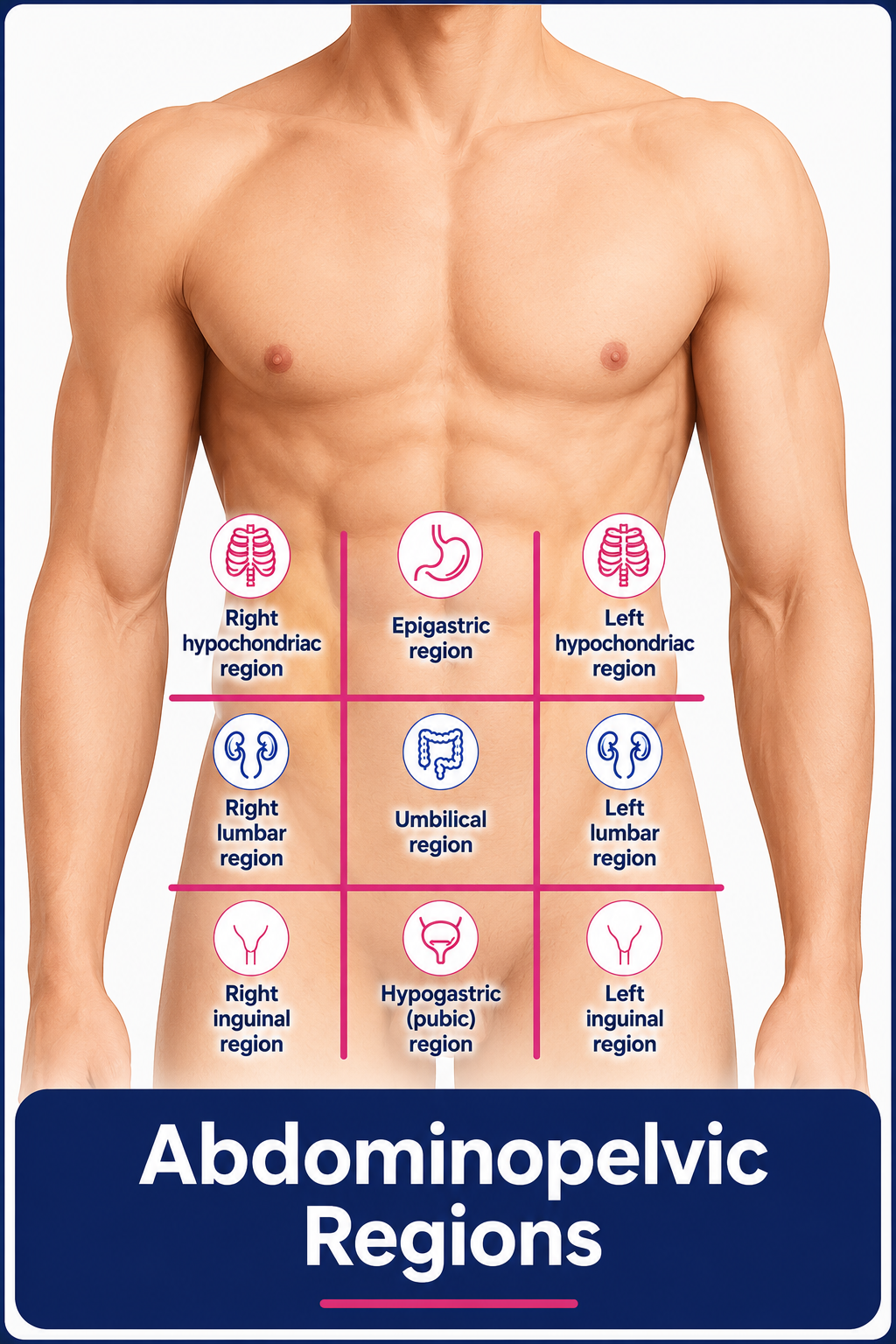
© Blausen.com staff (2014). "Medical gallery of Blausen Medical 2014". WikiJournal of Medicine 1 (2). DOI:10.15347/wjm/2014.010. ISSN 2002-4436., CC BY 3.0 , via Wikimedia Commons
Often nowadays, the abdomen is described in quadrants rather than using the nine areas. These are described as the right upper, right lower, left upper and left lower quadrants.
Abdominal mass symptoms
Voltar ao conteúdoIt is possible to feel a lump in the stomach (the mass in your own abdomen) before any other symptom but, much more frequently, it is first felt by a doctor examining the abdomen because of a different symptom, such as abdominal pain.
Therefore, it is more usual to become aware of a mass in the abdomen because of other symptoms such as:
A mass in the kidney may also cause sangue na urina. Other symptoms will depend on the cause of the mass.
Continue lendo abaixo
Abdominal mass causes
Voltar ao conteúdoThe possible cause of the abdominal mass will depend on where it is in the abdomen. The following lists are examples of the more common causes of an abdominal mass in each area. A lump (swelling) that can be seen and felt over the front of the abdomen (abdominal wall) may also be a skin lump, a lipoma (fatty lump) or a hérnia.
Right upper quadrant
Fígado: enlarged liver (hepatomegaly), câncer de fígado. There are many causes of an enlarged liver, including infecção, insuficiência cardíaca, liver cancer, doença hepática alcoólica e doença hepática gordurosa.
Gallbladder: colecistite, cancer of the bile duct in the liver (cholangiocarcinoma).
Epigastrium
Úlceras: for example, câncer de estômago.
Pancreas: for example, a pancreatic abscesso ou câncer de pâncreas.
Ribcage: at the very bottom of the rib cage in the centre of the body, there is a small bone called the xiphisternum. In some people this bone sticks out and can feel like a lump. This is entirely normal and can be easily diagnosed by a doctor on clinical examination.
Left upper quadrant
Baço: enlarged spleen (splenomegaly). There are many causes of an enlarged spleen, including leucemia, linfoma, talassemia, anemia falciforme, malária e mononucleose infecciosa.
Úlceras: for example, câncer de estômago.
Pancreas: for example, an abscess or câncer de pâncreas.
Gut (bowel): for example, colon cancer.
Kidney: for example, câncer de rim.
Right loin
Kidney: for example, câncer de rim.
Periumbilical
Enlarged part of the major blood vessel (aorta): aortic aneurysm.
Left loin
Kidney: for example, câncer de rim.
Right lower quadrant
Bowel: for example, colon cancer.
Kidney: for example, câncer de rim.
Ovary: for example, cancer of the ovary.
Suprapubic and pelvis
Bexiga: for example, a distended bladder caused by a blockage preventing you from emptying the bladder - such as in aumento da glândula prostática in men.
Ovary: for example, cisto ovariano, câncer de ovário.
Abdominal aorta: for example, a pulsatile mass due to an abdominal aortic aneurysm.
Left lower quadrant
Bowel: for example, constipation, colon cancer, doença diverticular.
Kidney: for example, câncer de rim.
Ovary: for example, cancer of the ovary.
Diagnosing an abdominal mass
Voltar ao conteúdoQuais testes são necessários?
There are lots of different causes of an abdominal mass. Doctors will ask about various other symptoms and do a physical examination of the abdomen. Further tests depend on what they find, and what they think the cause might be.
Examples of tests that might be needed include:
Blood tests - for example, a CA-125 test to look for ovarian cancer.
Urine tests - to look for hidden blood in the urine which can be a sign of câncer de rim ou bladder cancer.
Stool tests - a qFIT test is a test to look for hidden blood in the stool which can be a sign of câncer de intestino.
Scans or other imaging, such as:
Exames de ultrassom; abdominal ultrasound and sometimes transvaginal ultrasound scans.
Depending on the scan results, sometimes a biópsia (sample) of the mass is needed. This would be done in hospital. It might require an operation, depending on where the mass is.
Blood, stool and urine tests can be done by a GP; others need to be done by a hospital team.
If the GP suspects that the mass might be due to cancer, they are likely to make an urgent referral to the hospital - suspected cancer pathways mean that patients should have been seen and investigated within 28 days of referral. Often particular tests are needed before the hospital referral can be sent (for example, a qFIT result may be needed in advance).
Cancer is one cause of an abdominal mass, but there are many others. Most people referred to hospital for suspected cancer end up with normal or reassuring test results. For instance, miomas are a common cause of a pelvic mass in women, but are not cancerous.
Continue lendo abaixo
Abdominal mass treatment
Voltar ao conteúdoTreatment options will depend on the cause of the abdominal mass. If the mass isn't cancer, and isn't causing any problems, no treatment may be needed. Treatment for câncer depends on the type of cancer and how advanced it is. Depending on what the mass is, an operation to remove it may be possible.
Complications of an abdominal mass
Voltar ao conteúdoThere are lots of different causes of an abdominal mass. Complications differ depending on the cause.
In general, masses can cause:
Pressure symptoms. A large mass in the abdomen can press on other organs. This might cause bloating, abdominal swelling, a reduced appetite, leg swelling and pain.
Other complications depend on the cause of the mass. For example:
Uterine (womb) miomas can cause sangramento menstrual intenso e anemia.
People with doença renal policística, which causes enlarged kidneys with multiple fluid-filled cysts in them, can develop pressão alta e problemas renais.
Câncer can spread to other organs.
Patient picks for Outras condições digestivas

Saúde digestiva
Laceração de Mallory-Weiss
A síndrome de Mallory-Weiss (também chamada de laceração de Mallory-Weiss) é o nome dado ao sangramento e outros sintomas causados por uma laceração no revestimento da parte superior do trato digestivo (trato gastrointestinal). Geralmente é diagnosticada por meio de um exame chamado gastroscopia (endoscopia). Isso envolve a passagem de um tubo através do esôfago até o estômago. Em muitos casos, o sangramento já parou quando a gastroscopia é realizada e um tratamento específico não é necessário. A laceração geralmente cicatriza sozinha após alguns dias.
por Dra. Philippa Vincent, MRCGP

Saúde digestiva
Gastroparesia
A gastroparesia é agora mais comumente conhecida como esvaziamento gástrico retardado. É uma condição crônica em que os alimentos passam pelo estômago e entram no intestino mais lentamente do que o normal. Os nervos que normalmente acionam os músculos do estômago para mover os alimentos para fora do estômago e para o intestino não funcionam tão eficazmente quanto o normal. Isso não é causado por uma obstrução ou anomalia estrutural, mas por uma falha dos mecanismos normais.
por Dra. Philippa Vincent, MRCGP
Leitura adicional e referências
- Câncer suspeito: reconhecimento e encaminhamento; Diretriz NICE (2015 - última atualização em abril de 2026)
Continue lendo abaixo
Histórico do artigo
As informações nesta página são escritas e revisadas por clínicos qualificados.
Próxima revisão prevista para: 29 Jul 2027
30 Jul 2024 | Última versão

Pergunte, compartilhe, conecte-se.
Navegue por discussões, faça perguntas e compartilhe experiências em centenas de tópicos de saúde.

Sentindo-se mal?
Avalie seus sintomas online gratuitamente
Inscreva-se no boletim informativo do Patient
Sua dose semanal de conselhos de saúde claros e confiáveis - escritos para ajudá-lo a se sentir informado, confiante e no controle.
By subscribing you accept our Política de Privacidade. Você pode cancelar a inscrição a qualquer momento. Nunca vendemos seus dados.