Abscess
Peer reviewed by Dr Colin Tidy, MRCGPLast updated by Dr Hayley Willacy, FRCGP Last updated 26 Sept 2023
Meets Patient’s editorial guidelines
- DownloadDownload
- Share
- Language
- Discussion
- Audio Version
- Add to preferred sources on Google
In this series:Anal fistula
An abscess can develop in many different parts of the body. A small operation may be needed to drain the pus. You may also need to take antibiotic medicine.
At a glance
An abscess is a collection of pus, which is a thick fluid containing white blood cells, dead tissue, and germs.
Skin abscesses often appear as a swollen, pus-filled lump and can cause a high temperature and chills.
Abscesses can form anywhere in the body, including under the skin or deeper within organs.
A doctor usually drains an abscess by making a cut to let the pus out, and antibiotics may also be prescribed.
See a doctor for a painful, red, or hot lump, especially if you have a fever or the lump is getting bigger.
What is an abscess?
An abscess is a collection of pus. Pus is a thick fluid that usually contains white blood cells, dead tissue and germs (bacteria). The pus may be yellow or green and may have a bad smell.
What does an abscess look like?
A skin abscess often appears as a swollen, pus-filled lump under the surface of the skin. You may also have other symptoms of an infection, such as a high temperature and chills.
An abscess can form anywhere in your body, and can be in or just below the skin, or deeper within your body. An abscess has a typical appearance depending on the body part where it is formed.
You might also notice that you have swollen lymph nodes near to where the abscess is. If you press them they might be tender.
Abscess: after five days
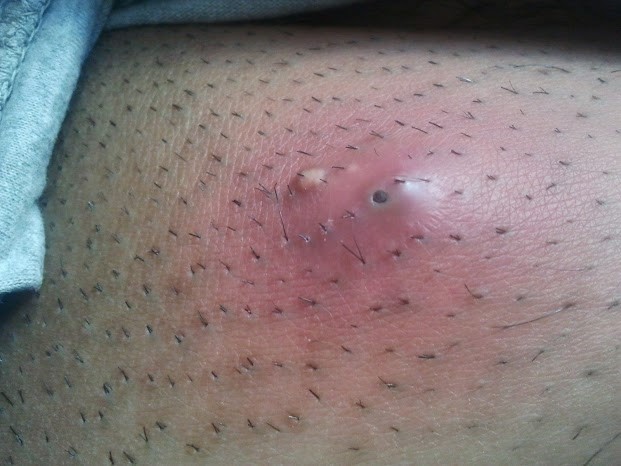
© Amrith Raj, CC BY-SA 3.0, via Wikimedia Commons
When an abscess forms in the skin, it initially looks like a pimple, boil, or an insect bite, but it then usually turns into a red, swollen lump, which is warm and tender to touch and filled with pus.
When an abscess forms under the skin, it forms a painful swollen lump with raised and inflamed edges, often with surrounding redness.
If an abscess forms deeper within the body, it usually causes localised pain with a very high temperature, but the symptoms will depend on which part of your body the abscess forms.
A pilonidal abscess is an infection of a pilonidal sinus. A pilonidal sinus develops in the cleft between your buttocks, just below the base of your spine (this is called the sacrococcygeal region). See also the leaflet Pilonidal Sinus for further information.
Types of abscesses
There are two different types of abscess:
Skin abscesses
Most abscesses form just under the skin. A boil is the most common example. In this case, a hair follicle becomes infected and develops into a small abscess. A gland just below the skin at the entrance to the vagina can become infected and develop into a Bartholin's abscess.
Occasionally, women who are breastfeeding can develop an infection in the breast and an abscess can occur (breast abscess). The symptoms of a skin abscess include swelling, redness, and pain, and they can often be warm to the touch. It is usually easier to treat a skin abscess.
Internal abscesses
An abscess sometimes forms inside the body within an organ or in a space between organs. Various symptoms may occur, depending on the site of the abscess. This usually happens because of another condition. Infection in the liver, for example, can result in a liver abscess.
An ultrasound scan or other types of scan can confirm the diagnosis. If infection occurs in the gums or teeth a dental abscess can develop. GP surgeries cannot provide treatment for dental abscesses. You should always see a dentist to assess your dental abscess and advise on the treatment you need.
What causes an abscess?
The usual cause is an infection with bacteria entering the body. Certain bacteria are more likely to be 'pus-forming' as they make chemicals that can damage the body's tissues. These include Staphylococcus aureus and Streptococcus pyogenes.
The infection causes the immune system to set off white blood cells and chemicals to fight the bacterial infection. In this 'battle' some tissue dies. A cavity forms and fills with pus. The cavity becomes bigger if the infection continues and the pus can't get out.
How to get rid of an abscess
Draining the abscess
The main treatment is to drain the abscess. Usually this involves a small operation to make a cut in the skin and allow the pus to drain. A local anaesthetic may be used to numb the area but may not be necessary. A scar will form as the skin heals. If the abscess is deep, a small piece of gauze (antiseptic wick) may be put in the drainage hole. This stops the hole from sealing over before all of the pus has drained and the cavity has shrunk.
A more difficult operation is needed to drain the infection when it is inside the body. The techniques vary, depending on the site. Sometimes a tube will be left in the hole to drain the pus.
Antibiotics may also be prescribed, especially if there is a skin infection (cellulitis). However, they are often not able to treat the infection on their own.
Can an abscess burst on its own?
A skin abscess would normally eventually burst on to the skin surface and let out the pus. This may be after it becomes larger and more painful. So surgical drainage is usually best. However, a small boil may burst and heal without treatment, particularly after applying a warm compress.
An untreated abscess inside the body is usually very serious. You are likely to become very ill and treatment is usually needed.
How to prevent an abscess
An abscess is difficult to prevent inside the body as it usually happens in people who are ill with other problems.
It may be possible to prevent a skin abscess. 1 in 10 people with them develop another one within 12 months. Good personal hygiene (washing with soap and water) will reduce the number of bacteria on the skin and prevent re-infection. A large number of bacteria are frequently present on sheets and clothes of people with boils. Carefully washing clothes and sheets, and not sharing clothes and towels, may reduce the chances of re-infection or the chances of spreading the infection to friends and family members.
Used dressings and gauze should be thrown away to avoid spreading the infection further. Frequent changing of dressings is recommended for the same reason.
They are more common in people who smoke or are obese, so stopping smoking or losing weight, may help to prevent boils. They are also more common in young people (aged under 30), people with diabetes and people who have taken an antibiotic in the previous six months.
Who develops abscesses?
Most skin abscesses occur in people who are otherwise well. There is often no underlying cause and usually no further problems occur once it has gone. Your doctor may check your urine for sugar, as abscesses tend to occur more often in people with diabetes. Recurring skin abscesses may be the first indication of a problem with your immune system.
An abscess inside the body usually occurs in people who are ill with other medical conditions, or in people with a weakened immune system. For example, a lung abscess may form following a bout of pneumonia; a brain abscess may form after a penetrating head wound (an injury in which the outer covering of the brain is pierced) which can be life-threatening.
When to see a doctor for an abscess
If you have a lump that is painful, red or hot, or you feel hot and shivery you should see doctor urgently. Similarly, if you have a swelling or redness spreading away from the lump – the redness may be harder to see on brown or black skin.
You should also ask a doctor to check:
a lump that is getting bigger.
a lump anywhere on your body that lasts more than 2 weeks.
a lump that is hard and does not move.
a lump or swelling in your breast.
a lump and you have a weakened immune system or a long-term condition such as diabetes.
Patient picks for Other infections
Infections
Strep A
Strep A, or Group A streptococcus, is a common type of bacteria, which has been recognised as a cause of infections for many years. Most Group A streptococcus infections are mild, but in rare cases, these can cause serious illness and even death.
by Dr Colin Tidy, MRCGP

Infections
Rheumatic fever
Rheumatic fever is an illness caused by a particular type of bacterium called beta-haemolytic streptococcus. It is the same bug that can cause a sore throat. It can affect your heart, as well as your joints, skin and nervous system.
by Dr Hayley Willacy, FRCGP
Frequently asked questions
Can pus from an abscess spread infection to other parts of my body?
Yes, pus from an abscess contains bacteria. It's important to dispose of used dressings and gauze carefully and frequently change them to avoid spreading the infection further. Good hygiene and not sharing clothes or towels are also important preventative measures.
What should I do if an abscess bursts at home?
The article primarily discusses surgical drainage or a small boil bursting on its own. While it notes that a skin abscess would normally eventually burst, it suggests that surgical drainage is usually best. If it bursts at home, it would be wise to follow up with a doctor for advice, especially to ensure it heals properly and to manage any ongoing infection risk.
Are there any specific lifestyle changes I can make to reduce my risk of getting abscesses?
Yes, certain lifestyle factors can increase your risk. If you smoke or are obese, stopping smoking or losing weight may help to prevent boils, which are a type of skin abscess. Good personal hygiene, such as washing with soap and water, also reduces bacteria on the skin and can prevent re-infection.
How long does it typically take for an abscess to heal after being drained?
The article mentions that a scar will form as the skin heals after surgical drainage. If a small piece of gauze is used, it stops the hole from sealing over too quickly, allowing the pus to drain and the cavity to shrink. However, the exact duration of the healing process is not specified and can vary depending on the size and location of the abscess.
Can children get abscesses, and are they treated differently?
The article does not specifically discuss abscesses in children or if their treatment differs from adults. It focuses on the general causes, types, and treatments of abscesses in individuals of all ages. However, it does note that skin abscesses are more common in young people (under 30).
What is the difference between a boil and an abscess?
A boil is a common example of a skin abscess, where a hair follicle becomes infected and develops into a small collection of pus. While all boils are a type of abscess, not all abscesses are boils. Abscesses can form anywhere in the body, either just under the skin or deeper within organs.
Further reading and references
- Boils; DermNet NZ
- Boils, carbuncles, and staphylococcal carriage; NICE CKS, May 2024 (UK access only)
- Thomas O, Ramsay A, Yiasemidou M, et al; The surgical management of cutaneous abscesses: A UK cross-sectional survey. Ann Med Surg (Lond). 2020 Nov 27;60:654-659. doi: 10.1016/j.amsu.2020.11.068. eCollection 2020 Dec.
- Pastorino A, Tavarez MM; Incision and Drainage.
About the authorView full bio

Dr Hayley Willacy, FRCGP
General Practitioner, Medical Author
MBChB (1992), DRCOG, DFFP, MRCOG (Part 1) MRCGP (2007), DFSRH (2013), MSc - medical education (2020)
Dr Hayley Willacy was an NHS GP working in northwest England, who retired from clinical practice in 2022 after 30 years.
About the reviewerView full bio

Dr Colin Tidy, MRCGP
General Practitioner, Medical Author
MBBS, MRCGP, MRCP (Paediatrics), DCH
Dr Colin Tidy is an NHS Doctor, based in Oxfordshire.
Article history
Article also available in English, German, Spanish, French, Italian, Portuguese, Hindi, Hebrew, Arabic, and Swedish.
Next review due: 24 Sept 2028
26 Sept 2023 | Latest version
Join the conversation
Share your thoughts or experiences with others in our patient communities.

Ask, share, connect.
Browse discussions, ask questions, and share experiences across hundreds of health topics.

Feeling unwell?
Assess your symptoms online for free
Sign up to the Patient newsletter
Your weekly dose of clear, trustworthy health advice - written to help you feel informed, confident and in control.
By subscribing you accept our Privacy Policy. You can unsubscribe at any time. We never sell your data.
More in infections
- 6-in-1 vaccine
- Acute bronchitis
- Croup
- Febrile seizure
- Food poisoning
- Gonorrhoea
- Guillain-Barré syndrome
- Japanese encephalitis vaccine
- Lumbar puncture
- Lyme disease
- Middle ear infection (otitis media)
- MRSA
- Mucolytics
- Postherpetic neuralgia
- Recurrent cystitis in women
- Sepsis
- Tonsillitis
- Urine infection in men
- Worm medicines