Infecção fúngica nas unhas
Tinea unguium
Revisado por Dr Colin Tidy, MRCGPÚltima atualização por Dr Philippa Vincent, MRCGPÚltima atualização 19 de maio de 2023
Atende aos diretrizes editoriais
- BaixarBaixar
- Compartilhar
- Language
- Discussão
- Versão em Áudio
- Adicionar às fontes preferidas no Google
A infecção fúngica das unhas (tinea unguium) é comum, particularmente nas unhas dos pés em idosos. A infecção causa unhas espessas e desagradáveis que às vezes se tornam dolorosas. A medicação muitas vezes funciona bem para eliminar a infecção, mas pode ser necessário tomar o medicamento por vários meses ou mais.
Em resumo
Fungal nail infection often causes thickened, discoloured and sometimes crumbling nails.
It is commonly painless and usually affects toenails more than fingernails.
Diagnosis is confirmed by a doctor sending a nail clipping for laboratory testing.
Treatment options include antifungal nail paint, antifungal medication, or rarely nail removal.
Treatment may take several months and does not always restore the nail's appearance.
Keeping nails short and treating athlete's foot can help prevent infections.
Seek medical advice if you have diabetes or a weakened immune system, or if symptoms are troublesome.
Explore fungal nail treatments
Obtenha aconselhamento especializado em saúde no conforto da sua casa. Faça uma consulta online rápida, disponível 24 horas por dia, 7 dias por semana, e tenha o seu pedido avaliado por um profissional de saúde registado no Reino Unido. Entrega no dia seguinte disponível para tratamentos elegíveis.

What does a fungal nail infection look like?
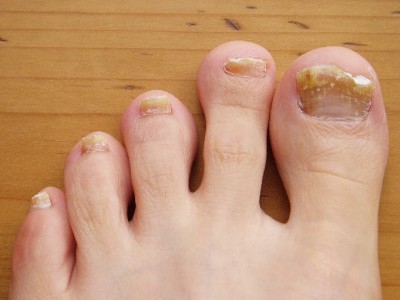
This photo shows the typical appearance of fungal infection of the toenails:
Tinea unguium
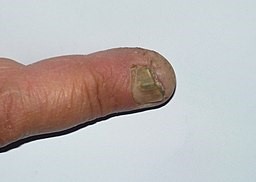
This photo shows fingernail fungal infection, which is less common than toenail fungal infection:
Tinea unguium
Fungal nail infection symptoms
Often the infection is just in one nail but several may be affected. It is usually painless. The most common symptoms are:
Thickened nail.
Discoloured nail (often a yellowish colour).
Commonly, this is all that occurs and fungal nail infections often cause no other symptoms. The main reason people see their doctor is because the appearance is unsightly.
Sometimes the infection becomes worse and additional symptoms occur. These include:
The nail becoming soft and crumbling.
White or yellow patches appearing where the nail has come away from the skin.
The skin next to the nail becoming inflamed or scaly.
Sometimes the whole nail comes away. If left untreated, the infection may eventually destroy the nail and the nail bed, and may become painful. Walking may become uncomfortable if a toenail is affected.
Who develops fungal nail infection?
Between 3 and 8 out of 100 people in the UK will develop a fungal nail infection (tinea unguium) at some stage of their lives. Toenails are more commonly affected than fingernails. It is more common in people aged over 60 and in younger people who share communal showers, such as swimmers or athletes.
What causes fungal nail infections?
Spread from a fungal skin infection. For example, athlete's foot (tinea pedis) is a fungal skin infection of the toes. This may spread to the toenails if the skin infection is not treated early. See the separate leaflet called Athlete's Foot (Tinea Pedis).
Fingernail infection may occur after a toenail infection has become established. The fungus may spread to a finger after scratching itchy toes and toenails.
Fingernail infections are also more likely to occur in someone who washes their hands frequently or has them in water a lot, for example, cooks or cleaners. Constant washing may damage the protective skin at the base of the nail. This may allow fungi to enter.
A nail that has recently been damaged is also more likely to become infected.
There is an increased risk of developing a fungal nail infection with various other conditions - for example:
Poor circulation.
A weakened immune system (for example, if you have AIDS or are on quimioterapia).
A general poor state of health such as heavy alcohol consumption.
Nail infections are more common in people who live in hot or humid climates.
Smoking also increases the risk of developing a nail infection.
In some cases there is no apparent reason. Fungal germs are common and an infection can occur 'out of the blue'.
Fungal nail infection diagnosis
Other nail conditions can sometimes look like a fungal infection (typically "trauma" to the nails from shoes). Therefore, to confirm the diagnosis, a doctor will usually request that a nail clipping is sent to the laboratory for testing.
Fungal nail infection treatment
Nenhum tratamento
This is an option if the infection is mild or causing no symptoms. For example, a single small toenail may be infected and remain painless and of little concern. Some people may prefer not to take treatment because:
Treatment does not always cure the infection. Cure rates are about 60-80%.
Treatment that clears the infection does not always restore the nail's appearance to normal.
The antifungal medicines used for treatment need to be taken for several months - sometimes longer.
Although rare, unpleasant side-effects sometimes occur with antifungal medicines.
You can read more about these treatments in the separate leaflet called Antifungal Medicines.
The option to treat can be reviewed at a later date if the infection becomes worse.
However, treatment is usually advised if:
Symptoms are troublesome. For example, if walking is uncomfortable due to an affected nail.
Abnormal-looking nails cause distress.
You have diabetes, vascular disease or a connective tissue disorder (because of a higher risk factor for secondary bacterial infections and cellulitis).
The nail infection is thought to be the source of a fungal skin infection on your body.
There are problems with the immune system, for example, someone having chemotherapy.
Antifungal nail paint (nail lacquer)
A nail lacquer that contains the antifungal medicine amorolfine is an alternative for most (but not all) types of fungi that infect nails. You can buy amorolfine nail lacquer from pharmacies as well as obtaining it on prescription.
This takes longer to work than medication taken by mouth but has fewer side effects and risks. This treatment does not tend to work so well if the infection is near the skin, or involves the skin around the nail.
The nail lacquer has to be put on exactly as prescribed for the best chance of success. It can take six months of nail lacquer treatment for fingernails and up to a year for toenails.
Tioconazole is another solution that can be applied to the nail. It is available on prescription, although research trials suggest it does not work as well as amorolfine.
Medicação antifúngica
Antifungal tablets will often clear a fungal nail infection. The medication will also clear any associated fungal skin infection, such as athlete's foot (tinea pedis).There are two main medications:
The one chosen may depend on the type of fungus causing the infection. Both of these medicines cause side-effects in a small number of people, so read the packet that comes with the medicine for a full list of cautions and possible side-effects. The side effects can be very severe, including liver failure, so blood tests are usually required before starting them.
Terbinafina tablets. The usual adult dose is 250 mg once a day; for between six weeks and three months for fingernails, and for three to six months for toenails. Visible improvement should be expected after a month of treatment, although treatment will then need to be completed for the recommended duration.
Itraconazole comprimidos. This is usually given as pulsed treatment. That is, for an adult: 200 mg twice a day for one week, with subsequent courses repeated after a further 21 days. Fingernail infections require two pulsed courses and toenail infections require at least three pulsed courses.
Studies suggest that in about 5 in 10 cases the nail will look fully normal again after treatment. In about a further 2 in 10 cases the fungus will be cleared from the nail after treatment but the nail does not look fully normal again. Fingernails tend to respond better to treatment than toenails do. One reason for treatment to fail is because some people stop their medication too early.
Nail removal
If other treatments have failed, an option is to have the nail surgically removed by a small operation done under local anaesthetic. This is combined with treatment with antifungal medication.
Newer options
Research is looking at newer methods of treating fungal nail infections. These include laser treatment and ultrasound. Initial results are positive but more evidence is needed about the long-term results of the treatments.
How to tell the nail is recovering
Nail during treatment for fungal nail infection
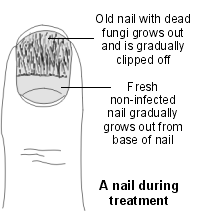
The fungi that are killed with treatment remain in the nail until the nail grows out. Fresh healthy nail growing from the base of the nail is a sign that treatment is working. After finishing a course of treatment, it will take several months for the old infected part of the nail to grow out and be clipped off. The non-infected fresh new nail continues growing forward. When it reaches the end of the finger or toe, the nail will often look normal again.
Fingernails grow faster than toenails, so it may appear they are quicker to get back to normal. It may take up to a year after starting treatment before toenails look completely normal again and six months for fingernails to look completely normal.
However, the infection can still respond to treatment even after finishing a course of medication. This is because the antifungal medication stays in the nail for about nine months after stopping taking medication.
How to manage a fungal nail infection
Medication needs to be taken as directed.
Tips on nail care with a fungal nail infection, with or without taking medication, include the following:
Keeping the nails cut short and file down any thickened nail.
Using a separate pair of scissors to cut the infected nail(s) to prevent contaminating the other nails and not sharing nail scissors with anyone else (for the same reason).
Avoiding injury and irritants to the nails, for example, wearing gloves for manual work.
If the toenails are affected, wearing properly fitted shoes with a wide toe box.
Keeping the feet as cool and dry as possible.
Preventing fungal nail infections
Studies suggest that in about 1 in 4 cases where the fungal nail infection (tinea unguium) has been cleared from the nail, the infection returns within three years. One way to help prevent a further bout of nail infection is to treat athlete's foot (tinea pedis) as early as possible to stop the infection spreading to the nail.
Athlete's foot is common and may recur from time to time. It is easy to treat with an antifungal cream which can be bought from pharmacies. The first sign of athlete's foot is itchy and scaling skin between the toes. See the separate leaflet called Athlete's Foot (Tinea Pedis) for more details. Also:
Try to avoid injury to nails, which may increase the risk of developing a nail infection.
Wear footwear such as flip-flops in public places, such as communal bathing/shower places, locker rooms, etc.
Avoid towel sharing.
Consider replacing old footwear, as this could be contaminated with fungal spores.
Escolhas do paciente para Distúrbios das unhas
Saúde da pele, unhas e cabelos
psoríase ungueal
Psoriasis is a persistent (chronic) skin condition which tends to flare up from time to time. About half of the people who have psoriasis also have changes affecting their nails. Psoriatic nail disease is very variable in appearance and severity. Psoriasis affecting the nails can be mild and not need any treatment. More severe nail psoriasis is often difficult to treat but modern treatments can be effective.
por Dr. Doug McKechnie, MRCGP

Saúde da pele, unhas e cabelos
Paroníquia
Paroníquia é uma infecção comum da pele ao redor das unhas dos dedos das mãos ou dos pés. Pode ser aguda ou crônica. O tratamento nem sempre é necessário, mas geralmente envolve medicamentos antibióticos para infecções bacterianas. Ocasionalmente, são usados medicamentos antifúngicos para infecções causadas por leveduras (cândida). Ocasionalmente, cremes esteroides podem ser usados para a pele ao redor da unha. Raramente, uma pequena operação é necessária para drenar o pus que pode ter se acumulado.
por Dra. Philippa Vincent, MRCGP
Perguntas frequentes
Is fungal nail infection dangerous?
Fungal nail infections are generally painless and often only cause cosmetic concerns. However, if left untreated, the infection may eventually destroy the nail and the nail bed, and can become painful. This can lead to difficulty walking if a toenail is affected. For individuals with certain health conditions like diabetes, vascular disease, or a weakened immune system, there's a higher risk of secondary bacterial infections and cellulitis.
How many people in the UK are affected by fungal nail infections?
Between 3 and 8 out of every 100 people in the UK will experience a fungal nail infection at some point in their lives. Toenails are more commonly affected than fingernails.
How does a fungal nail infection spread?
Fungal nail infections can spread in several ways. They often start from a fungal skin infection, such as athlete's foot, which can spread to toenails if not treated. Fingernail infections can occur after a toenail infection, spreading to the finger after scratching. Frequent hand washing or hands being in water a lot can also damage the skin at the base of the nail, allowing fungi to enter. Additionally, a damaged nail is more susceptible to infection.
Can fungal nail infections be permanently cured?
Treatment for fungal nail infections does not always result in a permanent cure; typical cure rates are around 60-80%. Even when the infection is cleared, the nail's appearance may not always return to completely normal. The infection can also recur, with studies suggesting that in about 1 in 4 cases, the infection returns within three years after being cleared.
What is the typical recovery time after treating a fungal nail infection?
After completing a course of treatment, it takes time for the old infected nail to grow out and be clipped off. Fresh, healthy nail growth indicates that the treatment is working. Fingernails grow faster, so they may appear normal within six months. However, toenails can take up to a year after starting treatment to look completely normal again. The antifungal medication can remain in the nail for about nine months after stopping treatment, which can continue to help clear the infection.
Leitura adicional e referências
- Del Rosso JQ; The role of topical antifungal therapy for onychomycosis and the emergence of newer agents. J Clin Aesthet Dermatol. 2014 Jul;7(7):10-8.
- Infecção fúngica nas unhas; NICE CKS, março de 2018 (acesso apenas no Reino Unido)
- Fungal infections of the nails; British Association of Dermatologists, 2017
Sobre o autorVer biografia completa
Atualizado por

Dr Philippa Vincent, MRCGP
Médico Generalista, Autor Médico
MB BS, Bsc, MRCGP (2000), DCH, DFSRH, DRCOG
Dra Philippa Vincent é um médico do NHS trabalhando no norte de Londres.
Sobre o revisorVer biografia completa

Dr Colin Tidy, MRCGP
Médico Generalista, Autor Médico
MBBS, MRCGP, MRCP (Paediatrics), DCH
Dr Colin Tidy é um médico do NHS, baseado em Oxfordshire.
Participe da conversa
Compartilhe seus pensamentos ou experiências com outros em nosso comunidades de pacientes.

Pergunte, compartilhe, conecte-se.
Navegue por discussões, faça perguntas e compartilhe experiências em centenas de tópicos de saúde.

Sentindo-se mal?
Avalie seus sintomas online gratuitamente
Inscreva-se no boletim informativo do Patient
Sua dose semanal de conselhos de saúde claros e confiáveis - escritos para ajudá-lo a se sentir informado, confiante e no controle.
Ao se inscrever, você aceita nossos Política de Privacidade. Você pode cancelar a inscrição a qualquer momento. Nunca vendemos seus dados.