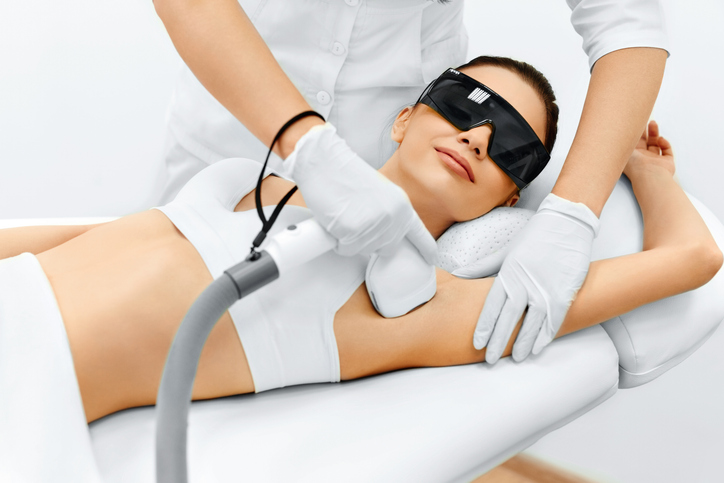
Remoção de pelos a laser
Revisado por A Associação Britânica de Cirurgiões Plásticos (BAAPS)Autoria de A Associação Britânica de Cirurgiões Plásticos (BAAPS)Publicado originalmente 23 Mar 2016
Atende aos diretrizes editoriais
- BaixarBaixar
- Compartilhar
- Language
- Discussão
- Ask Patient
- Versão em Áudio
- Adicionar às fontes preferidas no Google
Aviso sobre o conteúdo
Esta página não foi revisada recentemente, portanto, algumas informações ou links externos podem ter mudado.
This leaflet is provided by the Associação Britânica de Cirurgiões Plásticos Estéticos, o órgão profissional responsável pelo avanço da educação e segurança na cirurgia plástica estética.
Em resumo
A depilação a laser é um método de remoção de pelos indesejados do corpo.
É frequentemente usado por pessoas com excesso de pelos, chamado hirsutismo.
A luz do laser mira o pigmento na raiz do cabelo para interromper o crescimento do cabelo.
O tratamento funciona melhor em cabelos escuros e é menos eficaz em cabelos grisalhos ou loiros.
A área tratada pode ficar vermelha e quente por algumas horas após o tratamento.
Tratamentos repetidos geralmente são necessários várias vezes ao ano.
Recomenda-se primeiro um pequeno teste para verificar efeitos colaterais.
Explore options for unwanted facial hair
Obtenha aconselhamento especializado em saúde no conforto da sua casa. Faça uma consulta online rápida, disponível 24 horas por dia, 7 dias por semana, e tenha o seu pedido avaliado por um profissional de saúde registado no Reino Unido. Entrega no dia seguinte disponível para tratamentos elegíveis.

Traditional methods for removing unwanted body hair include shaving, waxing, the application of depilatory cream and electrolysis. Depilation by laser is a relatively new technique. It helps not only those with normal hair growth, but also those with excessive hairiness of the body or face, a condition called hirsutism which causes considerable psychological distress.
Hirsutism affects approximately 10% of women between the ages of 18 and 35. In most cases there is no obvious cause but some patients may have a hormonal disturbance. Hirsutism may also be a feature of the menopause. Unwanted hair is a significant problem for transsexuals and transvestites, and many males with hair on their back dislike it intensely. Children with hairy moles of the face or lumbar spine area are often teased.
Hair biology
Hair biology
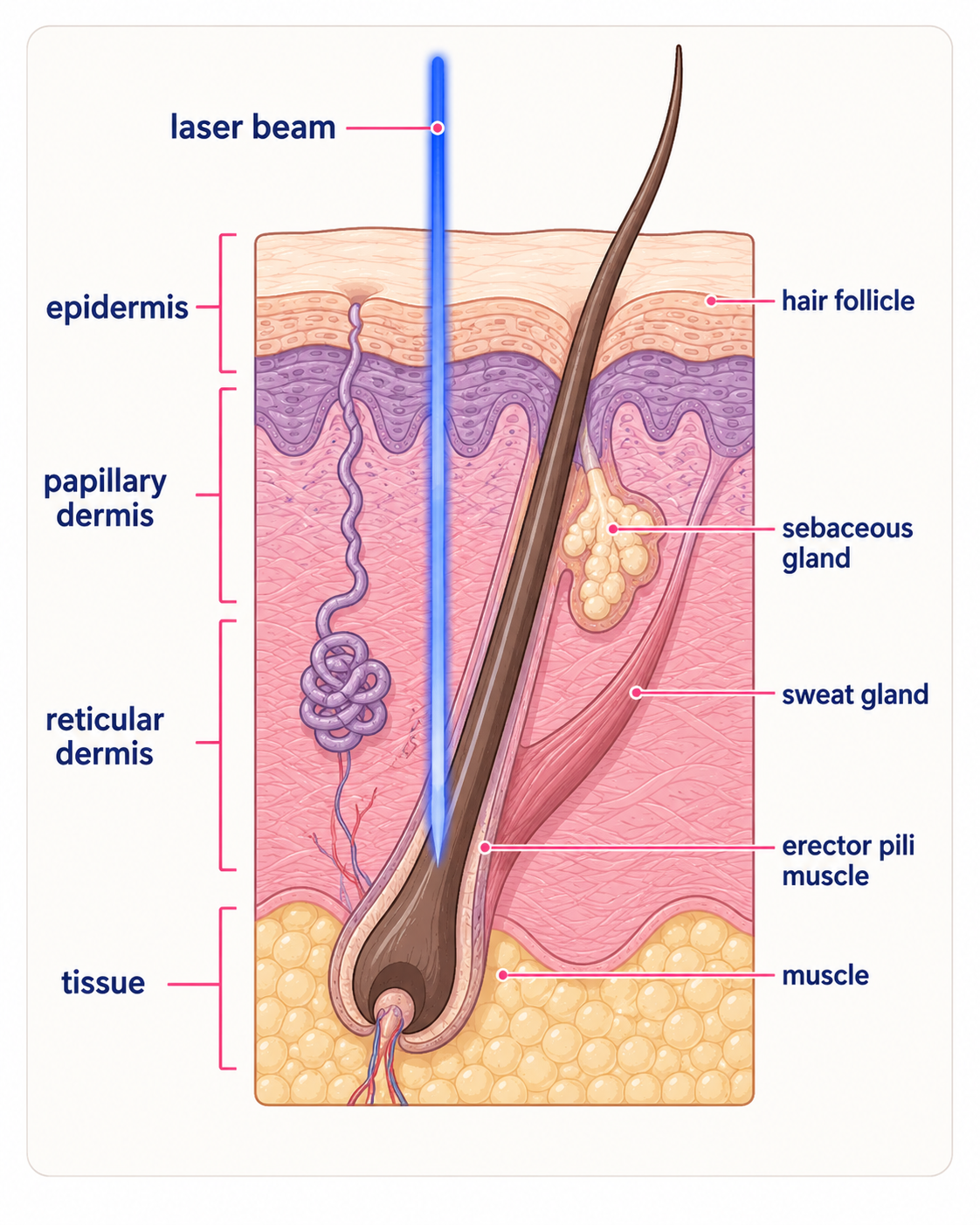
The hair grows in cycles, alternating between a growing phase (anagen) and a quiescent phase (telogen); catagen is the period of transition between the two.
Cells half way up the hair follicle are thought to be responsible for hair growth. The depilation laser delivers a particular wavelength of laser light which targets the pigment in the hair. This light penetrates up to a millimetre beneath the skin where it is absorbed by the pigment in the part of the hair root which is important for growth.
Hairs come in a variety of thicknesses and colours according to the pigment they contain. Black and laser light penetrates through the skin and is preferentially absorbed by the hair.
The stem cells responsible for hair growth are thought to be located at the attachment of the erector pili muscle to the follicle. The brown hairs contain most pigment and are easiest to treat. Grey or blonde hair has little pigment and is unlikely to respond to treatment.
Tratamento
Treatment may be a little uncomfortable - it feels a little like an elastic band snapping against the skin - but some patients prefer to use local anaesthetic cream to numb the area first. Aloe vera gel may also be used during or after treatment for its cooling effect. Some lasers have a cooling system which reduces the discomfort of the treatment.
After treatment, the treated area may look red and feel warm and tender. This feeling goes after a couple of hours, but in a few patients, particularly those with dark skin, blistering and crusting of the skin sometimes occur after laser treatment. Some hairs disappear at the treatment session; others, which initially look curled up or "frazzled" may take a few days to fall out.
Types of laser
A variety of laser systems are now available. Ruby lasers, Alexandrite lasers, Nd-YAG lasers and white light machines can all be used to remove hair with varying degrees of success. The size of the area covered by each pulse of laser energy varies with the machine used.
Resultados
Initial reports of laser hair removal were extremely promising, and some research went so far as to claim that it may be permanent, but this is generally not the case. A few patients do not respond to the laser treatment at all but many will have good results. Regrowth is not only less dense but also less coarse. In the ideal patient, with dark hair and pale skin, the hair usually disappears for two to three months and then slowly regrows. Repeat treatment is usually required several times a year.
Safety
When laser treatment is carried out it is essential that all those within the treatment room, you and the staff, should wear protective goggles or glasses. Entry to the room is strictly controlled whilst treatment is being given.
Complications and problems
Laser light can damage the skin's pigment and sometimes the treatment area may become unusually pale or dark several months after treatment. For this reason, it is always wise to carry out a small trial of treatment in an unobtrusive area before proceeding to extensive treatment. The test patch is examined six to eight weeks later for unwanted side effects and to carefully assess success before proceeding to further treatment. Special care is needed when treating patients with black or brown skin. The Nd-YAG laser may be most suitable for dark skins as it causes less skin damage. After treatment you should stay out of the sun as exposure of recently laser treated skin to strong sunshine may increase the risk of pigmentation problems.
O futuro
At present many patients derive great benefit from laser hair removal, achieving hair-free intervals of up to three months. Further research is likely to improve results in the future. Permanency, the gold standard of hair removal, seems to be some way off however.
Content used with permission from the British Association of Aesthetic Plastic Surgeons website: Remoção de pelos a laser. Os direitos autorais deste folheto pertencem à BAAPS.
Aviso Legal
Este folheto foi elaborado para fornecer informações úteis, mas não deve ser considerado como aconselhamento específico para qualquer caso particular. Ele não substitui a necessidade de uma consulta completa, e todos os pacientes em potencial devem buscar o conselho de um médico devidamente qualificado. A BAAPS não aceita responsabilidade por qualquer decisão tomada pelo leitor em relação ao tratamento que decidir realizar.
Explore options for unwanted facial hair
Obtenha aconselhamento especializado em saúde no conforto da sua casa. Faça uma consulta online rápida, disponível 24 horas por dia, 7 dias por semana, e tenha o seu pedido avaliado por um profissional de saúde registado no Reino Unido. Entrega no dia seguinte disponível para tratamentos elegíveis.
Escolhas do paciente para Cirurgia estética

Cirurgias e procedimentos
Aumento dos lábios
Este folheto é fornecido pela Associação Britânica de Cirurgiões Plásticos Estéticos, o órgão profissional responsável pelo avanço da educação e segurança na cirurgia plástica estética.
pela Associação Britânica de Cirurgiões Plásticos (BAAPS)
Cirurgias e procedimentos
Cirurgia de redução do nariz (rinoplastia)
Este folheto é fornecido pela Associação Britânica de Cirurgiões Plásticos Estéticos, o órgão profissional responsável pelo avanço da educação e segurança na cirurgia plástica estética.
pela Associação Britânica de Cirurgiões Plásticos (BAAPS)
Perguntas frequentes
A depilação a laser funciona em todas as cores de cabelo?
A depilação a laser é mais eficaz em pelos castanhos e pretos porque o laser mira o pigmento dentro do pelo. Cabelos grisalhos ou loiros têm muito pouco pigmento, tornando improvável que respondam efetivamente ao tratamento.
Quantas sessões de depilação a laser são normalmente necessárias para ver resultados?
O crescimento geralmente ocorre após dois a três meses, e o tratamento repetido é geralmente necessário várias vezes ao ano para manter o intervalo sem pelos e gerenciar o crescimento. Com o tempo, o crescimento é menos denso e menos grosso.
Como é a sensação da depilação a laser durante o tratamento?
O tratamento pode causar um pequeno desconforto, frequentemente descrito como a sensação de um elástico estalando contra a pele. Alguns pacientes optam por usar um creme anestésico local para anestesiar a área previamente, e alguns lasers incluem um sistema de resfriamento para ajudar a reduzir esse desconforto. Gel de aloe vera também pode ser usado durante ou após o tratamento para um efeito refrescante.
Existem instruções específicas de cuidados após a remoção de pelos a laser?
Após receber tratamento a laser, é importante evitar a exposição ao sol forte, pois isso pode aumentar o risco de problemas de pigmentação na pele recentemente tratada. A área tratada também pode ficar vermelha, sentir-se quente e estar sensível por algumas horas após a sessão.
A depilação a laser pode causar alterações permanentes na cor da pele?
Sim, a luz do laser pode, às vezes, danificar o pigmento da pele, potencialmente causando que a área tratada se torne incomumente pálida ou escura vários meses após o tratamento. Para minimizar esse risco, um pequeno teste é geralmente realizado em uma área discreta. Após 6-8 semanas, esse teste é verificado para efeitos colaterais indesejados e eficácia antes de prosseguir com um tratamento mais extenso.
Sobre o autorVer biografia completa
Autoria de

A Associação Britânica de Cirurgiões Plásticos (BAAPS)
A Associação Britânica de Cirurgiões Plásticos Estéticos (BAAPS) é a entidade profissional para Cirurgiões Plásticos no Reino Unido.
Sobre o revisorVer biografia completa
A Associação Britânica de Cirurgiões Plásticos (BAAPS)
A Associação Britânica de Cirurgiões Plásticos Estéticos (BAAPS) é a entidade profissional para Cirurgiões Plásticos no Reino Unido.
Histórico do artigo
Artigo também disponível em Inglês, Alemão, Espanhol, Francês, Italiano, Português, Hindi, Hebraico, Árabe, e Sueco.
23 Mar 2016 | Publicado originalmente
Escrito por:
A Associação Britânica de Cirurgiões Plásticos (BAAPS)Revisado por
A Associação Britânica de Cirurgiões Plásticos (BAAPS)
Compartilhe seus pensamentos ou experiências com outros em nosso comunidades de pacientes.
Acesso simples a tratamentos confiáveis e serviços de saúde online.
Common conditions
Get help with common conditions through the NHS, without a GP appointment.
 Sinusite aguda
 Amigdalite bacteriana
 Impetigo
 Mordidas de insetos
 Herpes zosterInfecção do trato urinário (ITUs)
Inscreva-se no boletim informativo do Patient
Sua dose semanal de conselhos de saúde claros e confiáveis - escritos para ajudá-lo a se sentir informado, confiante e no controle.
Ao se inscrever, você aceita nossos Política de Privacidade. Você pode cancelar a inscrição a qualquer momento. Nunca vendemos seus dados.