Infertilidade
Revisado por Dr Colin Tidy, MRCGPÚltima atualização por Dr Toni Hazell, MRCGPÚltima atualização 1 Aug 2025
Atende aos diretrizes editoriais
- BaixarBaixar
- Compartilhar
- Language
- Discussão
- Versão em Áudio
Nesta série:Tratamentos para infertilidadeTeste de esperma
Infertility means difficulty in conceiving naturally (becoming pregnant) despite having regular unprotected sex when not using contracepção. There is no definite cut-off point to say when a couple is infertile. Many couples take several months to conceive. About 84 couples out of 100 conceive within a year of trying. About 92 couples out of 100 conceive within two years. Looking at this another way, about 1 in 7 couples do not conceive within a year of trying. However, more than half of these couples will conceive over the following year, without any treatment.
Doctors usually suggest some tests if a couple has not conceived after one year, despite regular sexual intercourse. Tests or treatment may start earlier if the woman is older, or if there is an obvious reason why a particular couple will not conceive, however long they try.
It is usually worth seeing your doctor if you have not conceived after one year of trying. A doctor can check for some common causes, talk things over and discuss possible options. You may want to see your doctor earlier, if the woman in the couple is over the age of 36 or if either partner has a history of fertility problems, or a condition such as endometriosis or polycystic ovarian syndrome which are known to be linked with fertility problems.
Neste artigo:
Vídeos selecionados para Informações gerais sobre gravidez
Continue lendo abaixo
What can cause fertility problems?
Older women tend to be less fertile than younger women. The fall off of fertility seems to be greatest once you are past your middle 30s.
92 out of 100 women aged 19-26 trying to conceive will do so within a year.
Between the ages of 35 and 39, this drops to 82 out of 100.
Ovulation problems in women
Not producing eggs (ovulating) is the cause of problems in about 1 in 4 couples. In some women this is a permanent problem. In some it only happens from time to time: some months ovulation occurs and some months it doesn't. There are various causes of ovulation problems including:
Hormone problems (such as hormone imbalance).
Being very underweight or overweight.
Excessive exercise (such as regular long-distance running) can affect your hormone balance which can affect ovulation.
Long-term (chronic) illnesses. Some women with severe chronic illnesses, such as uncontrolled diabetes, cancers and doença renal crônica, may not ovulate.
A side-effect from some medicines. Medicines that sometimes cause this include quimioterapia medicines. Some drogas ilícitas such as cannabis and cocaine can also affect your ability to ovulate.
Various other problems with the ovary such as certain genetic problems.
Fallopian tube, cervix or uterine problems
These are the cause in about 2 or 3 in 10 couples with infertility. Problems include:
Endometriose, which causes about 1 in 20 cases of infertility.
Previous surgery to the Fallopian tubes, the neck of the womb (cervix) or the uterus.
What can cause infertility in men?
Voltar ao conteúdoMale reproductive organs
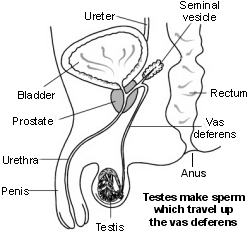
In some couples, a condition which might affect fertility is found in the male partner. The most common reason for male infertility is a problem with sperm, due to an unknown cause. The sperm may be reduced in number, less able to swim forwards (less mobile) and/or be abnormal in their form.
There are various risk factors that may affect sperm production and male infertility. These include:
Current or past infection of the testicles (for example, caxumba).
Current or past infections of another part of the sperm-producing system, such as gonorreia ou outros infecções sexualmente transmissíveis.
Side-effects of some medicines and street drugs. These include sulfasalazine, nitrofurantoin, tetracyclines, cimetidine, colchicine, allopurinol, some chemotherapy drugs, cannabis, cocaine and anabolic steroids.
Scarring from previous operations (such as an inguinal hernia repair) may block the ducts which carry sperm, and affect fertility.
Um varicocele may possibly affect male fertility.
Certain hormone problems (for example, problems with the pituitary gland in the brain leading to conditions such as Síndrome de Cushing ou hyperprolactinaemia).
Some inherited conditions, due to abnormal genes, may affect the development and function of the testicles. Examples are conditions known as Síndrome de Klinefelter and Kallman's syndrome.
Estar acima do peso may reduce fertility in men.
Causas desconhecidas
No cause can be found in about 1 in 4 couples with infertility.
Continue lendo abaixo
When to see a doctor about infertility
Voltar ao conteúdoMost doctors are happy to talk through any difficulties that you may have concerning fertility. It is best for both partners to seek medical advice together. It is quite usual for doctors to do the following:
Ask how long you have been trying to get pregnant and if you have been pregnant before. (This includes asking the male partner if any previous partner of his has been pregnant before.)
Go over your general health and discuss any past illnesses and infections.
Ask about any medication or recreational drugs that you may be taking.
Ask if you smoke and how much alcohol you drink. Your doctor may also discuss your weight.
Ask about your occupation.
Ask if either partner is feeling stressed at present.
Talk about sex and be sure there are no sexual problems. Sometimes people ask their doctor about difficulties with fertility when the real problem is difficulty with sex.
Examine both partners. This can include weighing both partners, a pelvic examination for a woman and an examination of the penis and scrotum for a man.
Tests for infertility
Voltar ao conteúdoYour doctor may suggest a few tests. For example:
Um sperm test (semen analysis) of the male partner.
A blood test to check that ovulation occurs in the female partner. This measures the hormone progesterone which is high just after ovulation. The blood sample is taken on the 21st day of a regular 28-day cycle (counting day one as the first day of bleeding).
Blood tests for other hormones, including prolactin, thyroid hormone, and a hormone called FSH which is high in women who have gone through their menopause.
They may also suggest some other tests, depending on any other symptoms that you may have. For example, whether the female partner has regular periods or not, etc. Further blood tests or uma ultrassonografia may be helpful in finding out your risk of infertility.
Tests for common infections, such as teste de HIV, hepatitis B and hepatitis C.
A test to see if the woman is immune to rubella - if not, she should have the Vacinação MMR and ideally pause trying to conceive for three months after the vaccination.
Tests or referral to a doctor who is a specialist are generally not suggested until you have been trying to conceive for 12 months:
If the female partner is under the age of 36.
If both partners are otherwise healthy.
If your doctor has not found any problems in the examination or tests that he or she has carried out.
If any of these conditions do not apply, you may be referred earlier to a doctor who is a specialist.
Continue lendo abaixo
Some general advice
Voltar ao conteúdoThe success rate of conceiving gradually goes down over time. However, for couples where no cause is found for the problem, there is still a good chance of conceiving without treatment. In such couples, without treatment, about half who do not conceive within one year conceive within the following year. Therefore, the usual pre-conception advice still applies. For example, women are advised to:
Take ácido fólico each day to reduce the chance of a spinal cord problem in a baby.
Eat a healthy diet.
See the separate leaflet called Planning to Become Pregnant.
In addition, the following may be relevant to some people:
Fumar
This can affect fertility in men and women. It has been estimated that in each menstrual cycle, smokers have about two thirds the chance of conceiving compared to non-smokers. Smoking is also harmful to a developing baby if the mother smokes. Therefore, it is a good time for both partners to stop if they are smokers.
Alcohol in excess
This may affect fertility - both for men and for women. The Department of Health recommends that women trying to become pregnant do not drink any alcohol. However, the exact amount of alcohol that is safe during pregnancy is not known. This is why the advice is not to drink at all.
If you do choose to drink when trying to become pregnant then limit it to one or two units, once or twice a week. (This is the equivalent of one or two glasses of wine, once or twice a week.) You should never binge drink or get drunk. This is because alcohol may harm a developing baby.
Medicação
If you take any medication regularly and are thinking about becoming pregnant, discuss this with your doctor in advance. Some medicines can affect a developing baby and may need to be changed before you become pregnant. An important example of this is medicines for epilepsy.
Diabetes
If you have a medical condition which needs regular monitoring, in particular diabetes, it is very important to start planning before you ever become pregnant.
Controle de peso
You may have a reduced chance of conceiving if you are very acima do peso or underweight. For the best chance of conceiving, you should aim to have your índice de massa corporal (IMC) at between 20 and 30.
If appropriate, see your practice nurse to measure your BMI and for advice about diet and weight control. Participating in a group programme involving exercise and dietary advice has been shown to lead to more pregnancies than weight loss advice alone.
Some recreational drugs
Drogas recreativas can affect fertility and should be avoided.
Sex and fertility
Voltar ao conteúdoAfter a couple has had unprotected sex, sperm survive for up to seven days. Therefore, even though an egg (ovum) only survives for 12-24 hours, having sex two or three times a week is sufficient if you are trying to conceive.
Studies have shown that having sex every two to three days is likely to maximise your chance of getting pregnant. You may want to have sex more often, which is fine, but it probably will not increase your chance of conceiving. It is thought that the more relaxed and spontaneous your sex life, the more likely that you will conceive.
The idea behind using temperature charts and ovulation kits to help predict when you are most fertile is that this can help you time when to have sex. However, using methods like this has not been shown in studies to improve your chance of conceiving. It can also cause a lot of stress within a relationship. They are therefore not usually recommended.
Doctors are used to talking about sexual problems. Any worries or concerns in this area are best talked over with your doctor.
Infertility treatment
Voltar ao conteúdoThe treatments for infertility will depend on the underlying cause. The treatments, such as fertility drugs, are discussed in a separate leaflet on infertility treatments.
Escolhas do paciente para Informações gerais sobre gravidez

Gravidez
Planejando engravidar
Este folheto oferece orientações para mulheres que estão planejando engravidar. O objetivo é se planejar com antecedência para reduzir o risco de qualquer dano ao bebê e diminuir as complicações na gravidez. Mulheres que fazem uso de medicação regular ou que possuem uma condição médica de longo prazo podem precisar consultar um médico para discutir possíveis mudanças necessárias. Isso deve ser feito idealmente antes da gravidez. Há uma lista de verificação resumida no final do folheto.
por Dra. Philippa Vincent, MRCGP
Gravidez
Tratamentos para infertilidade
O tratamento de fertilidade pode ser feito com medicamentos, com operações cirúrgicas ou pelo uso de técnicas de concepção assistida, como a FIV.
por Dr. Doug McKechnie, MRCGP
Leitura adicional e referências
- Santos EP, Lopez-Costa S, Chenlo P, et al; Impacto da cessação espontânea do tabagismo na qualidade do esperma: relato de caso. Andrologia. 2011 Dez;43(6):431-5. doi: 10.1111/j.1439-0272.2010.01089.x. Epub
- Fertilidade - Avaliação e tratamento para pessoas com problemas de fertilidade; Diretrizes NICE (fevereiro de 2013, atualizadas em setembro de 2017)
- Infertilidade; NICE CKS, agosto de 2018 (acesso apenas no Reino Unido)
- Saúde Sexual e Reprodutiva; Associação Europeia de Urologia. 2025.
- Human Fertilisation and Embryology Authority
- Bordewijk EM, Ng KYB, Rakic L, et al; Perfuração ovariana laparoscópica para indução da ovulação em mulheres com síndrome do ovário policístico anovulatório. Cochrane Database Syst Rev. 11 de fevereiro de 2020;2(2):CD001122. doi: 10.1002/14651858.CD001122.pub5.
- Gibbons T, Reavey J, Georgiou EX, et al; Timed intercourse for couples trying to conceive. Cochrane Database Syst Rev. 2023 Sep 15;9(9):CD011345. doi: 10.1002/14651858.CD011345.pub3.
Continue lendo abaixo
Histórico do artigo
As informações nesta página são escritas e revisadas por clínicos qualificados.
Próxima revisão prevista: 31 Jul 2028
1 Aug 2025 | Última versão

Pergunte, compartilhe, conecte-se.
Navegue por discussões, faça perguntas e compartilhe experiências em centenas de tópicos de saúde.

Sentindo-se mal?
Avalie seus sintomas online gratuitamente
Inscreva-se no boletim informativo do Patient
Sua dose semanal de conselhos de saúde claros e confiáveis - escritos para ajudá-lo a se sentir informado, confiante e no controle.
Ao se inscrever, você aceita nossos Política de Privacidade. Você pode cancelar a inscrição a qualquer momento. Nunca vendemos seus dados.