Bócio
Thyroid swelling
Revisado por Dr Surangi Mendis, MRCGPÚltima atualização por Dr Rachel Hudson, MRCGPÚltima atualização 31 Out 2023
Atende aos diretrizes editoriais
- BaixarBaixar
- Compartilhar
- Language
- Discussão
- Versão em Áudio
- Adicionar às fontes preferidas no Google
Nesta série:Glândula tireoide hiperativaDoença ocular da tireoideTestes de função da tireoideExames de cintilografia e captação da tireoideMedicamentos antitireoidianos
O bócio (pronunciado goy-ter, às vezes escrito como 'bócio') é uma glândula tireoide aumentada. Isso causa um nódulo na parte frontal do pescoço. Algumas pessoas com bócio têm uma glândula tireoide pouco ativa ou hiperativa. Isso significa que produzem hormônio tireoidiano em excesso ou em quantidade insuficiente. Existem várias causas para o bócio e o tratamento depende da causa.
Em resumo
Um bócio é um inchaço no pescoço causado por uma glândula tireoide aumentada.
Pode ser um inchaço geral ou um ou mais nódulos na glândula tireoide.
Bócios podem ser causados por vários fatores, incluindo condições autoimunes, deficiência de iodo e alguns medicamentos.
Os sintomas podem incluir inchaço no pescoço, dificuldade para respirar ou engolir, mas geralmente sem dor.
O tratamento depende da causa, do tamanho e se está causando sintomas.
What is a goitre?
Neck cross-section showing the thyroid gland
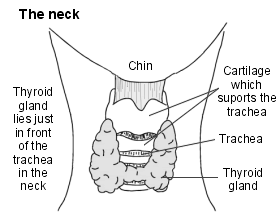
A goitre is an enlarged thyroid gland. A goitre can mean that all the thyroid gland is swollen or enlarged, or one or more swellings or lumps develop in a part or parts of the thyroid gland.
Where is the thyroid gland?
The thyroid gland is in the lower part of the front of the neck. It lies just in front of the windpipe (trachea). It has a right and left lobe which are connected together by a narrow band of thyroid tissue called the isthmus.
It is roughly the shape of a butterfly. You cannot usually see or feel a normal thyroid gland. If the thyroid gland enlarges, it causes a swelling in the neck which you can see - a goitre.
The thyroid gland makes thyroid hormones - called thyroxine (T4) and triiodothyronine (T3). These hormones are carried around the body in the bloodstream. T4 and T3 help to keep the body's functions (the metabolism) working at the correct pace. Many cells and tissues in the body need T4 and T3 to keep them working correctly.
Causes of goitre
There are different types of goitre, each with various causes.
Diffuse smooth goitre
This means that the entire thyroid gland is larger than normal. The thyroid gland feels smooth but is larger than normal.
There are a number of causes. For example:
Doença de Graves - an autoimmune disease which causes the thyroid to swell and produce too much of the thyroid hormone thyroxine (T4). In autoimmune disorders your body produces proteins called antibodies which damage a different part of your body - in this case, your thyroid gland.
Inflammation of the thyroid gland (thyroiditis) - which can be due to various causes. For example, another autoimmune condition called tireoidite de Hashimoto can damage the thyroid gland. Infections with germs such as bacteria and viruses can cause different types of thyroiditis. Radioterapia treatment to the neck can also lead to inflammation of the thyroid gland.
Iodine deficiency. The thyroid gland needs iodine to make T4 and triiodothyronine (T3). If you lack iodine in your diet, the thyroid swells as it tries to make enough T4 and T3.
Alguns medicamentos, como lítio e amiodarona can cause the thyroid gland to swell as a side-effect.
Hereditary factors - some people inherit a tendency for a thyroid gland to swell. In particular, it may swell at times of life when you may make more T4 and T3 - for example, when you are pregnant, or during puberty.
Any other disorder which causes problems in the making of T4 or T3 may cause the thyroid gland to swell.
Nodular goitres
A thyroid nodule is a small lump which develops in the thyroid gland. There are two types:
A multinodular goitre. This means the thyroid gland has developed many lumps or nodules. The thyroid gland feels generally lumpy.
A single nodule. Causes include:
A cyst. This is a non-cancerous sac-like swelling filled with fluid.
An adenoma. This is a solid non-cancerous tumour.
A cancerous tumour (thyroid cancer is rare however).
Other rare causes.
Goitre symptoms
Swelling in the neck. The size of a goitre can range from very small and barely noticeable, to very large.
A lack of pain. However, an inflamed thyroid gland (thyroiditis) can be painful.
Difficulty with breathing or with swallowing. A large goitre may press on the windpipe (trachea) or the gullet (oesophagus).
If your thyroid gland makes too much or too little thyroxine (T4) or triiodothyronine (T3), this can cause a range of symptoms. See the separate leaflets called Overactive Thyroid Gland (Hyperthyroidism), Underactive Thyroid Gland (Hypothyroidism) e Doença Ocular da Tireoide para mais detalhes.
Diagnosing a goitre
Examination by a doctor
This is done to determine if a neck swelling arises from the thyroid, or from another structure in the neck.
Exames de sangue
When you have a goitre, a doctor will usually do some exames de sangue to check if you are making too much or too little thyroxine (T4) or triiodothyronine (T3). Blood tests may also help to find out the cause of some goitres. See the separate leaflet called Testes de função da tireoide.
Exame de ultrassom
Uma ultrassonografia of the thyroid. This is the best test for thyroid swellings. An ultrasound scan is a safe and painless test which uses sound waves to create images of organs and structures inside your body. It can tell if a nodule is a cyst or a solid lump. See the separate leaflet called Thyroid Scans and Uptake Tests.
Biópsia
A small piece of tissue (a biopsy) may be taken from a nodule to look at under the microscope. The biopsy is done by inserting a thin needle into the nodule. It is a simple and safe procedure. The specialist doing the biopsy can see where they are inserting the needle by doing an ultrasound scan at the same time.
Outros exames
Occasionally other specialist blood tests are needed to help establish the cause. Occasionally a tomografia computadorizada (TC) ou um exame de ressonância magnética (RM) is needed.
Goitre treatment
Treatment depends on the cause, the size of the goitre, and whether it is causing symptoms. For example:
If you have a small goitre that is not due to a cancerous nodule, and your thyroid gland is making the correct amounts of thyroid hormones then you may not need any treatment.
You will need treatment if you make too much or too little of your thyroid hormones. For medicines used in the treatment of an overactive thyroid gland, see the separate leaflet called Antithyroid Medications.
An operation to remove some or all of the thyroid gland may be an option in some cases.
Radioactive iodine treatment may be an option for a goitre causing an overactive thyroid gland (hyperthyroidism).
This involves taking a drink, or swallowing a capsule, which contains radioactive iodine.
The radioactive iodine builds up in the thyroid gland.
As the radioactivity is concentrated in the thyroid gland, it destroys some thyroid tissue.
You may need to take thyroxine (T4) tablets after having radioactive iodine, if too much of the thyroid is destroyed.
Se você tiver cancer of the thyroid, you will probably need an operation to remove the cancer and some of the thyroid gland.
Iodine replacement is given if the goitre is due to lack of iodine in the diet.
Escolhas do paciente para Condições da tireoide

Hormônios
Glândula tireoide hiperativa
O hipertireoidismo é uma condição incomum em que sua glândula tireoide (que está no seu pescoço) entra em 'sobrecarga'. Ela produz uma quantidade excessiva de um químico chamado tiroxina. Todos nós temos uma certa quantidade de tiroxina em nossos corpos para nos manter funcionando no nível de 'energia' adequado. Se muita tiroxina for produzida, você pode ficar muito doente com cansaço, batimentos cardíacos acelerados e perda de peso. Inicialmente, os sintomas podem imitar muitas outras condições. No entanto, o diagnóstico geralmente é feito com um simples exame de sangue. Existem vários tratamentos disponíveis que tornam o hipertireoidismo relativamente fácil de tratar: comprimidos são a base do tratamento, seguidos por radioterapia. Ocasionalmente, a cirurgia é necessária.
por Dr. Colin Tidy, MRCGP
Hormônios
Doença ocular da tireoide
A doença ocular da tireoide faz com que os músculos e os tecidos moles dentro da órbita do olho inchem. Isso empurra o globo ocular para frente e causa vários sintomas oculares, incluindo olhos salientes. O tratamento envolve medidas para proteger o olho enquanto a doença progride. Isso pode incluir o uso de colírios para fornecer lágrimas artificiais lubrificantes, medicamentos e, em alguns casos, cirurgia. A doença ocular da tireoide geralmente está associada a uma anormalidade na função da glândula tireoide. Isso também precisa ser tratado.
por Dr. Colin Tidy, MRCGP
Perguntas frequentes
Um bócio sempre significa que minha glândula tireoide não está funcionando corretamente?
Não necessariamente. Embora um bócio possa estar ligado a problemas em que a glândula tireoide produz hormônios tireoidianos em excesso ou em quantidade insuficiente, ele também pode ocorrer quando a glândula está produzindo a quantidade correta de hormônios. Seu médico realizará exames de sangue para verificar seus níveis hormonais.
What is the difference between a diffuse smooth goitre and a nodular goitre?
Um bócio difuso e liso significa que toda a glândula tireoide está aumentada e parece lisa. Um bócio nodular, por outro lado, envolve o desenvolvimento de um ou mais caroços, chamados nódulos, dentro da glândula tireoide, fazendo com que ela pareça geralmente irregular.
Um bócio pode ser doloroso?
Normalmente, um bócio não causa dor. No entanto, se a glândula tireoide ficar inflamada (uma condição chamada tireoidite), pode ser doloroso.
O que é uma biópsia e por que eu precisaria de uma para um nódulo na tireoide?
Uma biópsia envolve a retirada de um pequeno pedaço de tecido de um nódulo usando uma agulha fina, que é então examinado ao microscópio. Este procedimento ajuda a determinar se o nódulo é não canceroso ou canceroso, já que tumores cancerosos são uma causa rara de nódulos.
Quanto tempo leva para o tratamento com iodo radioativo funcionar para uma glândula tireoide hiperativa?
O iodo radioativo acumula-se na glândula tireoide e atua destruindo parte do tecido tireoidiano. O artigo não especifica um prazo exato para quando você notará os efeitos, mas é um processo que reduz a atividade da glândula ao longo do tempo.
Leitura adicional e referências
- Doenças da tireoide: avaliação e manejo; Orientação NICE (novembro de 2019 - última atualização em outubro de 2023)
Sobre o autorVer biografia completa

Dra. Rachel Hudson, MRCGP
Médico Generalista e Autor Médico
MBChB, MRCGP (2008), BSc (Medical Science), DFSRH, DRCOG, DCH
Dra. Rachel Hudson é uma médica do NHS que trabalha no Noroeste da Inglaterra.
Sobre o revisorVer biografia completa

Dr Surangi Mendis, MRCGP
Consultor e Autor Médico
MBBS, BSc (1º), MRCGP (2014), DFSRH, PGcert otologia e audiologia
Surangi Mendis é consultora em Medicina Audiovestibular e Neuro-otologia no The Royal National ENT and Eastman Dental Hospitals, UCLH.
Histórico do artigo
As informações nesta página são escritas e revisadas por clínicos qualificados.
Artigo também disponível em Inglês, Alemão, Espanhol, Francês, Italiano, Português, Hindi, Hebraico, Árabe, e Sueco.
Próxima revisão prevista: 29 Out 2028
31 Out 2023 | Última versão

Pergunte, compartilhe, conecte-se.
Navegue por discussões, faça perguntas e compartilhe experiências em centenas de tópicos de saúde.

Sentindo-se mal?
Avalie seus sintomas online gratuitamente
Inscreva-se no boletim informativo do Patient
Sua dose semanal de conselhos de saúde claros e confiáveis - escritos para ajudá-lo a se sentir informado, confiante e no controle.
Ao se inscrever, você aceita nossos Política de Privacidade. Você pode cancelar a inscrição a qualquer momento. Nunca vendemos seus dados.
Mais sobre hormônios
- Curso de Menopausa de 10 Semanas
- Acromegalia
- Fadiga adrenal
- Alternativas à TRH para sintomas da menopausa
- Hiponatremia
- Hipoparatireoidismo
- Deficiência de iodo
- Descompensação horária
- Baixo nível de testosterona
- Menopausa - o que você precisa saber
- cisto ovariano
- Glândula tireoide hiperativa
- Dor pélvica em mulheres
- Perimenopausa
- Distúrbios da glândula pituitária
- Teste de Synacthen
- Problemas de tireoide e paratireoide
- Testes de função da tireoide
- Glândula tireoide hipoativa
- Secura vaginal