Pituitary gland disorders
Peer reviewed by Dr Colin Tidy, MRCGPLast updated by Dr Hayley Willacy, FRCGP Last updated 21 Aug 2023
Meets Patient’s editorial guidelines
- DownloadDownload
- Share
- Language
- Discussion
- Audio Version
- Add to preferred sources on Google
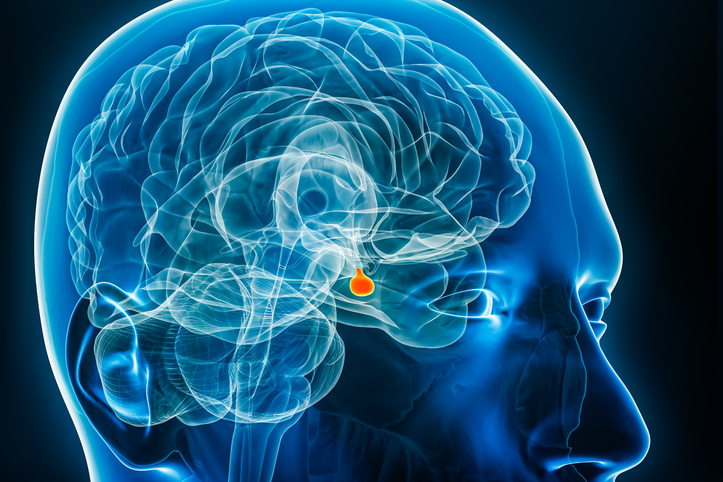
This leaflet gives a brief overview of the pituitary gland and the hormones it makes. The pituitary gland is found at the base of the brain and is 'pea-sized'. The pituitary gland is an overall controller of a number of other glands in the body, overseeing the function of these organs through hormones.
At a glance
The pituitary gland is a pea-sized gland at the base of the brain that produces hormones.
Pituitary disorders occur when the gland is overactive or underactive.
Symptoms of pituitary disorders can include vision problems or hormone-related issues.
Diagnosis involves hormone blood tests and an MRI brain scan.
Treatment for pituitary disorders depends on the cause and may involve surgery or hormone replacement.
Some of the pituitary gland disorders
Pituitary disorders generally occur when the pituitary gland is either too active or not active enough. Often there is a discrete piece of pituitary gland which leads to the problems, this is called a pituitary adenoma (if it is large it may be called pituitary macroadenoma). These are usually benign, non-cancerous tumours. Pituitary adenomas can cause problems through:
Releasing excess of one or more hormone.
Not releasing any hormones but pressing on the normal pituitary tissue and thus interfering with normal function; and/or
Causing pressure on nearby structures - for example, pressing on the nerve of the eye, leading to blurred vision or loss of part of the vision.
Conditions where the pituitary gland produces too much of one or more of its hormones include:
Conditions where the pituitary gland fails to produce enough hormones include:
Adult growth hormone deficiency.
Hypopituitarism.
Pituitary tumours.
Tumours of, or injury to, the hypothalamus, having a knock-on effect on the pituitary gland.
How are pituitary gland disorders diagnosed?
The diagnosis usually involves hormone blood tests and also brain scans. Hormone blood tests can be taken randomly for some hormones, but others may require specialised testing with substances that should provoke the release or prevent release in certain conditions.
This may require attendance at a day unit and having several hormone blood tests throughout the day. Usually an MRI scan of the pituitary gland is undertaken to look for pituitary abnormalities - eg, pituitary adenoma or cysts.
What is the treatment for pituitary gland disorders?
This will depend upon the cause. If there is hormone deficiency then this may need replacement with tablets. If a tumour is discovered as the cause of the problems then pituitary surgery may be required.
This is usually via the nose. If there is a pituitary tumour which is found to be cancerous then radiotherapy may be needed after surgery. There may also be a need for lifelong hormone replacement following any treatment.
What is the pituitary gland?
The pituitary gland is located in the brain and is an endocrine gland. This means that it produces chemicals called hormones. Hormones are chemical messengers which help different organs in the body communicate with each other. The pituitary gland is one part of a messenger system.
The pituitary gland helps to control the body's functions by releasing hormones into the bloodstream. These hormones are transported in the blood to their target. Here they usually cause the release of a second hormone.
The target can either be specialised endocrine glands or other types of body tissue such as groups of cells.
The pituitary gland is sometimes called the master gland because it controls several other hormone-releasing glands. Some of the glands the pituitary gland controls are the thyroid gland, the ovaries, the testicles (testes) and the adrenal glands.
Where is the pituitary gland located?
About the size of a pea, the pituitary gland is found at the base of the brain, behind the bridge of your nose. The pituitary gland is very close to another part of the brain, called the hypothalamus.
The pituitary
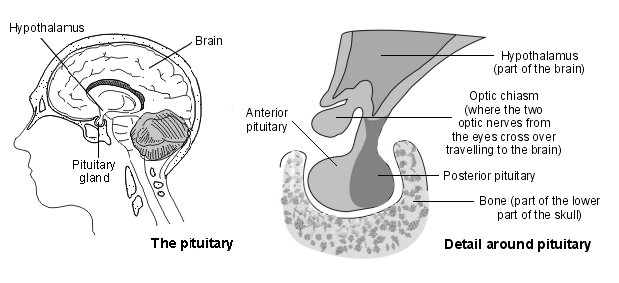
The pituitary gland has two main parts:
The part of the pituitary gland at the front, called the anterior pituitary.
The part of the pituitary gland at the back, called the posterior pituitary.
These two parts release different hormones which are aimed at different parts of the body.
There is also a section between the two main parts, called the intermediate part, which releases a single hormone. The final part of the pituitary gland is the stalk, which connects the posterior pituitary to the hypothalamus.
How does the pituitary gland work?
The body is in a constant state of change. Heart rate, blood pressure and body temperature all change in response to what you do and your surroundings. The body has systems that constantly monitor these and other vital functions. Not only must these systems monitor changes, they must also respond to the changes and help the body to restore balance.
Some of these systems involve the hypothalamus and the pituitary gland. The hypothalamus and the pituitary gland are part of several loops or circuits. The loops include other glands. The hormones produced by each gland complete the loops by travelling in the bloodstream between them.
The hypothalamus receives information from many sources about the basic functions of the body. It uses the information it receives to help regulate these functions. One of the ways the hypothalamus does this involves controlling the pituitary gland. The hypothalamus does this by using its own hormones to communicate with the pituitary gland.
Among the information monitored by the hypothalamus is the level of various hormones in the blood. The hypothalamus has special cells which receive information from the body indicating how much of each hormone is present in the bloodstream.
When these hormones drop below a particular level this stimulates the hypothalamus to release hormones. These hormones travel to the pituitary gland, acting as the signal to the pituitary gland to produce one or more of its hormones.
The hormones produced by the pituitary gland are released into the bloodstream. The bloodstream transports the pituitary hormones to other endocrine glands, such as the thyroid gland.
The pituitary gland hormones may then stimulate their target endocrine glands to produce their own hormones. These locally produced hormones do the actual work of regulating your body.
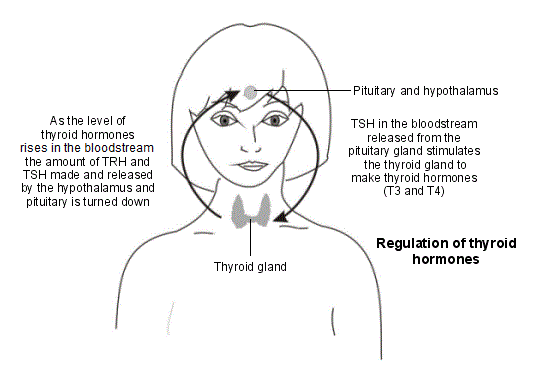
Take the example of the control of thyroid hormones from the thyroid gland in the neck. The hypothalamus produces a hormone called thyrotropin-releasing hormone (TRH). TRH travels to the pituitary gland and stimulates it to release thyroid-stimulating hormone (TSH).
TSH travels to the thyroid gland and stimulates it to release thyroid hormones, T3 and T4. When levels of T3 and T4 get high enough, levels in the bloodstream are detected by the hypothalamus.
The hypothalamus then knows to stop releasing more TRH. This last part of the loop is called negative feedback and prevents hormone levels from rising too high.
Regulation of thyroid hormones
The anterior pituitary produces hormones that regulate a wide range of bodily activities, from growth to reproduction. Whether a hormone is released by the anterior pituitary is governed by the hypothalamus. There are at least seven different hormones secreted by the anterior pituitary. The posterior pituitary produces just two hormones.
The anterior pituitary hormones
Hormone released | Main target | Function |
|---|---|---|
Adrenocorticotrophic hormone (ACTH) | Adrenal glands | Stimulates the adrenal glands to produce cortisol. Cortisol is important in controlling your metabolism, blood sugar levels and blood pressure. It is also an anti-inflammatory agent and helps your body to resist certain stresses such as bleeding or fasting. |
Follicle-stimulating hormone (FSH) | Ovaries -women Testicles (testes) - men | Stimulates the ovaries to produce an egg (ovum) for fertilisation. Also causes an increase in the hormone oestrogen. Stimulates the testicles to produce sperm. |
Growth hormone (GH) | Many different cells of the body | The most well-known effect in children is to increase height. In adults and children it helps to control the amount of muscle and fat in the body. It also helps to heal injuries and it promotes your immune system. |
Luteinising hormone (LH) | Ovaries - women Testicles - men | Triggers ovulation - the release of an egg (ovum) ready for fertilisation. Stimulates cells in the testes to produce testosterone. |
Melanocyte-stimulating hormone (MSH) | Brain (not known for sure) | The exact role in humans is unknown. It may influence brain activity. When too much is present, it may cause darkening of the skin. This is also produced in the intermediate part of the pituitary gland. |
Prolactin | Breasts | Together with other hormones, prolactin stimulates the breasts to produce milk. It is also found in women who aren't pregnant. Men also have prolactin but its function is not understood well. |
Thyroid-stimulating hormone (TSH) | Thyroid gland | TSH stimulates the thyroid gland to produce its own hormones, triiodothyronine (T3) and thyroxine (T4). These hormones help to control many bodily functions, including heart rate, temperature and metabolism. |
The posterior pituitary makes and releases just two hormones
Hormone released | Main target | Function |
Antidiuretic hormone (ADH) | Kidneys | Decreases urine production. (It causes more water filtered by the kidneys to be returned to the blood. This reduces the amount of urine.) ADH also causes a rise in blood pressure. |
Oxytocin | Breasts and womb (uterus) | Stimulates contraction of the womb during childbirth. Helps breasts to release milk. |
Further more detailed information available free online
The Hypophysis Cerebri
From Gray's Anatomy Online
Human Physiology/The endocrine system
From Wikibooks, the open-content textbooks collection
Additional reading information can be found in the 'Further reading' section, below.
Patient picks for Hormone imbalance

Hormones
Diabetes insipidus
Diabetes insipidus is a rare condition where the body is unable to control the balance of water. People with diabetes insipidus become very thirsty and pee a lot.
by Dr Doug McKechnie, MRCGP
Hormones
Prolactinoma
A prolactinoma is a non-cancerous growth in the pituitary gland that makes a hormone called prolactin.
by Dr Hayley Willacy, FRCGP
Frequently asked questions
How does the anterior pituitary gland differ from the posterior pituitary gland in terms of hormone release?
The anterior pituitary gland releases at least seven different hormones that regulate a wide range of bodily activities, from growth to reproduction, with its hormone release controlled by the hypothalamus. In contrast, the posterior pituitary gland produces and releases just two specific hormones: antidiuretic hormone (ADH) and oxytocin.
What is the function of the intermediate part of the pituitary gland?
There is a section called the intermediate part located between the anterior and posterior sections of the pituitary gland. This part releases a single hormone, melanocyte-stimulating hormone (MSH). While its exact role in humans is not fully understood, it may influence brain activity, and too much of it can cause skin darkening.
How does the pituitary gland contribute to maintaining a stable internal environment in the body?
The pituitary gland, in conjunction with the hypothalamus, plays a vital role in maintaining the body's internal balance by responding to changes and restoring stability. It's part of a loop system where the hypothalamus monitors hormone levels and signals the pituitary gland to release its own hormones. These pituitary hormones then stimulate other endocrine glands to produce their hormones, ensuring bodily functions like heart rate, blood pressure, and body temperature are regulated through a negative feedback system.
What are some of the long-term implications after treatment for a pituitary gland disorder?
Depending on the treatment, some individuals may require lifelong hormone replacement following any intervention for a pituitary gland disorder. This is particularly relevant if surgery or other treatments affect the gland's ability to produce necessary hormones.
Can pituitary gland disorders affect parts of the body not directly involved in hormone production?
Yes, pituitary gland disorders can affect other body parts. For example, a pituitary adenoma can cause problems by pressing on nearby structures, such as the optic nerve, leading to symptoms like blurred vision or partial vision loss. This occurs independently of the tumour's hormonal activity.
Further reading and references
- The Pituitary Foundation
- El Sayed SA, Fahmy MW, Schwartz J; Physiology, Pituitary Gland.
- Reeves RA, Parekh M; Pituitary Gland Imaging.
About the authorView full bio
Updated by

Dr Hayley Willacy, FRCGP
General Practitioner, Medical Author
MBChB (1992), DRCOG, DFFP, MRCOG (Part 1) MRCGP (2007), DFSRH (2013), MSc - medical education (2020)
Dr Hayley Willacy was an NHS GP working in northwest England, who retired from clinical practice in 2022 after 30 years.
About the reviewerView full bio

Dr Colin Tidy, MRCGP
General Practitioner, Medical Author
MBBS, MRCGP, MRCP (Paediatrics), DCH
Dr Colin Tidy is an NHS Doctor, based in Oxfordshire.
Join the conversation
Share your thoughts or experiences with others in our patient communities.

Ask, share, connect.
Browse discussions, ask questions, and share experiences across hundreds of health topics.

Feeling unwell?
Assess your symptoms online for free
Sign up to the Patient newsletter
Your weekly dose of clear, trustworthy health advice - written to help you feel informed, confident and in control.
By subscribing you accept our Privacy Policy. You can unsubscribe at any time. We never sell your data.