Testes de função da tireoide
Revisado por Dr Hayley Willacy, FRCGP Última atualização por Dr Toni Hazell, FRCGPÚltima atualização 15 Set 2023
Atende aos diretrizes editoriais
- BaixarBaixar
- Compartilhar
- Language
- Discussão
- Ask Patient
- Versão em Áudio
- Adicionar às fontes preferidas no Google
Nesta série:Glândula tireoide hiperativaBócioDoença ocular da tireoideExames de cintilografia e captação da tireoideMedicamentos antitireoidianos
Thyroid function tests are blood tests which help to check the function of your thyroid gland. They are mainly used to detect an underactive thyroid gland (hypothyroidism) and an overactive thyroid gland (hyperthyroidism).
Lots of basic information about the thyroid gland can be found in the separate leaflet called Thyroid Problems (also including Parathyroid Glands). This leaflet will only deal with the blood test that measures how your thyroid is working, not the specific diseases, such as Graves' disease, that affect the thyroid.
Nota: the information below is a general guide only. The arrangements, and the way tests are performed, may vary between different hospitals. Someone can have their thyroid function test in one hospital and it could give slightly different results to having it measured in another hospital. It is important to interpret the results of your thyroid function test with the doctor who requested them - so if the test was requested by your GP, they will give you the result. If it was requested by a hospital consultant, you need to get the result from them and your GP will not have it.
Em resumo
A thyroid function test is a blood test that measures hormones from your thyroid and pituitary glands.
It is mainly used to diagnose underactive or overactive thyroid glands.
You do not need to fast before the test.
Tell your doctor if you are taking any medication or are pregnant.
Test results usually take 1-3 days to come back.
Escolhas de vídeos para Exames de sangueBiblioteca de vídeos
What is a thyroid function test?
A thyroid function test is a blood test measuring the levels of the hormones made by your thyroid gland. The test also checks the level of a hormone made by the pituitary gland in your brain, which acts on your thyroid gland.
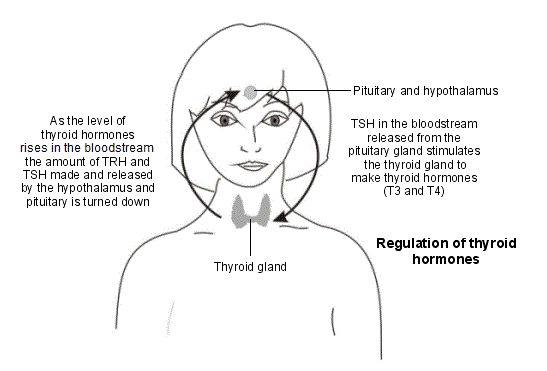
The two hormones, thyroxine (T4) and thyroid-stimulating hormone (TSH), work together and are usually in balance. In a healthy person the brain produces just the right amount of TSH to keep the thyroid gland ticking over. The thyroid gland then produces just the right amount of thyroxine.
This is called a feedback loop: if the thyroid gland makes too much thyroxine it will feed back to the brain to make less TSH. This diagram shows the feedback loop between the thyroid gland in your neck and the pituitary gland in the brain:
Regulation of thyroid hormones
What are thyroid function tests used for?
Thyroid function tests are usually done to find out whether the thyroid gland is working properly. This is mainly to diagnose uma glândula tireoide hipoativa (hipotireoidismo) e an overactive thyroid gland (hyperthyroidism).
People with some conditions have an increased risk of autoimmune thyroid problems and so are often advised to have thyroid function tests undertaken each year. This conditions include:
Certain medicines can also affect the function of your thyroid - for example, amiodarona e lítio.
Thyroid function tests can also be done to:
Monitor treatment with thyroid replacement medicine for people who have hypothyroidism.
Check thyroid gland function in people who are being treated for hyperthyroidism.
Screen newborn babies for inherited problems with the thyroid gland.
Patrocinado
At home thyroid blood test
Understand your thyroid function with a simple blood test at Randox Health. Weight fluctuation, trouble sleeping and sensitivity to heat or cold can all be indicative of a thyroid disorder. They test for 5 key markers to give you a comprehensive overview of your thyroid health.
What happens during a thyroid function test?
A thyroid function test is a simple blood test. The blood sample is then sent to the laboratory for analysis and the results are sent back to the doctor who asked for the tests. The results usually take 1-3 days to come back.
What should I do to prepare for a thyroid function test?
Thyroid function tests usually require very little preparation. Things to consider:
You don't need to fast before the blood test. And it doesn't matter if you have taken your thyroid medicine just before the blood test.
Tell your doctor if you are taking any medication, as some medicines can alter the test results and how they are interpreted.
It is also important to mention if you have had any X-ray tests that have used a special contrast dye, either injected or if you have been asked to swallow a small amount of dye, as this may contain iodine which can affect the results.
Levels of thyroid chemicals (hormones) also change in pregnancy, so tell your doctor if you are pregnant when the test is taken.
Nota: all newborn children have their thyroid function tested as part of the heel prick test which is offered to all babies and undertaken when they are 5 days old. See the separate leaflet called Newborn Baby Screening Tests for more information.
Thyroid function test results explained
The thyroid usually changes slowly. It hardly ever changes quickly to being overactive or underactive: it usually takes a few weeks at least, or even a few months. If you have a thyroid function test that shows something is wrong, it's usually worth repeating it in 6-8 weeks. That is because there's always the chance that your thyroid gland could have gone back to normal by itself.
The second thing to bear in mind about thyroid function tests is that medications, and even herbal remedies or vitamin supplements, can affect the accuracy of thyroid results.
For these two reasons it's always recommended to have a thyroid function test if it is recommended to you by a doctor, rather than having it done privately or without a doctor suggesting it.
Normal range
The following are approximate values for what is normal for TSH and thyroxine levels. These are a rough guide only and will vary from hospital to hospital.
Normal range for thyroid-stimulating hormone: 0.4-4.0 mU/L.
Normal range for thyroxine: 9-24 pmol/L.
So in general if your TSH is low and your thyroxine level is high, you may have an overactive glândula tireoide.
Conversely if your TSH is high and your thyroxine level is low, you may have an hipoativa glândula tireoide.
There are other options such as having a high TSH but a normal thyroxine and that can indicate something called subclinical hypothyroidism. If this is the case then a thyroid antibody test may also be requested, to help with the decision about whether or not treatment is indicated.
Be aware that there are other conditions that can cause abnormalities with the thyroid function tests (such as adrenal insufficiency) and so the pointers above are a guide only: you should discuss your thyroid function tests with your doctor before reaching any conclusions.
Escolhas do paciente para Exames de sangue

Exames e investigações
Exame de PSA
O teste de PSA (antígeno prostático específico) é um exame de sangue que avalia a probabilidade de câncer de próstata. Ele também é usado para monitorar o tratamento do câncer de próstata. O nível de PSA no sangue também pode estar aumentado em outras condições. Ter um resultado de teste de PSA elevado não significa, portanto, que o diagnóstico seja câncer de próstata. No momento, não há um programa nacional de rastreamento para câncer de próstata no Reino Unido, mas atualmente há estudos analisando se o rastreamento seria apropriado para o câncer de próstata. O ensaio clínico randomizado TRANSFORM está sendo planejado para começar em 2024. Isso incluirá um teste de PSA, entre outros, na avaliação de se um programa de rastreamento de câncer de próstata é possível ou apropriado.
por Dra. Philippa Vincent, MRCGP

Exames e investigações
Grupos e tipos sanguíneos
ABO e Rh são ambos tipos de antígenos encontrados na superfície das hemácias. Existem muitos outros tipos, mas estes são os mais importantes.
por Dra. Rosalyn Adleman, MRCGP
Perguntas frequentes
How long does it take to get thyroid blood test results back?
The blood sample is sent to a laboratory for analysis, and the results are typically sent back to the requesting doctor within 1 to 3 days.
Leitura adicional e referências
- Doenças da tireoide: avaliação e manejo; Orientação NICE (novembro de 2019 - última atualização em outubro de 2023)
- Hipotireoidismo; NICE CKS, maio de 2021 (acesso apenas no Reino Unido)
- CKS Hyperthyroidism; NICE CKS, janeiro de 2021 (acesso apenas no Reino Unido)
Sobre o autorVer biografia completa
Atualizado por

Dr Toni Hazell, FRCGP
MBBS, BSc, FRCGP, DFSRH, Dip GU med, DRCOG, DCH (London, UK, 2000)
A Dra. Toni Hazell se formou na Escola de Medicina do Hospital St. Mary e fez seu VTS no Hospital Northwick Park.
Sobre o revisorVer biografia completa

Dr Hayley Willacy, FRCGP
Médico Generalista, Autor Médico
MBChB (1992), DRCOG, DFFP, MRCOG (Part 1) MRCGP (2007), DFSRH (2013), MSc - medical education (2020)
A Dra. Hayley Willacy era uma médica do NHS atuando no noroeste da Inglaterra, que se aposentou da prática clínica em 2022 após 30 anos.
Profissionais de Saúde
Looking for more in-depth clinical detail? Our Professional Reference articles are written for doctors, nurses and other healthcare professionals. They include comprehensive clinical guidance, diagnostic information and UK/European evidence summaries. If you need the clinical version, you can read the Professional Reference article on this topic.
Compartilhe seus pensamentos ou experiências com outros em nosso comunidades de pacientes.
Acesso simples a tratamentos confiáveis e serviços de saúde online.
Common conditions
Get help with common conditions through the NHS, without a GP appointment.
 Sinusite aguda
 Amigdalite bacteriana
 Impetigo
 Mordidas de insetos
 Herpes zosterInfecção do trato urinário (ITUs)
Inscreva-se no boletim informativo do Patient
Sua dose semanal de conselhos de saúde claros e confiáveis - escritos para ajudá-lo a se sentir informado, confiante e no controle.
Ao se inscrever, você aceita nossos Política de Privacidade. Você pode cancelar a inscrição a qualquer momento. Nunca vendemos seus dados.