Queratose pilar
Revisado por Dr Toni Hazell, FRCGPÚltima atualização por Dr Jo SealeÚltima atualização 29 Nov 2022
Atende aos diretrizes editoriais
- BaixarBaixar
- Compartilhar
- Language
- Discussão
- Versão em Áudio
- Adicionar às fontes preferidas no Google
Profissionais de Saúde
Os artigos de Referência Profissional são projetados para uso por profissionais de saúde. Eles são escritos por médicos do Reino Unido e baseados em evidências de pesquisa, diretrizes do Reino Unido e da Europa. Você pode encontrar um dos nossos artigos de saúde mais útil.
Synonyms: hyperkeratosis, folliculocentric keratotic papules, follicular keratotic papules
Keratosis pilaris is a very common skin condition characterised by the presence of follicular keratotic papules, sometimes associated with baseline erythema on the affected areas. Keratosis pilaris is often described in association with other dry skin conditions.
How common is keratosis pilaris? (Epidemiology)
It affects nearly 50-80% of all adolescents and approximately 40% of adults.1
Most people with keratosis pilaris are asymptomatic and are often unaware of the condition.
There is no racial bias but females are affected more often than males.
It tends to present in the first decade of life. It may become worse in adolescence and often improves or disappears in adult life.
Around half of cases have a positive family history.
There have been reports of genetic syndromes, such as chromosome 18p deletion, which may manifest as prominent and extensive keratosis pilaris.2
Fatores de risco
There is an association with ichthyosis and atopy. It tends to improve in the summer. There may be a chronic course of exacerbations and remissions. It is worse with dry skin.
Other associations of keratosis pilaris include scarring alopecia, ectodermal dysplasia, obesity and Down's syndrome.1 3
Keratosis pilaris symptoms3
There is a rough, goose-flesh appearance of the skin.
There are small papules of keratosis that are one to two millimetres in diameter.
There may be some erythema around the lesions or they may be a normal skin colour. A coiled hair may be apparent beneath the papule.
Pruritus may also be present
Keratosis pilaris can affect all skin surfaces where hair grows. However, it is more common on the proximal and extensor surfaces of extremities and convex areas such as cheeks and buttocks.
Keratosis pilaris - moderate
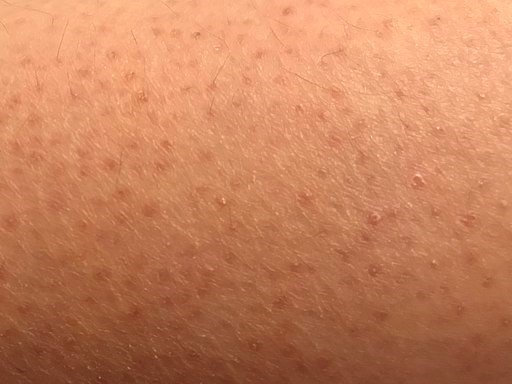
© QuarterNotes, CC BY-SA 4.0, via Wikimedia Commons
Diagnóstico diferencial
Eruptive vellus hair cysts.
Keratosis follicularis (Darier's disease).
Kyrle's disease.
Lichen nitidus.
Lichen spinulosus.
Perforating folliculitis.
Investigações
The diagnosis is purely clinical and no investigations are required. In very exceptional atypical cases a skin biopsy with histopathological examination may be used to confirm diagnosis.
Keratosis pilaris treatment and management
Current treatment options for keratosis pilaris can temporarily improve the condition although they do not cure it.4 Treatment options vary, focusing on avoiding skin dryness using emollients and adding keratolytic agents when necessary.5
The British Association of Dermatologists recommends the following:4
Avoid excessive dryness of the skin; emollients and moisturisers can help soften the skin.
Creams with salicylic acid, lactic acid or urea may be of use in flattening the bumps on the skin
Expensive cosmetic or vitamin creams have not been shown to be effective.
An abrasive pad may be helpful.
Take tepid showers rather than hot baths.
Laser treatment has been shown to lead to significant improvements in skin texture and roughness or bumpiness in keratosis pilaris patients.6
Complicações
Complications are uncommon. Pigmentary changes and even scarring can sometimes occur.
Prognóstico
It often resolves spontaneously over time but there may be exacerbations and remissions over many years. The outcome can be quite variable between cases.
Atualizações exclusivas para profissionais de saúde
Mantenha-se informado com as últimas atualizações clínicas, insights profissionais e orientações baseadas em evidências. O boletim informativo Patient Pro seleciona conteúdo essencial para profissionais de saúde—entregue diretamente na sua caixa de entrada.
Ao se inscrever, você aceita nossos Política de Privacidade. Você pode cancelar a inscrição a qualquer momento. Nunca vendemos seus dados.
Leitura adicional e referências
- Queratose pilar; DermNet
- Thomas M, Khopkar US; Keratosis pilaris revisited: is it more than just a follicular keratosis? Int J Trichology. 2012 Oct;4(4):255-8. doi: 10.4103/0974-7753.111215.
- Carvalho CA, Carvalho AV, Kiss A, et al; Keratosis pilaris and ulerythema ophryogenes in a woman with monosomy of the short arm of chromosome 18. An Bras Dermatol. 2011 Jul-Aug;86(4 Suppl 1):S42-5.
- Wang JF, Orlow SJ; Keratosis Pilaris and its Subtypes: Associations, New Molecular and Pharmacologic Etiologies, and Therapeutic Options. Am J Clin Dermatol. 2018 Oct;19(5):733-757. doi: 10.1007/s40257-018-0368-3.
- Keratosis Pilaris; British Association of Dermatologists
- Hwang S, Schwartz RA; Keratosis pilaris: a common follicular hyperkeratosis. Cutis. 2008 Sep;82(3):177-80.
- Maghfour J, Ly S, Haidari W, et al; Treatment of keratosis pilaris and its variants: a systematic review. J Dermatolog Treat. 2022 May;33(3):1231-1242. doi: 10.1080/09546634.2020.1818678. Epub 2020 Sep 14.
Sobre o autorVer biografia completa

Dra. Jo Seale
Sobre o revisorVer biografia completa

Dr Toni Hazell, FRCGP
MBBS, BSc, FRCGP, DFSRH, Dip GU med, DRCOG, DCH (London, UK, 2000)
A Dra. Toni Hazell se formou na Escola de Medicina do Hospital St. Mary e fez seu VTS no Hospital Northwick Park.
Histórico do artigo
As informações nesta página são escritas e revisadas por clínicos qualificados.
Artigo também disponível em Inglês, Alemão, Espanhol, Francês, Italiano, Português, Hindi, Hebraico, Árabe, e Sueco.
Próxima revisão prevista para: 28 Nov 2027
29 Nov 2022 | Última versão

Pergunte, compartilhe, conecte-se.
Navegue por discussões, faça perguntas e compartilhe experiências em centenas de tópicos de saúde.

Sentindo-se mal?
Avalie seus sintomas online gratuitamente
Mais em dermatologia
- Fenômenos alérgicos
- Dermatoses bolhosas
- Psoríase em placas crônica
- Nevo pigmentado congênito
- Eritema multiforme
- Herpes genital na gravidez
- Gota
- Vírus do herpes
- Hirsutismo
- Hiperidrose
- Trombocitopenia imune
- Coceira
- Líquen plano
- Sarampo
- Nocardia
- Lesões cutâneas pigmentadas
- Cistos pilares
- Erupções purpúricas
- Varíola
- Baqueteamento digital