Keratosis pilaris
Peer reviewed by Dr Toni Hazell, FRCGPAuthored by Dr Philippa Vincent, MRCGPOriginally published 3 Aug 2026
Meets Patient’s editorial guidelines
- DownloadDownload
- Share
- Language
- Discussion
- Audio Version
- Add to preferred sources on Google
Keratosis pilaris is a very common skin condition which affects children and teenagers more than adults. It causes rough skin, particularly over the upper arms, outer legs and buttocks.
Key points
Keratosis pilaris is a harmless, very common skin condition caused by a build-up of keratin.
It causes rough, small bumps, usually on the upper arms, thighs, face, or buttocks.
Moisturisers and gentle exfoliation can improve its appearance, but there's no cure.
Keratosis pilaris usually improves over time. It often gets worse during colder weather, better in warmer weather.
What is keratosis pilaris?
Keratosis pilaris is a very common skin condition which causes rough skin with raised red bumps. It is caused by "keratin" - the protein that makes your hair, nails, and the outer layer of your skin - building up in the pores of your skin, instead of shedding as normal.
Who gets keratosis pilaris?
Keratosis pilaris is very common. Between five and eight in ten of all teenagers have keratosis pilaris but it is also common in babies and younger children. It tends to settle down after your teenage years; about four in ten adults have keratosis pilaris.
People with all skin types get keratosis pilaris but it seems to be more common in girls and women than in boys and men.
If you have another skin condition, such as eczema or dry skin, you are more likely to get keratosis pilaris. You are also more likely to have keratosis pilaris if other people in your family have it as well.
Can I catch keratosis pilaris?
Keratosis pilaris cannot be caught from someone else. No one knows why it develops or what makes some people get keratosis pilaris and others not.
What does keratosis pilaris look like?
Keratosis pilaris is often described as being like "chicken skin" or "goosebumps". There are lots of tiny bumps over the surface of the skin which feels rough if you run your hand over it. In white or pale skin, these usually look red but in darker skin they can look dark brown or black.
It is most common on the upper arms but it can also occur on:
Face and neck.
Legs, especially thighs.
Back.
Chest.
Buttocks.
Forearms.
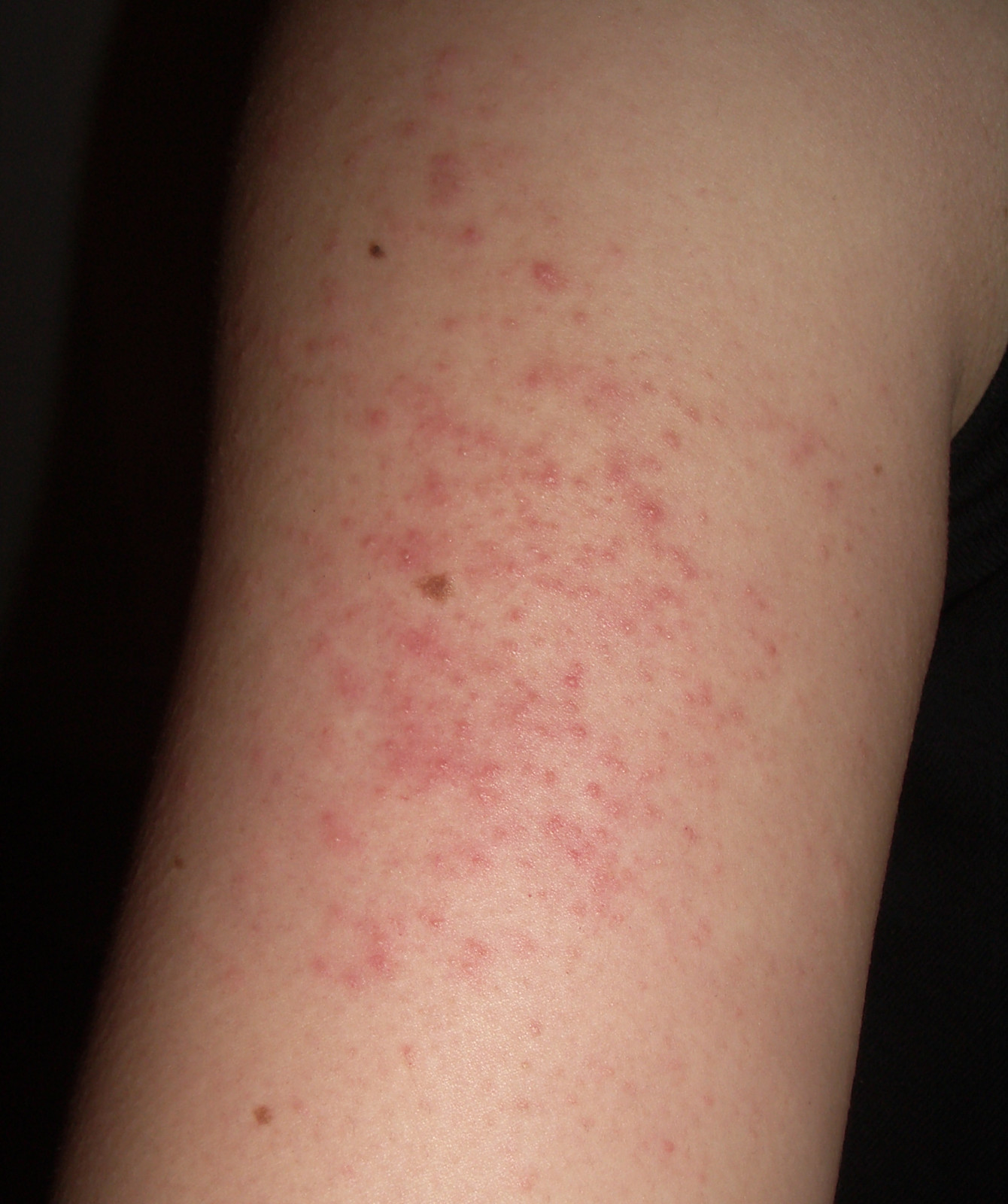
© Irja from San Francisco, CC BY-SA 2.0 <https://creativecommons.org/licenses/by-sa/2.0>, via Wikimedia Commons
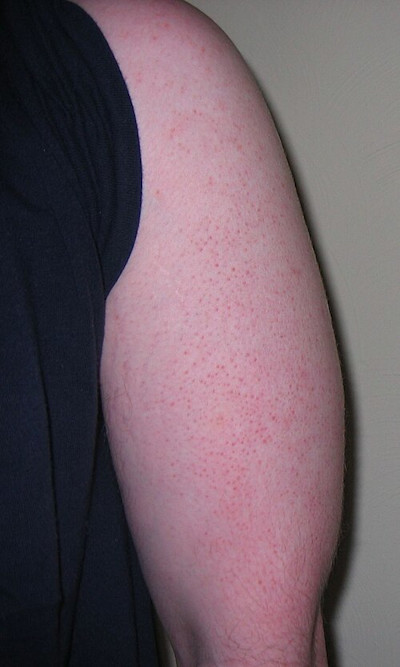
© No machine-readable author provided. Feedmecereal~commonswiki assumed (based on copyright claims)., Public domain, via Wikimedia Commons
How is keratosis pilaris diagnosed?
There are no tests for keratosis pilaris. You don't need to see a doctor but, if you do, then they will diagnose keratosis pilaris by looking at it.
Treatment of keratosis pilaris
Keratosis pilaris is not harmful. It does not need to be treated. It often gets better in warmer weather and worse in colder weather.
However, some people find that keratosis pilaris makes them feel self-conscious and they want to try and reduce the appearance of it. Although keratosis pilaris can't be cured, there are some treatments which can help.
Some things that can help the appearance of keratosis pilaris include:
Using emollients or moisturisers regularly to try and soften the skin (but avoid scented products).
Using creams that contain urea, salicylic acid, or lactic acid to try and flatten the bumps.
Using exfoliating pads or mittens.
Having lukewarm showers and avoiding hot baths.
Using a humidifier in winter to stop your skin drying out.
Laser treatment has been shown to be beneficial but is not available on the NHS.
Treatments that have not been shown to help include:
Expensive cosmetics which are sold specifically to help with keratosis pilaris.
Vitamin creams.
Scratching or picking at your skin can make keratosis pilaris worse.
How long does it take for keratosis pilaris to get better?
When the treatments above work, it usually takes around six to eight weeks for the skin to start improving. However, even without treatments, it usually gets better with time and is usually much better after the age of 30.
Patient picks for Other skin conditions

Skin, nail and hair health
Vitiligo
Vitiligo causes white patches on the skin which vary in size and number. There are usually no other symptoms, but it can have a significant effect on mood and self-esteem. Affected areas of skin can be covered by skin camouflage creams. Treatment has improved in recent years and in some cases the pigment can be restored.
by Dr Colin Tidy, MRCGP
Skin, nail and hair health
Sun and sunburn
This leaflet discusses the risks and benefits of sunlight to your skin. It gives tips on how to enjoy sunshine safely so it you can do you good and reduce the risk of causing harm. It is very important to protect children from the sun. The delicate skin of a child is more sensitive to sun damage than the skin of an adult.
by Dr Caroline Wiggins, MRCGP
Further reading and references
- Keratosis pilaris; British Association of Dermatologists
- Keratosis Pilaris; DermNet
About the authorView full bio

Dr Philippa Vincent, MRCGP
General Practitioner, Medical Author
MB BS, Bsc, MRCGP (2000), DCH, DFSRH, DRCOG
Dr Philippa Vincent is an NHS GP working in North London.
About the reviewerView full bio

Dr Toni Hazell, FRCGP
MBBS, BSc, FRCGP, DFSRH, Dip GU med, DRCOG, DCH (London, UK, 2000)
Dr. Toni Hazell qualified from St. Mary’s Hospital Medical School and did her VTS at Northwick Park Hospital.
Article history
Article also available in English, German, Spanish, French, Italian, Portuguese, Hindi, Hebrew, Arabic, and Swedish.
Next review due: 2 Feb 2031
3 Aug 2026 | Originally published
Authored by:
Dr Philippa Vincent, MRCGPPeer reviewed by
Dr Toni Hazell, FRCGP
Join the conversation
Share your thoughts or experiences with others in our patient communities.

Ask, share, connect.
Browse discussions, ask questions, and share experiences across hundreds of health topics.

Feeling unwell?
Assess your symptoms online for free
Sign up to the Patient newsletter
Your weekly dose of clear, trustworthy health advice - written to help you feel informed, confident and in control.
By subscribing you accept our Privacy Policy. You can unsubscribe at any time. We never sell your data.