Sangramento retal
Blood in stool
Revisado por Dr Colin Tidy, MRCGPÚltima atualização por Dr Doug McKechnie, MRCGPÚltima atualização 25 Jun 2024
Atende aos diretrizes editoriais
- BaixarBaixar
- Compartilhar
- Language
- Discussão
- Versão em Áudio
Nesta série:Sangramento retal em criançasHemorroidasFissura analIntussuscepção e vólvulo em criançasPreparações locais para distúrbios anais
Existem muitas causas para o sangramento retal (sangramento pelo ânus). A gravidade pode variar de um sangramento leve (comum) a um sangramento grave e potencialmente fatal (incomum). Se o sangramento for intenso ou se você tiver fezes pretas (sangue antigo devido a um sangramento na parte superior do intestino), procure um médico imediatamente ou chame uma ambulância. No entanto, o sangramento retal geralmente é leve. Nessa situação, marque uma consulta com seu médico para que a causa possa ser identificada.
Neste artigo:
Vídeos selecionados para Problemas anais e retais
Continue lendo abaixo
What is rectal bleeding?
The term rectal bleeding is used by doctors to mean any blood that is passed out of your bottom when you go to the toilet to pass stools (faeces). However, not all bleeding that is passed out actually comes from the back passage (rectum). The blood can come from anywhere in the gut. The more correct term is gastrointestinal tract bleeding, often abbreviated to GI bleeding. There are many causes of rectal bleeding (GI bleeding) which are discussed later.
What is the gut?
The gut (gastrointestinal tract) starts at the mouth and ends at the anus. When we eat or drink, the food and liquid travel down the gullet (oesophagus) into the stomach. The stomach starts to break up the food and then passes it into the small intestine.
The small intestine (sometimes called the small bowel) is several metres long and is where food is digested and absorbed. Undigested food, water and waste products are then passed into the large intestine (sometimes called the large bowel). The main part of the large intestine is called the colon, which is about 150 cm long.
This is split into four sections: the ascending (on the right side of your tummy), transverse (across the top of your tummy), descending (on the left side of your tummy) and sigmoid colon (in your pelvis). Some water and salts are absorbed into the body from the colon. The colon leads into the back passage (rectum) which is about 15 cm long. The rectum stores stools (faeces) before they are passed out from the anus.
How common is rectal bleeding?
Voltar ao conteúdoRectal bleeding is common. Studies suggest that about 15% of all people have experienced rectal bleeding in the last year.
Continue lendo abaixo
What causes rectal bleeding?
Voltar ao conteúdoThere are many possible causes. Below is a brief overview of the more common causes:
Hemorroidas
Hemorroidas are swellings that can occur in the anus and lower back passage (lower rectum). There is a network of small blood vessels (veins) within the inside lining of the anus and lower rectum. These veins sometimes become wider and filled with more blood than usual. These swollen (engorged) veins and the overlying tissue may then form into one or more small swellings called haemorrhoids. External haemorrhoids develop under the skin around the anus, and internal haemorrhoids form inside the rectum (the back passage).
Haemorrhoids are very common and many people develop one or more haemorrhoids at some stage. Small haemorrhoids are usually painless. The most common symptom is bleeding after going to the toilet. Larger haemorrhoids may cause a mucous discharge, some pain, irritation and itch.
Fissura anal
An anal fissure is a small tear of the skin of the anus. Although the tear of an anal fissure is usually small (usually less than a centimetre), it can be very painful because the anus is very sensitive. Often an anal fissure will bleed a little. You may notice blood after you pass stools (faeces). The blood is usually bright red and stains the toilet paper but soon stops.
Divertículos
A diverticulum is a small pouch in the wall of the gut (intestines). Divertículos is the word used for more than one diverticulum. They can develop on any part of the gut but usually occur in the colon. Several diverticula may develop over time.
A diverticulum may occasionally bleed and you may pass some blood via your anus. The bleeding is usually abrupt and painless. The bleeding is due to a burst blood vessel that can happen in the wall of a diverticulum and so the amount of blood loss can be heavy. Diverticula can cause other symptoms such as tummy pains and changes in your normal bowel habit.
Doença de Crohn
Doença de Crohn is a condition which causes the gut to become inflamed. The disease flares up from time to time. Symptoms vary, depending on the part of the gut affected and how bad the condition is. Common symptoms include bloody diarreia, tummy (abdominal) pain and feeling unwell. See the separate leaflet called Crohn's disease for details.
Ulcerative colitis and other forms of colitis
Ulcerative colitis (UC) is a disease where inflammation develops in the colon and rectum. A common symptom when the disease flares up is diarrhoea mixed with blood. The blood comes from ulcers that develop on the lining of the inflamed gut. There are other rare causes of inflammation of the colon (colitis) or inflammation of the rectum (proctitis) that can cause rectal bleeding. See the separate leaflet called Ulcerative colitis for details.
Polyps
A bowel polyp is a small growth that sometimes forms on the inside lining of the colon or rectum. Most develop in older people. Polyps are non-cancerous (benign) and usually cause no problems. However, sometimes a polyp bleeds and sometimes a polyp can turn cancerous. See the separate leaflet called Bowel polyps (Colonic polyps) for details.
Câncer de cólon
Cancer of the colon and rectum are common cancers in older people. They sometimes affect younger people. Rectal bleeding is one symptom that may occur. Bleeding is often not visible (occult - see later) and other symptoms are often present before visible bleeding occurs. For example, weight loss, tiredness due to blood loss (anemia), diarrhoea or constipação. Cancers of other parts of the gut higher up from the colon sometimes cause rectal bleeding but these are uncommon. See the separate leaflet called Bowel cancer for details.
Angiodysplasia
Angiodysplasia is a condition where you develop a number of enlarged blood vessels within the inner lining of the colon. Angiodysplasia most commonly develops in the ascending (right) colon, but they can develop anywhere in the colon. The cause is unknown but they occur most commonly in older people.
Bleeding from an angiodysplasia is painless. The blood seen can range from bright red brisk bleeding, to dark blood mixed with faeces, to black- or plum-coloured faeces (melaena). An angiodysplasia may also cause non-visible (occult) blood loss (see below).
Abnormalities of the gut
In young children various abnormalities of the gut or the gut wall may cause rectal bleeding. Examples include:
Volvulus - a twisting of the gut.
Intussuscepção - one part of the gut is sucked into another, creating a blockage.
Meckel's diverticulum - an extra bulge or pouch in the small intestine, present from birth (congenital).
Hirschsprung's disease - a condition where a part of the lower bowel does not function as it should. The muscles of the bowel wall are unable to squeeze along the faeces as they should do.
Abnormal blood vessel development.
Stomach and duodenal ulcers
An ulcer in the stomach or duodenum may bleed. This can cause melaena, where your faeces turn black- or plum-coloured as described earlier.
There are separate leaflets on both of these conditions, called Stomach ulcer (Gastric ulcer) e Úlcera duodenal.
Some gut infections
These may cause bloody diarrhoea due to inflammation of the gut, caused by some infections.
See the separate leaflet called Gastroenteritis for more information.
There are various other rarer causes.
When should I worry about rectal bleeding?
Voltar ao conteúdoWhen you have GI bleeding, the things that a doctor needs to assess include the following:
How bad (severe) the bleeding is
Bleeding can range from a mild trickle to a massive life-threatening severe bleed (haemorrhage). In most cases the bleed is mild and intermittent. In this situation, any tests that need to be done can be done as an outpatient. There is no immediate risk to life with mild, intermittent GI bleeding. However, always report to a doctor if you have a large amount of bleeding, as a lot of blood loss needs urgent treatment.
Sometimes bleeding from a condition in the gut (GI tract) is so mild (like a slight trickle) that you do not notice any actual bleeding and it is not enough to change the colour of your stools (faeces). However, a test of your faeces can detect even small amounts of blood. This test may be done in various situations (described later).
Where the bleeding is coming from
Bleeding can come from anywhere in the GI tract. As a general rule:
Bleeding from the anus or low down in the back passage (rectum) - the blood tends to be bright red and fresh. It may not be mixed in with faeces but instead you may notice blood after a bowel movement, or streaks of blood covering faeces. You might also notice blood in the toilet bowl. For example, bleeding from an anal tear (fissure) or from hemorroidas.
Bleeding from the colon - often the blood is mixed up with faeces. The blood may be a darker red. For example, bleeding from colite, doença diverticular, ou de um bowel tumour. However, sometimes, if the bleeding is brisk then you may still get bright red blood not mixed up too much with faeces. For example, if you have a sudden large bleed from a diverticulum.
Bleeding from the stomach or small intestine - the blood has far to travel along the gut before it is passed out. During the time it takes to do this the blood changes and becomes dark red and mixed with faeces. This can make your faeces turn a black and tarry or plum colour - this is called melaena. For example, this may occur due to a bleeding úlcera estomacal ou uma úlcera duodenal. Nota: if you have melaena it is a medical emergency, as it usually indicates a lot of bleeding that is coming from the stomach or duodenum. You should tell a doctor immediately if you suspect that you have melaena.
The cause of the bleeding
A doctor may ask various questions to get a good idea as to the main possible causes of the bleeding. So, for example, you may be asked about possible symptoms. You may be asked about:
Whether you have any pain.
If you have any pain, where it is and what type of pain it is.
Any itching around your bottom.
Any change in your bowels, such as diarrhoea or constipation.
Any weight loss.
Whether you have been feeling unusually tired.
Any history in your family of bowel disease.
Any medications you take, as some can increase the risk of GI bleeding.
The doctor is then likely to examine you. This may include examining your back passage (anus and rectum) by inserting a lubricated gloved finger into your anus. Sometimes they may use an instrument called a proctoscope to look a little way inside your back passage. Sometimes, a diagnosis can be made after this. For example, of an fissura anal ou pile (haemorrhoid).
However, further tests are commonly needed to clarify the cause. This is because the examining finger or the proctoscope can only go a short way up your GI tract. If no cause is found, the bleeding may be coming from higher up.
Continue lendo abaixo
What should I do if I have rectal bleeding?
Voltar ao conteúdoSee a doctor. If the bleeding is heavy, or if you have black- or plum-coloured stools (faeces) - called melaena (described above), see a doctor immediately or call an ambulance. If you feel dizzy, collapse or feel generally unwell then consider calling an ambulance, as this might indicate a heavy bleed. However, often the bleeding is mild. In this situation, make an appointment with your doctor soon.
Some people assume that their rectal bleeding is due to piles (haemorrhoids) and do not get it checked out. Haemorrhoids are perhaps the most common cause of rectal bleeding. However, you should not assume the bleeding is coming from a haemorrhoid unless you have been properly assessed by a doctor.
What tests might be advised?
Voltar ao conteúdoIt depends on the possible causes of the bleeding. This will be determined by a doctor talking to you (your history) and examining you. You will often have a blood test (for anemia) and usually one of the following tests is suggested:
Sigmoidoscopy.
Colonoscopy.
A virtual colonoscopy (CT colonography).
Colonoscopy new
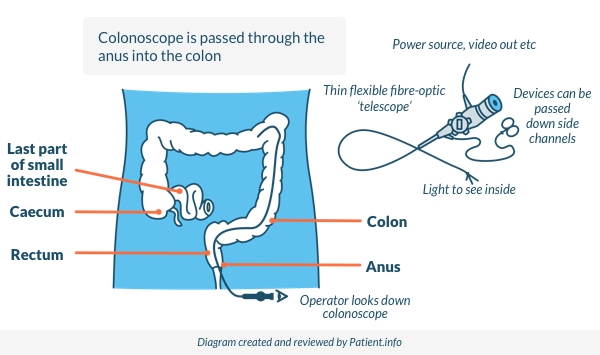
What is a colonoscopy?
A colonoscopy is a test where a doctor or nurse looks into your colon using a colonoscope. A colonoscope has fibre-optic channels that light up the inside of the colon. It is also possible to take a small sample (biopsy) using a colonoscope and sometimes to treat the cause of the rectal bleeding.
What is a sigmoidoscopy?
Uma sigmoidoscopia is a test that allows a doctor or nurse to look inside the rectum and sigmoid colon. The sigmoid colon is the final portion of the bowel that is joined to the rectum. A sigmoidoscope is similar to a colonoscope but much shorter. A sigmoidoscopy is quicker and easier to do than a colonoscopy, but doesn't assess as much of the gut.
What is a virtual colonoscopy?
A virtual colonoscopy (also called Colonografia por TC) is a newer test. It uses a CT scanner to produce detailed pictures of the inside of the colon. It is usually used for people who are more frail and cannot tolerate a colonoscopy. It is not possible to have a sample (biopsy) taken during a virtual colonoscopy.
What is a FIT kit used for?
Voltar ao conteúdoFaecal immunochemical testing (FIT) detects small amounts of blood in your stools (faeces) which you would not normally see or be aware of. Testing using the FIT kit has replaced the older 'guaiac' faecal occult blood test (FOBT).
When and why is testing using the FIT kit done?
Testing with the FIT kit is used to look for 'serious' gut problems, to help determine who should be offered an urgent colonoscopy.
The test detects tiny amounts of blood in poo that can't be seen with the naked eye. The tests can be used to look for blood in people with symptoms like persistente, perda de peso, anemia, or persistent dorzinha (abdominal). Surprisingly, testing using the FIT kit is also useful even in people with visible rectal bleeding, as a normal (negative) FIT result makes it unlikely that there is a serious cause of visible bleeding.
FIT is used:
As a screening test, to look for bowel cancer in people who don't have any symptoms.
To help to decide who should have further investigation (such as a colonoscopy), amongst people with symptoms of a gut problem (including rectal bleeding).
A positive FIT result doesn't necessarily mean that something is wrong, but will usually lead to further urgent tests - likely a colonoscopy - to look for bowel cancer and other gut problems.
How is testing using the FIT kit done?
FIT is a special test kit. You use a stick provided in the sample kit to collect a sample of poo, and then put this stick back into the sample bottle. You then return it, either in the post or to your doctor, depending on the instructions.
In a laboratory, the poo sample is tested using antibodies which measure the amount of blood in the sample.
Triagem para câncer de intestino
Screening means looking for early signs of a particular disease in otherwise healthy people who do not have any symptoms and when treatment is likely to be curative. Bowel cancer (colorectal cancer) screening aims to detect colorectal cancer at an early stage when there is a good chance that treatment will cure the cancer.
In the UK there is a screening programme for certain age groups. This involves testing three samples of your faeces for blood. The age group is slightly different in different parts of the UK. If you are in the relevant age groups, you will automatically be sent an invitation and then your FIT screening kit, so you can do the test at home. After your first screening test, you will then be sent another invitation and screening kit every two years until you reach the maximum age. You can then request further kits if you would like to continue to be included in the screening programme.
What to do about rectal bleeding
Voltar ao conteúdoSee a doctor if you have rectal bleeding. The treatment depends on the cause; for example, stool softeners can help haemorrhoids and an anal fissure. See individual leaflets on the various diseases that can cause rectal bleeding and the medical treatments to help them.
Escolhas do paciente para Problemas anais e retais
Saúde digestiva
Hemorroidas
Hemorroidas são inchaços no interior ou ao redor do ânus que causam desconforto, coceira ou sangramento. Muitas vezes melhoram por conta própria, mas podem precisar de tratamento para serem removidas.
por Dr. Toni Hazell, MRCGP
Saúde digestiva
Fissura anal
Uma fissura anal é um pequeno rasgo no revestimento da pele ao redor da passagem posterior (ânus). Uma fissura anal que dura mais de seis semanas é chamada de fissura anal crônica. Para a maioria das pessoas, a fissura anal cicatriza rapidamente, mas algum tipo de tratamento é frequentemente necessário. As fissuras anais podem voltar a aparecer.
por Dra. Hayley Willacy, FRCGP
Leitura adicional e referências
- Câncer suspeito: reconhecimento e encaminhamento; Diretriz NICE (2015 - última atualização em janeiro de 2026)
- Gastrointestinal tract (lower) cancers - recognition and referral; NICE CKS, agosto de 2023 (acesso apenas no Reino Unido)
- Hemorroidas; NICE CKS, julho de 2021 (acesso apenas no Reino Unido)
- Monahan KJ, Davies MM, Abulafi M, et al; Faecal immunochemical testing (FIT) in patients with signs or symptoms of suspected colorectal cancer (CRC): a joint guideline from the Association of Coloproctology of Great Britain and Ireland (ACPGBI) and the British Society of Gastroenterology (BSG). Gut. 2022 Jul 12;71(10):1939-62. doi: 10.1136/gutjnl-2022-327985.
Continue lendo abaixo
Histórico do artigo
As informações nesta página são escritas e revisadas por clínicos qualificados.
Próxima revisão prevista: 25 de jun de 2027
25 Jun 2024 | Última versão

Pergunte, compartilhe, conecte-se.
Navegue por discussões, faça perguntas e compartilhe experiências em centenas de tópicos de saúde.

Sentindo-se mal?
Avalie seus sintomas online gratuitamente
Inscreva-se no boletim informativo do Patient
Sua dose semanal de conselhos de saúde claros e confiáveis - escritos para ajudá-lo a se sentir informado, confiante e no controle.
Ao se inscrever, você aceita nossos Política de Privacidade. Você pode cancelar a inscrição a qualquer momento. Nunca vendemos seus dados.