Pólipos intestinais
Pólipos colônicos
Revisado por Dr Colin Tidy, MRCGPÚltima atualização por Dr Toni Hazell, FRCGPÚltima atualização 15 Set 2023
Atende aos diretrizes editoriais
- BaixarBaixar
- Compartilhar
- Language
- Discussão
- Ask Patient
- Versão em Áudio
- Adicionar às fontes preferidas no Google
Nesta série:Câncer de intestinoRastreamento de câncer de intestinoTeste imunológico fecalSigmoidoscopiaColonoscopiaColonografia por TC
Pólipos intestinais (pólipos colônicos) são pequenos crescimentos não cancerosos (benignos) no revestimento interno do intestino (cólon e reto).
Em resumo
Um pólipo intestinal é um pequeno crescimento não canceroso dentro do intestino.
A maioria dos pólipos intestinais não causa nenhum sintoma.
Alguns pólipos adenomatosos apresentam um pequeno risco de se tornarem cancerosos ao longo de vários anos.
A maioria dos pólipos intestinais pode ser removida durante uma colonoscopia.
Um estilo de vida saudável pode ajudar a reduzir o risco de desenvolver pólipos.
What are bowel polyps?
A bowel polyp is a small non-cancerous growth. There are many types of polyps, such as those that occur in the nose - this leaflet is about polyps that occur in the bowel.
Types of bowel polyps
Large bowel - polyp
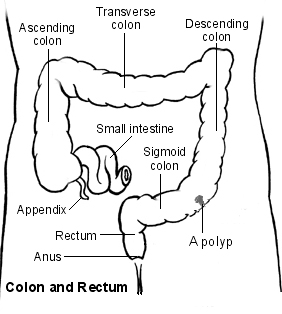
Most bowel polyps develop in the part of the colon called the descending colon, which leads down to the rectum. However, they can occur anywhere in the colon or rectum. Bowel polyps can be divided into three types: hyperplastic polyps, adenomas and polyposis syndromes.
Hyperplastic bowel polyps
These are a common type of bowel polyps. They are small - usually less than half a centimetre in diameter. They are generally regarded as harmless and only very rarely turn into cancer.
Adenomas
These too are a common type of bowel polyp. Most are small (usually less than a centimetre in diameter) but they can be bigger. There is a small risk that an adenoma may, in time, become cancerous. If one does turn cancerous, the change usually takes place after a number of years.
The relationship between polyps and cancer is that most bowel cancers (colorectal cancers) develop from a polyp that has been present for 5-15 years. In other words, although most adenomas do not become cancerous, the vast majority of cancers in the bowel initially develop from an adenoma that has been present for a number of years.
It is difficult to be certain of the exact risk of developing cancer from an adenoma. One study suggested that for a single 1 cm adenoma, the risk of it turning cancerous was about 1 in 12 after 10 years, and about a 1 in 4 after 20 years. However, the risk seems to vary depending on factors such as the size of the adenoma and the exact type of adenoma.
There are different types of adenoma and some types are more likely than others to develop into bowel cancer. See also the separate leaflet on Exame de Câncer de Intestino.
Síndromes de polipose
Polyposis syndromes are a group of inherited conditions. They include:
Familial adenomatous polyposis (FAP).
Hereditary nonpolyposis colorectal cancer (HNPCC)/Lynch's syndrome.
Gardner's syndrome.
Turcot's syndrome.
Síndrome de Peutz-Jeghers.
Cowden's disease.
Familial juvenile polyposis.
Hyperplastic polyposis.
These are rare syndromes. They cause polyps in young people and often cause multiple bowel polyps that have a high chance of developing into bowel cancer.
Bowel polyp symptoms
Most people with one or more bowel polyps do not have any symptoms. Most people who have a bowel polyp will never know they have one.
However, some people with bowel polyps will get symptoms. Polyps do not usually cause abdominal pain or a change in bowel habits. Symptoms include:
Blood in the stools (faeces). There may also be mucus in the stools.
Diarreia ou constipation, but this is much less likely than blood in the stools. Diarrhoea or constipation is much more likely to have a cause other than a bowel polyp.
Causes of bowel polyps
The lining of the bowel constantly renews itself throughout our lives. New cells are made in the lining of the bowel and these cells eventually die to be replaced by more new cells. Each of these cells contains genes which control how the cell works.
Family history may play a role, because if the gene doesn't work properly then some cells may grow more quickly. This may eventually cause a polyp to develop. Some faulty genes cause a tendency for the lining of the bowel to develop polyps or bowel cancer, which may be inherited from our parents.
How common are bowel polyps?
Bowel polyps are really common in older people. About 1 in 4 people over the age of 50 years develop at least one colonic polyp. Bowel polyps are much less common in younger people.
Some people develop just one bowel polyp. It is not uncommon to have two or more. However, having more than five polyps is unusual.
Fatores de risco
Risk factors include increasing age, being overweight and smoking. If you have a family history of a bowel polyp or cancer, or have had either of these yourself in the past, you are also at higher risk. Another risk factor is having inflammatory bowel disease (ulcerative colitis or Crohn's disease).
Diagnosing bowel polyps
Most bowel (colonic) polyps do not cause symptoms. So, most people with bowel polyps will not be diagnosed. Screening tests may be done if you have symptoms that indicate a bowel problem, or for various other reasons. For example, if you have seen blood in your stools (faeces) or if you are found to have blood in your stools following a routine screening test which is now offered to older people.
See the separate leaflet called Faecal Occult Blood Test for more details.
O que é uma colonoscopia?
Most bowel polyps are diagnosed by this procedure. Colonoscopy is a test where an operator - a doctor or a nurse - looks into your colon. A colonoscope is a thin, flexible telescope. It is about as thick as a little finger. It is passed through the anus and into the colon. It can be pushed all the way around the colon as far as the caecum (where the small and large intestine meet). The colonoscope contains fibre-optic channels which allow light to shine down so the operator can see inside your colon.
Consulte o folheto separado chamado Colonoscopia para mais detalhes.
A sample (biopsy) will be taken at the time of the colonoscopy. This is very important so that it can be checked whether the polyp is cancerous (malignant).
What about other tests?
Sometimes a bowel polyp is diagnosed by other tests:
A special X-ray test of the bowel - this procedure is called a barium enema.
A CT colonogram - air and a contrast dye are pumped into the bowel to make the anatomy clearer to see and you are then examined by a CT scanner.
A test procedure called sigmoidoscopia - this enables a doctor or nurse to use an instrument called a sigmoidoscope to look into the rectum and sigmoid colon. The procedure is similar to a colonoscopy but it uses a shorter telescope.
If a bowel polyp is seen on a barium enema or CT colonogram you will still need a colonoscopy to remove the polyp and to take a sample (biopsy) of it for further investigation. The advantage of a colonoscopy as the first test is that the biopsy can be taken and/or the polyp removed all at the same time.
You will also need a colonoscopy if a polyp is found when you have a sigmoidoscopy. This is to make sure there are no more polyps beyond the reach of sigmoidoscopy.
Treatments for bowel polyps
If you are diagnosed with a bowel polyp, you will usually be advised to have it removed, even if it is not causing any symptoms. This is because there is a small risk of the polyp developing into a cancerous (malignant) growth at some time in the future.
Colonoscopia
Most bowel polyps can be removed during a colonoscopy. The colonoscope has a side channel down which a grabbing device can be passed. This device can be manipulated by the operator. The operator can therefore see and also remove a polyp during a colonoscopy. The removal of the polyp is usually painless. Once removed, the bowel/colon polyp is sent to the laboratory to be looked at under a microscope. This is done to check:
That it has been completely removed.
The type of polyp.
Whether it is non-cancerous (benign) or showing signs of cancerous (malignant) change.
Most removed polyps will show full removal and be totally benign.
Your consultant will advise on the need for follow-up. This may depend on factors such as the size of the bowel polyp, the exact type of polyp that has been removed, the laboratory report about the polyp, and your age. Once these factors are considered, some people are advised to have regular colonoscopies in the future to make sure no more bowel polyps develop. As with any test, the results should be given to you by the team who arranged the test. So if you are not sure about how to access the results, phone or email your consultant's secretary, not your GP.
Cirurgia
If you have many bowel polyps (especially if you have a polyposis syndrome) then you may need to have an operation to remove part of your bowel. This is because it isn't possible to completely remove all the bowel polyps by using colonoscopy.
Preventing bowel polyps
Polyps cannot be prevented, but a healthy lifestyle (not smoking and not being overweight) can help to reduce your risk.
Escolhas do paciente para Bowel conditions

Saúde digestiva
Má absorção gastrointestinal
A síndrome de má absorção gastrointestinal significa a incapacidade de absorver completamente os alimentos digeridos do intestino (intestino) para o seu corpo. Existem muitas causas diferentes. A má absorção intestinal prolongada pode causar problemas devido à falta de carboidratos, proteínas, gorduras, minerais e vitaminas essenciais para manter a sua saúde. O tratamento dependerá da causa da má absorção, mas também incluirá suplementos e outras formas de compensar a quantidade reduzida de carboidratos, proteínas, gorduras, minerais e vitaminas que entram no seu trato gastrointestinal.
por Dra. Hayley Willacy, FRCGP

Saúde digestiva
Doença de Crohn
A doença de Crohn é uma condição que causa inflamação da parede do intestino (trato gastrointestinal). Qualquer parte do intestino pode ser afetada.
por Dr. Toni Hazell, FRCGP
Perguntas frequentes
Onde os pólipos intestinais ocorrem comumente?
Os pólipos intestinais desenvolvem-se mais frequentemente no cólon descendente, que leva ao reto. No entanto, eles podem se formar em qualquer parte do cólon ou reto.
Qual é o tamanho típico dos pólipos hiperplásicos do intestino e adenomas?
Pólipos hiperplásicos são geralmente pequenos, tipicamente com menos de meio centímetro de diâmetro. Adenomas também costumam ser pequenos, geralmente com menos de um centímetro, mas às vezes podem crescer mais.
O que é uma 'síndrome de polipose'?
As síndromes de polipose são um grupo de condições hereditárias incomuns que causam a formação de pólipos, muitas vezes em jovens, e geralmente envolvem múltiplos pólipos intestinais com alto risco de se desenvolverem em câncer intestinal. Exemplos incluem polipose adenomatosa familiar (PAF) e síndrome de Lynch.
O que acontece após a remoção de um pólipo intestinal durante uma colonoscopia?
Uma vez que um pólipo intestinal é removido, ele é enviado para um laboratório para exame ao microscópio. Isso é feito para confirmar que foi completamente removido, identificar seu tipo e verificar se é não cancerígeno ou se apresenta sinais de alteração cancerígena.
Vou precisar de consultas de acompanhamento após a remoção de um pólipo intestinal?
Seu consultor irá aconselhar se é necessário acompanhamento. Isso depende de fatores como o tamanho e o tipo do pólipo removido, o relatório de análise laboratorial e sua idade. Algumas pessoas podem ser aconselhadas a realizar colonoscopias regulares no futuro para monitorar novos pólipos.
Leitura adicional e referências
- Remoção combinada endoscópica e laparoscópica de pólipos do cólon; Diretrizes de procedimentos intervencionistas do NICE, setembro de 2014
- Câncer colorretal (gestão em pessoas com 18 anos ou mais); Diretrizes NICE (2020, última atualização em dezembro de 2021)
- Triagem intestinal; NICE CKS, maio de 2019 (acesso apenas no Reino Unido)
- Bonnington SN, Rutter MD; Surveillance of colonic polyps: Are we getting it right? World J Gastroenterol. 2016 Feb 14;22(6):1925-34. doi: 10.3748/wjg.v22.i6.1925.
Sobre o autorVer biografia completa
Atualizado por

Dr Toni Hazell, FRCGP
MBBS, BSc, FRCGP, DFSRH, Dip GU med, DRCOG, DCH (London, UK, 2000)
A Dra. Toni Hazell se formou na Escola de Medicina do Hospital St. Mary e fez seu VTS no Hospital Northwick Park.
Sobre o revisorVer biografia completa

Dr Colin Tidy, MRCGP
Médico Generalista, Autor Médico
MBBS, MRCGP, MRCP (Paediatrics), DCH
Dr Colin Tidy é um médico do NHS, baseado em Oxfordshire.
Profissionais de Saúde
Looking for more in-depth clinical detail? Our Professional Reference articles are written for doctors, nurses and other healthcare professionals. They include comprehensive clinical guidance, diagnostic information and UK/European evidence summaries. If you need the clinical version, you can read the Professional Reference article on this topic.
Compartilhe seus pensamentos ou experiências com outros em nosso comunidades de pacientes.
Acesso simples a tratamentos confiáveis e serviços de saúde online.
Common conditions
Get help with common conditions through the NHS, without a GP appointment.
 Sinusite aguda
 Amigdalite bacteriana
 Impetigo
 Mordidas de insetos
 Herpes zosterInfecção do trato urinário (ITUs)
Inscreva-se no boletim informativo do Patient
Sua dose semanal de conselhos de saúde claros e confiáveis - escritos para ajudá-lo a se sentir informado, confiante e no controle.
Ao se inscrever, você aceita nossos Política de Privacidade. Você pode cancelar a inscrição a qualquer momento. Nunca vendemos seus dados.