Scoliosis and kyphosis
Curvature of the spine
Peer reviewed by Dr Hayley Willacy, FRCGP Last updated by Dr Colin Tidy, MRCGPLast updated 16 Mar 2023
Meets Patient’s editorial guidelines
- DownloadDownload
- Share
- Language
- Discussion
- Audio Version
- Add to preferred sources on Google
Scoliosis is a back condition that causes the (back) spine to curve to the side - either left or right. Most cases develop in children between the ages of 9 and 14 years during the growth spurt of puberty. Scoliosis is usually mild and needs no treatment. For more severe cases treatments include specific exercises, a back brace or occasionally surgery to straighten the spine. A very pronounced front-to-back curve is called a kyphosis, which does not usually need treatment.
At a glance
Scoliosis is a sideways curve of the spine.
The curve can be mild or severe, and in different parts of the spine.
Most scoliosis cases have no known cause and often appear during puberty.
Symptoms can include a bulging back when bending or uneven shoulders/hips.
Regular monitoring, physiotherapy, a back brace, or surgery may be treatment options.
What is scoliosis?
Scoliosis
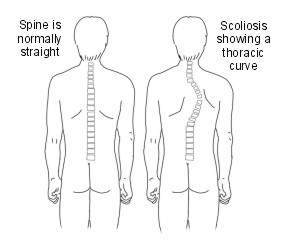
The word scoliosis comes from the Greek word meaning crooked. The back (spine) should look straight, up and down, when you look at someone from behind. If the spine has a sideways curve, it is called a scoliosis.
The curve can bend to the left or to the right. The severity of the curve can vary from very mild and barely noticeable to severe.
The curve can be in the lower part of the spine (a lumbar curve), in the upper part of the spine (a thoracic curve) or go from the upper to lower part of the spine (a thoracolumbar curve). In some cases there is a double curve - like an S shape.
What is the difference between scoliosis and kyphosis?
If you look at someone from the side, normally there are three slight front-to-back curves in the spine - one in the neck, one in the chest section and one in the lower back. An abnormal, more pronounced front-to-back curve is called a kyphosis. This is different to a scoliosis which isn't noticeable from the side.
What are the causes of kyphosis?
Kyphosis can occur at any age, although it is rare at birth. Adolescent kyphosis, is known as Scheuermann's disease.This type of kyphosis is caused by the wedging together in a row of several bones (vertebrae) of the back (spine). The cause of Scheuermann's disease is unknown.
In adults, various conditions affecting the spine can cause a higher risk of kyphosis, including:
Arthritis of the spine.
'Thinning' of the bones (osteoporosis) of the spine, if it has caused one or more of the bones in the spine to flatten (called a wedge-shaped fracture).
The treatment usually depends on the underlying cause. This is covered in the separate leaflets on those specific subjects - follow links in red.
What causes scoliosis?
There are several different types of scoliosis and the causes of each are different:
Non-structural scoliosis (functional or postural scoliosis)
In this type, the back (spine) is structurally normal, but looks curved because of another condition such as having one leg that is significantly longer than the other or muscle spasm in the back muscles. The curve is usually mild and it changes or goes away when the person bends sideways or forwards.
Structural scoliosis
In these cases, the curve is fixed and doesn't go away when the person changes position. There are different types:
Idiopathic. This means the cause is not known. For more than 8 out of every 10 people with scoliosis the cause is idiopathic.
Neuromuscular scoliosis. This means the curve is caused by a condition which affects muscles or nerves of the back. For example, it may happen in some people with muscular dystrophy, polio, cerebral palsy, or neurofibromatosis. Each of these conditions has other symptoms and problems in addition to a scoliosis. In around 1 out of every 10 people with scoliosis it is due to a neuromuscular problem.
Osteopathic. This means as a result of a bone abnormality.
Congenital scoliosis. This means the spine has not formed properly while the person was a baby developing in the womb. Around 1 in every 10 people with scoliosis have had it since birth.
The rest of this leaflet is about the most common type - idiopathic scoliosis.
Who develops idiopathic scoliosis?
Idiopathic scoliosis can develop at any stage in childhood. It is not known how or why it develops. It is not due to poor posture and you cannot prevent it starting.
It most commonly develops during the growth spurt of puberty and early adolescence. This is usually between the ages of 10-12 years for girls and 11-16 years for boys. About 1 in 40 children have some degree of scoliosis. Mild scoliosis affects about the same number of boys and girls. However, moderate or severe scoliosis is more common in girls.
Idiopathic scoliosis is not a straightforward hereditary condition. However, about 1 out of every 4 people affected with scoliosis have one or more other family members with the same condition.
Idiopathic scoliosis symptoms
In most cases the onset of the scoliosis is gradual and painless. Scoliosis is usually noticeable on bending down. Sometimes a mild-to-moderate scoliosis can develop without being noticed by the child or their parent/s. This is often because the condition usually develops during adolescence when children often become more self-conscious. Parents and others are less likely then to see a naked back (spine) and see the problem.
Scoliosis can cause mild pain and imbalance of the muscles. If scoliosis becomes more severe then it can become more disfiguring. This is because when the spine curves sideways, as the curve becomes more severe, the small bones (vertebrae) that make up the spine also twist around. This pulls any attached muscles, ligaments and ribs around with them. As a consequence:
If the scoliosis is in the chest (thoracic) region, the ribs and shoulder blades stick out like a bulge on one side of the back. Also, one shoulder may hang lower than the other and one shoulder blade may be higher than the other.
If the scoliosis is in the lower back (lumbar) region, it can make the pelvis thrust forward on one side and one leg may appear to be shorter than the other.
If scoliosis is not treated and becomes severe, it can cause problems later in life. For example, persistent back pain may develop and it can affect your general fitness and your overall quality of life. If the deformity is very severe, breathing problems or heart problems may develop - this is fortunately rare.
If a child has back pain it is very unlikely that it is due to scoliosis. For more common causes of children's back pain, see the separate leaflet called Back Pain in Children.
How is idiopathic scoliosis diagnosed?
Scoliosis diagnosis
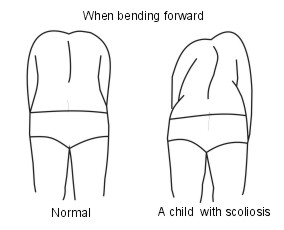
Scoliosis is often seen when you bend forward. A bulge on the back (spine) is more obvious when bending forward.
If your doctor diagnoses scoliosis then you will usually be referred to a specialist.
X-ray pictures of the back are sometimes done to assess the angle of the curve. This gives an idea of the severity of the condition and the likelihood of it getting worse. Other investigations - for example, magnetic resonance imaging (MRI) scanning or computerised tomography (CT) scanning of the neck - are needed in some cases.
What is the treatment for idiopathic scoliosis?
The aims of treating scoliosis are:
To prevent the curve becoming worse.
To avoid the need for surgery in later life.
To prevent breathing problems.
To improve how the spine looks.
People with more severe scoliosis may need treatment to stabilise the back (spine). Many people with scoliosis do not need treatment.
Treatment depends on various factors, such as:
The person's age.
Whether they are female or male - scoliosis in girls tends to worsen more quickly.
Whether they are still growing.
The severity of the curve.
The exact location of the scoliosis - for example, the upper (thoracic) or lower (lumbar) back.
The chance that scoliosis may progress.
Treatment options include observation, specific physiotherapy exercises, wearing a brace, and surgery. The international Scientific Society on Scoliosis Orthopaedic and Rehabilitation Treatment (SOSORT) recommend that non-surgical treatment should be delivered by a specialist team to include a doctor, physiotherapist, orthotist and possibly also a psychologist.
Observation
Most people have mild scoliosis and do not need any treatment. However, a specialist may arrange regular reviews to make sure that the scoliosis is not getting worse as children get older. Once the main bone growth ends after puberty, scoliosis does not usually worsen.
Sports and other activities can be done normally - there is some evidence that sport and exercise make people with scoliosis feel better about themselves and that they have fewer emotional problems. Occasionally, a specialist may advise against certain activities such as heavy contact sports or gymnastics.
Physiotherapy
Research that shows that specific exercises help to prevent scoliosis worsening has recently been published. The exercises are called physiotherapeutic scoliosis specific exercises (PSSE) and need to be performed from twice a week to daily and occasionally several times a day. This requires a lot of motivation.
Back braces
There are several different types of back brace. The more modern ones are more comfortable to wear than the older ones. If the scoliosis is moderate or becoming worse, then a back brace may be advised, either alone or in addition to PSSE. A brace does not cure a scoliosis. The aim of a brace is to prevent the scoliosis from becoming worse as the child grows. A brace is worn most of the day and night.
Towards the end of treatment they often only need to be worn at night. Most normal activities can be done whilst wearing a back brace. However, they need to be removed for washing and swimming. Wearing a back brace can be difficult for a young person to stick to. An expert team will involve them in the decision to wear a brace, so that they understand why they are doing it and what they are going to gain from it - if it isn't worn, it won't work.
Surgery
An operation is sometimes advised for people with severe scoliosis, although if a brace is worn it should be possible to prevent the need for surgery. The aim of the operation is to correct the curve, to stabilise the spine and also to fuse the curve. Spinal fusion is the joining of two or more back bones (vertebrae). Implants or rods are often used to keep the back straight after the operation. These rods are usually lengthened every 4-6 months as you grow.
There are different surgical techniques used. Your specialist will be able to advise which type of surgery, if any, may be beneficial for you. In general, the operations done for scoliosis are usually very long procedures and involve many months of recovery afterwards. Also, they are not always successful.
Alternative treatments
There is good-quality research that has shown that osteopathy does not help to resolve or improve scoliosis. There is also no reliable evidence that other techniques, such as chiropractic, reflexology, acupuncture, neurostimulation, are effective. However, some people with scoliosis find one or more of these complementary therapies to be useful to improve backache or pain.
Patient picks for Neck and spine disorders
Bones, joints and muscles
Torticollis
Torticollis means 'twisted neck'. It is also often called 'wry neck'.
by Dr Surangi Mendis, MRCGP
Bones, joints and muscles
Whiplash neck sprain
A whiplash neck sprain (also know as just whiplash) is common after a road traffic accident. Symptoms usually ease and go without any specific treatment. It is best to keep the neck active and moving. If required, painkillers can ease pain.
by Dr Doug McKechnie, MRCGP
Frequently asked questions
Can poor posture cause scoliosis?
No, idiopathic scoliosis, the most common type, is not caused by poor posture. It also cannot be prevented by consciously improving posture.
Is it normal for scoliosis to cause pain?
Scoliosis usually starts out as gradual and painless. While it can cause mild pain and muscle imbalance, back pain in children is very unlikely to be caused by scoliosis. If the condition becomes severe, persistent back pain can develop later in life.
How common is idiopathic scoliosis in children?
About 1 in 40 children have some degree of scoliosis. Mild scoliosis affects boys and girls equally, but moderate or severe cases are more common in girls.
Are there any alternative therapies that can cure or improve scoliosis?
Research has shown that osteopathy does not help resolve or improve scoliosis. There's also no reliable evidence that other techniques like chiropractic, reflexology, acupuncture, or neurostimulation are effective in treating the condition itself. However, some people find these complementary therapies useful for managing backache or pain associated with scoliosis.
Will my scoliosis get worse after puberty?
For most people, once the main bone growth ends after puberty, idiopathic scoliosis does not usually worsen.
Further reading and references
- Monticone M, Ambrosini E, Cazzaniga D, et al; Active self-correction and task-oriented exercises reduce spinal deformity and improve quality of life in subjects with mild adolescent idiopathic scoliosis. Results of a randomised controlled trial. Eur Spine J. 2014 Jun;23(6):1204-14. doi: 10.1007/s00586-014-3241-y. Epub 2014 Feb 28.
- Theis J, Gerdhem P, Abbott A; Quality of life outcomes in surgically treated adult scoliosis patients: a systematic review. Eur Spine J. 2014 Nov 8.
- Negrini S, Minozzi S, Bettany-Saltikov J, et al; Braces for idiopathic scoliosis in adolescents. Cochrane Database Syst Rev. 2015 Jun 18;(6):CD006850. doi: 10.1002/14651858.CD006850.pub3.
- Negrini S, Donzelli S, Aulisa AG, et al; 2016 SOSORT guidelines: orthopaedic and rehabilitation treatment of idiopathic scoliosis during growth. Scoliosis Spinal Disord. 2018 Jan 10;13:3. doi: 10.1186/s13013-017-0145-8. eCollection 2018.
- Bettany-Saltikov J, Turnbull D, Ng SY, et al; Management of Spinal Deformities and Evidence of Treatment Effectiveness. Open Orthop J. 2017 Dec 29;11:1521-1547. doi: 10.2174/1874325001711011521. eCollection 2017.
- Ali A, Fontanari V, Fontana M, et al; Spinal Deformities and Advancement in Corrective Orthoses. Bioengineering (Basel). 2020 Dec 25;8(1):2. doi: 10.3390/bioengineering8010002.
- Smith JS, Shaffrey CI, Ames CP, et al; Treatment of adult thoracolumbar spinal deformity: past, present, and future. J Neurosurg Spine. 2019 May 1;30(5):551-567. doi: 10.3171/2019.1.SPINE181494.
About the authorView full bio
Updated by

Dr Colin Tidy, MRCGP
General Practitioner, Medical Author
MBBS, MRCGP, MRCP (Paediatrics), DCH
Dr Colin Tidy is an NHS Doctor, based in Oxfordshire.
About the reviewerView full bio

Dr Hayley Willacy, FRCGP
General Practitioner, Medical Author
MBChB (1992), DRCOG, DFFP, MRCOG (Part 1) MRCGP (2007), DFSRH (2013), MSc - medical education (2020)
Dr Hayley Willacy was an NHS GP working in northwest England, who retired from clinical practice in 2022 after 30 years.
Join the conversation
Share your thoughts or experiences with others in our patient communities.

Ask, share, connect.
Browse discussions, ask questions, and share experiences across hundreds of health topics.

Feeling unwell?
Assess your symptoms online for free
Sign up to the Patient newsletter
Your weekly dose of clear, trustworthy health advice - written to help you feel informed, confident and in control.
By subscribing you accept our Privacy Policy. You can unsubscribe at any time. We never sell your data.