Back and spine pain
Peer reviewed by Dr Philippa Vincent, MRCGPLast updated by Dr Toni Hazell, FRCGPLast updated 17 Nov 2024
Meets Patient’s editorial guidelines
- DownloadDownload
- Share
- Language
- Discussion
- Audio Version
- Add to preferred sources on Google
In this series:Lower back painSlipped discSpinal stenosisCauda equina syndromeThoracic back painBack pain in children
Back pain is extremely common; most of us will have back pain at some point. Children can get back pain but it is more common in adults. This leaflet gives some general information about the back and back pain. It will also direct you to pages with more detailed information on the different conditions that can cause back pain.
At a glance
Back pain can be felt anywhere from the bottom of the neck to the bottom.
It can range from mild to severe, and may or may not have an obvious cause.
Common causes include simple muscular pain, slipped discs, and thoracic back pain.
Keep active and take painkillers if needed for pain relief and treatment.
See a doctor if pain lasts over 4-6 weeks, or if symptoms change or worsen.
Seek immediate medical advice if you suspect cauda equina syndrome.
Understanding the back
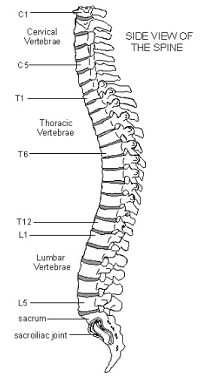
The spine is made up of many bones called vertebrae. These are roughly circular and between each vertebra is a disc. The discs are made of strong rubber-like tissue which allows the spine to be fairly flexible. A disc has a stronger fibrous outer part and a softer jelly-like middle part. The middle part is called the nucleus pulposus.
Strong ligaments also attach to next-door (adjacent) vertebrae to give extra support and strength to the spine. There are various muscles that are attached to the spine which enable the spine to bend and move in various ways. Small joints, called facet joints, help to attach the vertebrae to each other. The sacrum is formed from five vertebrae that are joined together (fused) to make one bone. The sacroiliac joints are the large joints that join the sacrum to the main bone of the pelvis (the ilium).
Spinal cord
Close-up diagram lumbar spinal cord
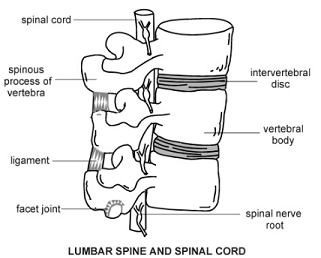
The spinal cord, which contains the nerves that come from the brain, is protected by the spine. Nerves from the spinal cord come out from between the vertebrae to relay messages to and from various parts of the body. The lower end of the spinal cord is at the level of the first or second lumbar vertebra. Below this, the nerves from the last part of the spinal cord branch to form what is called the cauda equina (from the Latin for a horse's tail).
Back pain causes (aetiology of back pain)
Common causes
Simple or nonspecific/muscular lower back pain:
This is the most common type of back pain and is often felt more as discomfort in the back.
It isn't possible to say exactly what the cause is of lower back pain but there is rarely any serious problem with the back.
Slipped disc, sometimes called prolapsed disc or sciatica:
Often causes severe back pain.
Pain is due to the tissues from a disc pressing on the structures nearby - for example, nerves, when the pain is called nerve root pain. For this reason it is sometimes called a trapped nerve.
May cause sciatica, which is pain that goes down the leg to the foot.
See the separate leaflet called Slipped disc (Prolapsed disc).
Thoracic back pain:
Thoracic back pain is more likely than lower back pain to have a serious cause.
It is more common in young people, possibly due to carrying heavy school bags, when it is not serious.
Less common causes
Arthritis (joint inflammation) of all types can cause back pain:
Osteoarthritis is a common type of arthritis that affects people as they get older. It can be a cause of back pain.
Spinal stenosis is a common cause of pain in the buttocks and legs, although it doesn't always cause back pain:
It mainly affects people aged over 60 years.
It is often caused by osteoarthritis of the spine.
Rheumatoid arthritis is a much less common type of arthritis. It can occasionally affect the spine.
Ankylosing spondylitis is a form of arthritis that mainly affects the spine:
It can affect other joints and other parts of the body.
Fracture of a vertebra:
Road traffic accidents, falls, sports injuries and violent attacks can all lead to fractures of the spine causing back pain.
Causes bones to be more likely to break with a minor injury.
May cause thoracic back pain, as well as low back pain.
Is more common in the elderly, particularly women.
Is more common in people on steroid medication.
Shingles:
Shingles is a common infection, which can cause pain before any sign of the typical rash.
Scoliosis of the spine:
Scoliosis causes the spine to curve to the left or right side.
It is often painless, but may cause back pain.
See the separate leaflet called Scoliosis and kyphosis (Curvature of the spine).
Rare causes
Tumours.
Infection - for example, tuberculosis.
Cauda equina syndrome:
This is a rare but serious type of nerve root problem.
The nerves at the bottom end of the spine are squashed causing:
Low back pain.
Problems with the bowel and bladder (usually not being able to pass urine).
Numbness in the 'saddle' area, which is around the back passage (anus).
Weakness in one or both legs.
Pain relief for back pain
Usually back pain settles down quickly, improving within a week or so and being gone by 4-6 weeks.
You should try to keep as active as you can and do your normal activities, if possible - the old advice of resting until the pain eases has been proven to be wrong and too much rest can be harmful.
If the pain is stopping you from being able to keep moving then you should take painkillers regularly so that you can keep active.
Back pain treatment
Aside from keeping active and taking painkillers if necessary, there are many other possible treatments. Which treatment is suitable for you may depend on the cause of your pain.
Structured exercise programme.
Manual therapy, including massage and spinal manipulation may help symptoms in some people.
Cognitive behavioural therapy (CBT) may be useful in some people with long-standing (chronic) back pain.
Spinal injections.
Surgery:
This is rarely needed.
About one person in every ten with a slipped disc (prolapsed disc) may benefit from surgery.
May be needed urgently for cauda equina syndrome.
See separate leaflets on the different causes of back pain for more details of other possible treatments.
Frequently Asked Questions
What are the symptoms of back pain?
Back pain is pain that is felt anywhere from the bottom of the neck to your bottom. It can range from mild and fleeting to severe or long-lasting. It can come on for an obvious reason - such as after a fall or lifting something very heavy or awkward - or it can just come on for no reason at all.
Sometimes back pain causes other symptoms:
Pain in the leg or foot.
Pain in the buttock or thigh.
Weakness in one or both legs.
Pins and needles in one or both legs.
Other sensations in the legs, such as warmth or a burning feeling.
Who gets back pain?
Everyone can get back pain at some time in their life. The most common type of back pain, low back pain, affects about 8 in 10 people. Back pain even occurs in children: 3 out of every 10 young people have had pain in their back.
If you suspect cauda equina syndrome you should see a doctor immediately.
Do I need any tests?
This depends on what is thought to be the cause of your back pain. Your doctor will usually be able to tell what the likeliest cause is of your pain, simply by talking to you and examining you. If you haven't had your back pain for very long and your doctor doesn't think it is serious, you are unlikely to need any tests. Most people do not need an MRI scan of their back - having an MRI can cause harm by finding something which is not actually related to the pain and which may lead to unnecessary treatment that can cause harm.
The pain is more likely to have a serious cause if it is constant and becoming worse, if it wakes you up at night, if you are older or if you are unwell in other ways, such as having a temperature or losing weight. In this case you may need further tests, such as:
When should I seek medical advice?
Generally if your pain lasts longer than 4-6 weeks or if your symptoms change, you should see a doctor.
Other reasons for seeking medical advice are:
You suspect cauda equina syndrome (see above):
Seek immediate medical advice.
Your pain is constant and is not eased by lying down or resting.
Your pain is gradually becoming worse and worse.
You are experiencing weakness in any of your muscles in your leg or foot or you are tripping up (which can be a symptom of weak ankle muscles).
You have a lack of feeling (numbness) in any part of your bottom or leg.
Your pain started after a road accident or a fall.
You have been diagnosed with osteoporosis.
You have recently taken or are still taking steroid medication.
Your pain is worst in the early hours of the morning and on waking and is eased by activity.
How can I avoid back pain?
In general, you should try to keep fit and active and exercise regularly - swimming, walking, running and cycling are all excellent forms of exercise. However not all forms of back pain can be avoided. Also it isn't known why some people develop back pain and some people never do.
What is the outlook (prognosis)?
Most people with back pain that doesn't have a serious cause, get better fairly quickly, often within a week or so. If you have low back pain (including pain caused by a disc problem), you will recover quicker if you can get moving again quickly and get back to work as soon as you are able.
It is common to have further bouts (recurrences).
Patient picks for Neck and spine disorders
Bones, joints and muscles
Whiplash neck sprain
A whiplash neck sprain (also know as just whiplash) is common after a road traffic accident. Symptoms usually ease and go without any specific treatment. It is best to keep the neck active and moving. If required, painkillers can ease pain.
by Dr Doug McKechnie, MRCGP
Bones, joints and muscles
Scoliosis and kyphosis
Scoliosis is a back condition that causes the (back) spine to curve to the side - either left or right. Most cases develop in children between the ages of 9 and 14 years during the growth spurt of puberty. Scoliosis is usually mild and needs no treatment. For more severe cases treatments include specific exercises, a back brace or occasionally surgery to straighten the spine. A very pronounced front-to-back curve is called a kyphosis, which does not usually need treatment.
by Dr Colin Tidy, MRCGP
Frequently asked questions
What is the difference between simple lower back pain and a slipped disc?
Simple or nonspecific lower back pain is the most common type and is often felt as general discomfort, with no clear serious problem. A slipped disc, also known as a prolapsed disc or sciatica, typically causes severe back pain due to the disc's tissues pressing on nearby structures, such as nerves, which can lead to pain radiating down the leg to the foot.
Can shingles cause back pain before a rash appears?
Yes, shingles is a common infection that can cause back pain even before the typical rash associated with the condition becomes visible.
Is it true that resting is the best way to recover from back pain?
No, the old advice of resting until the pain eases has been shown to be incorrect. It's important to try and stay as active as possible and continue with your normal activities. Too much rest can actually be harmful. Taking painkillers can help you stay active if the pain is too severe.
Besides keeping active and taking painkillers, what other treatments are available for back pain?
Other potential treatments for back pain include structured exercise programmes, manual therapies like massage and spinal manipulation. For people with long-standing (chronic) back pain, cognitive behavioural therapy (CBT) might be useful. In some cases, spinal injections or surgery may be considered, though surgery is rarely needed.
What types of back pain are more likely to have a serious underlying cause?
Thoracic back pain (in the upper back) is more likely to have a serious cause than lower back pain. Also, if your pain is constant and worsening, wakes you up at night, or if you are older or feel unwell with symptoms like a temperature or weight loss, it might indicate a more serious cause.
Further reading and references
- Low back pain and sciatica in over 16s: assessment and management; NICE Guidelines (November 2016 - last updated December 2020)
- Trompeter K, Fett D, Platen P; Prevalence of Back Pain in Sports: A Systematic Review of the Literature. Sports Med. 2017 Jun;47(6):1183-1207. doi: 10.1007/s40279-016-0645-3.
- Back pain - low (without radiculopathy); NICE CKS, September 2023 (UK access only)
- Sciatica (lumbar radiculopathy); NICE CKS, September 2023 (UK access only)
About the authorView full bio

Dr Toni Hazell, FRCGP
MBBS, BSc, FRCGP, DFSRH, Dip GU med, DRCOG, DCH (London, UK, 2000)
Dr. Toni Hazell qualified from St. Mary’s Hospital Medical School and did her VTS at Northwick Park Hospital.
About the reviewerView full bio

Dr Philippa Vincent, MRCGP
General Practitioner, Medical Author
MB BS, Bsc, MRCGP (2000), DCH, DFSRH, DRCOG
Dr Philippa Vincent is an NHS GP working in North London.
Article history
Article also available in English, German, Spanish, French, Italian, Portuguese, Hindi, Hebrew, Arabic, and Swedish.
Next review due: 16 Nov 2027
17 Nov 2024 | Latest version
Join the conversation
Share your thoughts or experiences with others in our patient communities.

Ask, share, connect.
Browse discussions, ask questions, and share experiences across hundreds of health topics.

Feeling unwell?
Assess your symptoms online for free
Sign up to the Patient newsletter
Your weekly dose of clear, trustworthy health advice - written to help you feel informed, confident and in control.
By subscribing you accept our Privacy Policy. You can unsubscribe at any time. We never sell your data.
More in bones, joints and muscles
- Biological medicines for rheumatoid arthritis
- Dislocation
- Fibromyalgia
- Frozen shoulder
- Groin strain
- Hypermobility spectrum disorders
- Leg cramps
- Multiple sclerosis
- Olecranon bursitis
- Osteoarthritis
- Osteomyelitis
- Pins and needles
- Preventing steroid-induced osteoporosis
- Recovering from a pelvic fracture
- Repetitive strain injury
- Septic arthritis
- Slipped disc
- Spinal anaesthetic
- Sports injuries
- Systemic sclerosis