Entrópio
Revisado por Dr Colin Tidy, MRCGPÚltima atualização por Dr Hayley Willacy, FRCGP Última atualização 6 Mar 2025
Atende aos diretrizes editoriais
- BaixarBaixar
- Compartilhar
- Language
- Discussão
- Versão em Áudio
- Adicionar às fontes preferidas no Google
Nesta série:Olhos lacrimejantes
Um entrópio ocorre quando sua pálpebra se volta para o olho. Os cílios então esfregam contra a parte frontal do seu olho (córnea). Irritação, dor e lacrimejamento do olho são os principais sintomas. Colar a pálpebra na bochecha, pomada lubrificante para os olhos e, às vezes, injeções de toxina botulínica ajudam a controlar os sintomas. As pessoas frequentemente precisam de cirurgia se o problema persistir.
Em resumo
Entropion is a condition where an eyelid turns inwards towards the eye.
This causes eyelashes to rub against the front of the eye, which can be irritating and painful.
Entropion mainly affects older people due to muscle weakness around the eyelid.
Eye ointment or eyelid taping can help temporarily.
Surgery can correct the eyelid position, stopping eyelashes from rubbing on the eye.
Untreated entropion can damage the front of your eye and affect eyesight.
Entrópio e triquíase
Olho com entrópio
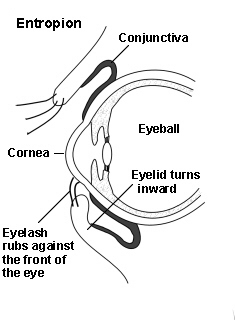
Um entrópio ocorre quando uma pálpebra se vira para dentro em direção ao seu olho. Isso faz com que os cílios esfreguem contra a parte frontal do seu olho (a córnea). Triquíase é o termo médico usado para descrever os cílios que se voltam contra a parte frontal do olho. A pálpebra inferior é a mais comumente afetada.
Sintomas de entrópio
Irritação e dor na parte da frente do olho.
Olho lacrimejante.
If left untreated, the front of the eye (the cornea) may become damaged (a corneal ulcer may develop). The cornea is vital for vision and a córnea danificada may affect eyesight.
Causas do entrópio
No Reino Unido, o entrópio ocorre principalmente em pessoas idosas, associado à fraqueza dos pequenos músculos ao redor da pálpebra.
A principal causa de entrópio em todo o mundo é o tracoma. Esta é uma infecção comum em países tropicais, que afeta a parte frontal do olho. Isso pode levar a cicatrizes e alterações na pálpebra, fazendo com que ela se vire para dentro.
Causas menos comuns incluem cicatrizes (de infecções oculares, trauma, síndrome de Stevens-Johnson ou danos químicos) ou espasmo muscular (espasticidade). Raramente, você pode nascer com um defeito que faz a pálpebra virar para dentro.
Tratamento do entrópio
Se a causa for provavelmente temporária, como uma infecção ou lesão leve, o seguinte pode ser suficiente até que a condição se recupere:
Taping the eyelid to your cheek; ou
Injetando os músculos da sua pálpebra com toxina botulínica.
O unguento ocular lubrificante é frequentemente prescrito enquanto isso para proteger a parte frontal do seu olho (córnea).
O que é a cirurgia de correção de entrópio?
If you have a condition which is unlikely to recover by itself, you will be offered surgery. A small operation is performed to virar a pálpebra para trás to its normal position. This stops the eyelashes from rubbing on the eye. The operation is usually successful and prevents any further damage to the front of the eye.
Dr. Mary Lowth é autora ou a autora original deste folheto.
Escolhas do paciente para Problemas nas pálpebras

Saúde ocular
Blefaroespasmo
Blepharospasm is a condition in which blinking or spasmodic closing of the eyes occurs at an increased rate. It ranges from a mild, embarrassing condition of twitching or fluttering of an eyelid to severe spasms of eye closure which interrupt useful vision. Secondary blepharospasm is a common response to many common eye conditions, and can be caused by some conditions affecting the nervous system. This leaflet is mainly about primary blepharospasm, also called benign essential blepharospasm (BEB). BEB cannot be cured, but is usually successfully managed with botulinum toxin injections, repeated at intervals. In the UK, if you have blepharospasm you must notify the Driver and Vehicle Licensing Agency (DVLA).
por Dra. Hayley Willacy, FRCGP
Saúde ocular
Pálpebra inchada
A swollen eyelid is very common and is usually due to allergy, inflammation, infection, or injury. It can affect either the upper or lower eyelid, or both.
por Dra. Caroline Wiggins, MRCGP
Perguntas frequentes
Which eyelid is most commonly affected by entropion?
The lower eyelid is most commonly affected by entropion.
What is trachoma and how does it relate to entropion?
Trachoma is a common infection in tropical countries that affects the front of the eye. It can lead to scarring and disruption of the eyelid, causing it to turn inwards, and is the main worldwide cause of entropion.
Can children be born with entropion?
Yes, although rarely, some individuals can be born with a defect that causes the eyelid to turn inwards.
How does botulinum toxin help treat entropion?
Botulinum toxin can be injected into the muscles of the eyelid to help correct entropion, especially if the cause is expected to be temporary.
What is the purpose of lubricating eye ointment when treating entropion?
Lubricating eye ointment is often prescribed to protect the front of your eye (the cornea) from irritation and potential damage while waiting for entropion treatment to take effect or for the condition to recover.
Leitura adicional e referências
- Khan AZ, Ueland HO, Bohman E, et al; Entropion. Tidsskr Nor Laegeforen. 2024 Dec 16;144(15). doi: 10.4045/tidsskr.24.0191. Print 2024 Dec 17.
- Deka A, Saikia SP; Toxina botulínica para correção de entrópio da pálpebra inferior. Orbit. 2011 Jan;30(1):40-2.
- Boboridis KG, Bunce C; Intervenções para entrópio involucional da pálpebra inferior. Cochrane Database Syst Rev. 7 de dezembro de 2011;(12):CD002221. doi: 10.1002/14651858.CD002221.pub2.
- Bergstrom R, Czyz CN; Eyelid Reconstruction, Entropion. StatPearls Publishing; 2023.
Sobre o autorVer biografia completa

Dr Hayley Willacy, FRCGP
Médico Generalista, Autor Médico
MBChB (1992), DRCOG, DFFP, MRCOG (Part 1) MRCGP (2007), DFSRH (2013), MSc - medical education (2020)
A Dra. Hayley Willacy era uma médica do NHS atuando no noroeste da Inglaterra, que se aposentou da prática clínica em 2022 após 30 anos.
Sobre o revisorVer biografia completa

Dr Colin Tidy, MRCGP
Médico Generalista, Autor Médico
MBBS, MRCGP, MRCP (Paediatrics), DCH
Dr Colin Tidy é um médico do NHS, baseado em Oxfordshire.
Histórico do artigo
As informações nesta página são escritas e revisadas por clínicos qualificados.
Artigo também disponível em Inglês, Alemão, Espanhol, Francês, Italiano, Português, Hindi, Hebraico, Árabe, e Sueco.
Próxima revisão prevista para: 5 Mar 2028
6 Mar 2025 | Última versão

Pergunte, compartilhe, conecte-se.
Navegue por discussões, faça perguntas e compartilhe experiências em centenas de tópicos de saúde.

Sentindo-se mal?
Avalie seus sintomas online gratuitamente
Inscreva-se no boletim informativo do Patient
Sua dose semanal de conselhos de saúde claros e confiáveis - escritos para ajudá-lo a se sentir informado, confiante e no controle.
Ao se inscrever, você aceita nossos Política de Privacidade. Você pode cancelar a inscrição a qualquer momento. Nunca vendemos seus dados.
Mais sobre saúde ocular
- Glaucoma de ângulo fechado agudo
- Ambliopia (olho preguiçoso)
- Catarata
- Calázio
- Deficiência de visão de cores
- Lentes de contato
- Episclerite e esclerite
- Manchas nos olhos, flashes e halos
- Arterite de células gigantes
- Glaucoma
- Febre do feno
- Alergia a ácaros e animais de estimação
- Hipermetropia
- Hipertensão intracraniana idiopática
- Conjuntivite infecciosa
- Miopia
- Uveíte
- Problemas visuais
- Hemorragia vítrea