Watering eyes
Epiphora
Peer reviewed by Dr Colin Tidy, MRCGPLast updated by Dr Hayley Willacy, FRCGP Last updated 21 Feb 2023
Meets Patient’s editorial guidelines
- DownloadDownload
- Share
- Language
- Discussion
- Audio Version
- Add to preferred sources on Google
In this series:Entropion
Watering eyes are common and can affect anyone. A blocked tear duct is the most common cause, especially in babies and older people, but there are a number of other causes. They usually get better on their own.
Key points
Watering eyes (epiphora) happen when too many tears are made or when tears can’t drain away properly because the drainage system is blocked.
Common causes of watery eyes include eye irritation, infections, blocked tear ducts, or eyelid problems (such as entropion or ectropion).
Tests including probing, syringing, or dye injection can be performed at an eye clinic to help find where the tear drainage is blocked or what else is the cause of your watery eyes.
Treatment depends on the cause - mild cases often settle on their own, while blocked ducts may need a small surgical procedure to fix the drainage.
Causes of watering eyes
Overactive tear ducts
Anything that irritates the eye can cause you to produce excess tears. The watering is a protective reflex to help clear irritants away from the eye. For example:
Chemical irritants such as onions or fumes from machines.
Eye infection in the front of the eye (infection conjunctivitis).
Allergy causing inflammation of the front of the eye (allergic conjunctivitis).
A small injury or scratch to the front of the eye, or a piece of dirt or grit which gets stuck in the eye.
Blocked drainage of tears
This is pretty common in babies: their tear ducts tend to be a bit narrow and can't handle all their tears (and babies do cry a lot). Babies' tears are quite thick and if they're blocked, they get a bit gunky. That's why a lot of babies have gunky eyes, even though there's no infection. It usually clears by itself in a few months, or certainly by the age of 1 year. All you need to do is wipe away the gunk with a clean cotton wool pad and warm water. See the separate leaflet called Tear Duct Blockage in Babies for more information about this.
In elderly people their tear ducts often get narrower with age. So the tears can't drain away properly, making their eyes very watery. Occasionally the blocked tear duct gets a mild infection and makes the skin just between the nose and eye red and sore.
Problems with eyelashes or eyelids
In the elderly the eyelashes can turn inwards, scratching the eyeball and making it sore and watery. This is called entropion and can be corrected with surgery.
Because the eyelids can become a bit lax and relaxed with age, the lower eyelids can droop outwards. Then tears just drop out of the eye instead of draining away down the tear ducts. This is called ectropion and can be corrected with surgery.
How tears work
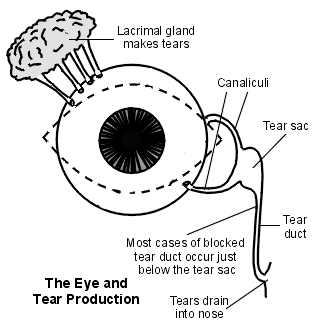
Just above, and to the outer side of, each eye is a small gland called the lacrimal gland. This constantly makes a small amount of tears. When you blink, the eyelid spreads the tears over the front of the eye to keep it moist.
The tears then drain down tiny holes (called canaliculi) on the inner side of the eye into a tear sac. From here they flow down a channel called the tear duct (the nasolacrimal duct) into the nose. This diagram shows how tears usually drain away:
Close-up view
What tests do I need for watering eyes?
Usually the cause is easily identified - for example, infections, ectropion, entropion, and conjunctivitis. If there is no obvious cause revealed by a simple examination, further tests may be advised. These may depend on how bad the watering is, and how much it bothers you.
If a drainage problem is suspected, an eye specialist may examine the tear drainage channels, under local anaesthetic. They may push a thin stick (probe) into the small channels (canaliculi) towards the tear sac to see if it is blocked. If the probe goes as far as the tear sac then fluid can be syringed into the tear duct to see if it comes out in the nose.
Syringing may sometimes clear a blockage, but it may only give temporary relief. If there seems to be a blockage then a dye may be injected into the tear duct. An X-ray picture is then taken. You can see the dye in the duct on the X-ray film. It will show exactly where there is any obstruction or narrowing of the tear duct.
Other scans - for example, a computerised tomography (CT) or magnetic resonance imaging (MRI) scan - may be undertaken in some cases. An eye specialist will be able to advise you.
Treatment for watering eyes (epiphora)
Treating eye irritation
Quite often the cause of watery eyes can be treated. For example:
Eyelashes irritating the front of the eye (entropion) can be removed.
Conjunctivitis can usually be treated with drops.
Pieces of grit, etc, can be removed.
Treating tear drainage problems
Babies with watering eyes usually grow out of it with no treatment.
Blockage of the channels in adults:
You may not need treatment if the watering is mild or does not bother you much.
A blocked tear duct can be treated with an operation. The usual operation is called dacrocystorhinostomy (DCR). A tiny probe is passed through the blocked tear duct and can unblock it.
DCR surgery is worthwhile if the watering is bad enough to interfere with your activities of daily living. It is also recommended if you have had an infection in your tear sac as a result of the blocked tear duct. The surgery may prevent repeated attacks of a red, painful swelling at the corner of your eye.
The surgery is not without its risks and should only be done if you fully understand the pros and cons.
A narrowed small channel (canaliculus) which is not fully blocked may be widened by pushing in a probe.
Frequently asked questions
How can I make my eyes stop watering?
You can help stop your eyes from watering by avoiding triggers such as smoke, wind, and allergens, and by using lubricating eye drops if your eyes are dry. Applying a warm compress can also help if blocked tear ducts are the cause. If symptoms don’t improve, speak to your doctor or optician.
What is the best medicine for watery eyes?
The best medicine for watery eyes depends on the cause. Antihistamine eye drops can help if allergies are the cause, while antibiotic drops may be needed for infections. If the problem is due to dryness or blocked tear ducts, lubricating drops or prescription treatments may be more effective.
When should I see a doctor about watery eyes?
You should see a doctor about watery eyes if the problem lasts more than a few days, affects your vision, or is accompanied by pain, redness, or discharge. Persistent or severe symptoms may indicate an infection, blocked tear duct, or another underlying eye condition that needs medical attention.
Patient picks for General signs and symptoms

Signs and symptoms
Pelvic pain in women
Pelvic pain is more common in women. There are many different causes of pain in your pelvic area. They can be separated by when they tend to happen, if you are pregnant and if they are accompanied by other symptoms such as vaginal bleeding. The most common causes are mentioned below. Most will improve with painkillers. Most recurring causes have treatments available.
by Dr Hayley Willacy, FRCGP

Signs and symptoms
Tinnitus
Tinnitus is a noise such as a ringing or buzzing that you can hear, but the noise is not caused by anything outside your ear.
by Dr Doug McKechnie, MRCGP
Further reading and references
- Shams PN, Chen PG, Wormald PJ, et al; Management of functional epiphora in patients with an anatomically patent dacryocystorhinostomy. JAMA Ophthalmol. 2014 Sep 1;132(9):1127-32. doi: 10.1001/jamaophthalmol.2014.1093.
- Nasolacrimal duct obstruction (nasolacrimal drainage dysfunction); College of Optometrists, March 2016
- Alam MS, Kundu D; Is dacryocystectomy effective in reducing epiphora? Indian J Ophthalmol. 2022 Dec;70(12):4416-4418. doi: 10.4103/ijo.IJO_972_22.
About the authorView full bio

Dr Hayley Willacy, FRCGP
General Practitioner, Medical Author
MBChB (1992), DRCOG, DFFP, MRCOG (Part 1) MRCGP (2007), DFSRH (2013), MSc - medical education (2020)
Dr Hayley Willacy was an NHS GP working in northwest England, who retired from clinical practice in 2022 after 30 years.
About the reviewerView full bio

Dr Colin Tidy, MRCGP
General Practitioner, Medical Author
MBBS, MRCGP, MRCP (Paediatrics), DCH
Dr Colin Tidy is an NHS Doctor, based in Oxfordshire.
Article history
Article also available in English, German, Spanish, French, Italian, Portuguese, Hindi, Hebrew, Arabic, and Swedish.
Next review due: 20 Feb 2028
21 Feb 2023 | Latest version
Join the conversation
Share your thoughts or experiences with others in our patient communities.

Ask, share, connect.
Browse discussions, ask questions, and share experiences across hundreds of health topics.

Feeling unwell?
Assess your symptoms online for free
Sign up to the Patient newsletter
Your weekly dose of clear, trustworthy health advice - written to help you feel informed, confident and in control.
By subscribing you accept our Privacy Policy. You can unsubscribe at any time. We never sell your data.
More in signs and symptoms
- Blood in urine
- Bornholm disease
- Chest pain
- Chronic pain
- Cluster headaches
- Costochondritis
- Coughing up blood
- Dry mouth
- Epidermoid and pilar cysts
- Globus sensation
- Headache
- Idiopathic oedema
- Insect bites and stings
- Loss of appetite
- Medication-overuse headache
- Ménière's disease
- Tension headache
- Vaginal dryness
- Vertigo
- Vomiting blood