Colour vision deficiency
Colour blindness
Peer reviewed by Dr Colin Tidy, MRCGPLast updated by Dr Hayley Willacy, FRCGP Last updated 5 Mar 2025
Meets Patient’s editorial guidelines
- DownloadDownload
- Share
- Language
- Discussion
- Audio Version
- Add to preferred sources on Google
Colour vision deficiency, also called colour blindness, is when you are unable to see certain colours. The most common form of the condition is red-green colour vision deficiency.
Key points
Colour vision deficiency (colour blindness) means you find it hard to tell certain colours apart, most often reds, greens, and sometimes blues.
It’s usually inherited and present from birth, though it can also develop later due to eye disease, ageing, or certain medications.
There’s no cure, but most people adapt well by using special colour filters, tinted lenses, or apps that can help distinguish colours more easily.
Colour vision deficiency can be diagnosed from an eye test called the Ishihara test.
What is colour vision deficiency?
Colour vision deficiency, or colour blindness, is when you have difficulty seeing or telling the difference between certain colours.
There are different types of colour vision deficiency. For example, you may be unable to tell red from green or blue from yellow. Red-green colour blindness is by far the most common form.
The effects of colour vision deficiency can be variable - from mild to severe. Some people with colour vision deficiency don't even know they've got it. Others may have a lot of difficulty and be unable to work in certain jobs.
How do we see colour?
Different colours are seen by special cells in the retina at the back of your eye. There are two types of cells, called rods and cones. Cones are concerned with colour vision. There are three types of cones: red cones, blue cones and green cones.
Side view of the structure of the eye
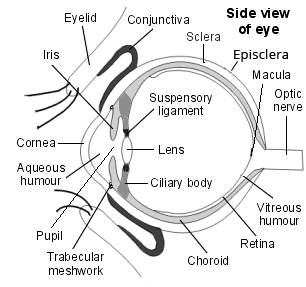
Each type of cone senses a different range of light. Therefore the combination of light sensed by the different cones allows you to know the colour you are looking at. For example, stimulation of green and red cones makes you see green. If all three types of cone are stimulated then you see white.
If you don't have any of the three types of cone then you will only be able to see black, white and shades of grey. But this severe form of colour blindness is very rare.
What are the causes of colour vision deficiency?
For most people with colour vision deficiency the cause is inherited (genetic) and the special code inside each cell in your body (the gene) is passed on from your parents. The most common type - red-green colour blindness - is caused by an abnormal gene on the X chromosome and is much more common in males.
Much more rarely colour vision deficiency can develop later in life as a result of conditions such as:
DNA, genes and chromosomes
In most cells of your body you have 46 chromosomes arranged in 23 pairs. 22 of the pairs are matching pairs. The 23rd pair of chromosomes are the sex chromosomes, which match exactly in women (who have two X chromosomes) but not in men - who have one X and one Y.
One chromosome from each pair comes from your mother and one from your father. Chromosomes are made of DNA, which stands for 'deoxyribonucleic acid'. This is your genetic material. It is found in the nucleus of every cell in your body.
Each of your 46 chromosomes carries hundreds of genes. A gene is the basic unit of your genetic material. It is made up of a piece (a sequence) of DNA and sits at a particular place on a chromosome. So, a gene is a small section of a chromosome.
A gene is effectively a coded set of instructions to the cells. Each gene has a particular function in your body. For example, a gene may be involved in dictating your eye colour or determining your height. Each gene has a matching 'paired' gene on the paired chromosome. So, as for chromosomes, one gene from each pair is inherited from your mother, the other from your father. Humans have between 20,000 and 25,000 genes.
How is colour vision deficiency diagnosed?
Colour vision deficiency is usually first diagnosed using special coloured pictures called Ishihara plates. The Ishihara plate has 16 different diagrams made up of dots to show a number. The Ishihara plate below is used to assess red-green colour vision. People with red-green colour vision deficiency will not be able to see the number clearly.
Ishahara plate
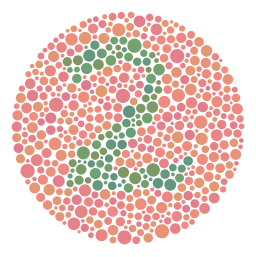
(For more information see the link to 'Online colour vision tests' in Further reading below).
Can colour vision deficiency be treated?
There is no treatment that can correct or prevent inherited (genetic) colour vision deficiencies.
Colour blindness may be caused by an underlying condition such as thyroid disease or diabetes. The colour vision deficiency may improve with treatment for the underlying condition.
How common is colour vision deficiency?
Colour blindness affects about 1 in 12 men and 1 in 200 women. It is much more common in men because the most common form (red-green colour vision deficiency) is passed on in a gene on the X chromosome (see below for further explanation).
What problems can colour vision deficiency cause?
Nearly all people with colour blindness can see things as clearly as other people but they cannot see certain colours clearly. If you have red-green colour vision deficiency you will not be able to clearly see any colour which has some red or green as part of the whole colour. For example, you will confuse blue and purple (because red and blue make purple).
The effects of colour blindness can be variable, ranging from mild to severe. Some people with colour vision deficiency are unaware that they've got it.
Colour vision deficiency need not prevent someone from driving. Traffic lights can be distinguished by the position of the light.
Colour vision deficiency may cause difficulty at school. Colour vision deficiency can also affect the choice of certain jobs and careers. The list of careers that may not be possible for a person with colour vision deficiency includes:
Certain grades within the armed forces.
Civil aviation: pilots, engineers, technical and maintenance staff, air traffic controllers.
Customs and excise officers.
Railways: drivers, engineers and maintenance staff.
Fire service officers.
Hospital laboratory technicians and pharmacists.
Workers in paint, paper and textile manufacture, photography and fine art reproduction.
However, the restrictions vary. For example, Australian airlines do now allow people with colour vision deficiency to be pilots.
Frequently asked questions
Is colour vision deficiency a disability?
Colour vision deficiency is not usually classed as a disability in the UK, but it can affect certain jobs or activities that rely on accurate colour recognition. Most people with colour blindness can adapt well and live normal daily lives
How do you know if you are colour blind?
You might be colour blind if you struggle to tell certain colours apart, such as reds and greens or blues and yellows. The most reliable way to know is through a colour vision test, like the Ishihara test, which can confirm the type and severity of colour blindness.
Patient picks for Eye conditions
Eye health
Myopia
The medical name for short-sightedness is myopia. Eyesight problems, such as myopia, are also known as refractive errors. Short-sightedness leads to blurred vision when looking at things at a distance, whilst close vision is usually normal. Short-sightedness is a very common problem that can be corrected by glasses, contact lenses, or laser eye surgery.
by Dr Philippa Vincent, MRCGP
Eye health
Retinal artery occlusion
Retinal artery occlusion occurs when the retinal artery or one of its branches becomes blocked. This cuts off the blood and nutrient supply to the nerve layer of the retina, leading to permanent damage. It is a common cause of sudden loss of vision in one eye, which occurs over a few seconds. The loss is usually severe. Occasionally both eyes are affected but this is rare. The condition is an emergency, as very early treatment is needed if there is to be a chance of restoring your sight.
by Dr Mary Elisabeth Lowth, FRCGP
Further reading and references
- Simunovic MP; Colour vision deficiency. Eye (Lond). 2010 May;24(5):747-55. doi: 10.1038/eye.2009.251. Epub 2009 Nov 20.
- Online colour vision tests
- Pasmanter N, Munakomi S; Physiology, Color Perception.
About the authorView full bio
Updated by

Dr Hayley Willacy, FRCGP
General Practitioner, Medical Author
MBChB (1992), DRCOG, DFFP, MRCOG (Part 1) MRCGP (2007), DFSRH (2013), MSc - medical education (2020)
Dr Hayley Willacy was an NHS GP working in northwest England, who retired from clinical practice in 2022 after 30 years.
About the reviewerView full bio

Dr Colin Tidy, MRCGP
General Practitioner, Medical Author
MBBS, MRCGP, MRCP (Paediatrics), DCH
Dr Colin Tidy is an NHS Doctor, based in Oxfordshire.
Join the conversation
Share your thoughts or experiences with others in our patient communities.

Ask, share, connect.
Browse discussions, ask questions, and share experiences across hundreds of health topics.

Feeling unwell?
Assess your symptoms online for free
Sign up to the Patient newsletter
Your weekly dose of clear, trustworthy health advice - written to help you feel informed, confident and in control.
By subscribing you accept our Privacy Policy. You can unsubscribe at any time. We never sell your data.