Broken upper arm
Peer reviewed by Dr Doug McKechnie, MRCGPLast updated by Dr Colin Tidy, MRCGPLast updated 7 Mar 2025
Meets Patient’s editorial guidelines
- DownloadDownload
- Share
- Language
- Discussion
- Audio Version
- Add to preferred sources on Google
Most of us will break a bone at some point in our lives. As a child it usually takes something major, like falling out of a tree, but we bounce back and usually recover quickly. As we get older though, more minor accidents such as tripping over from standing can result in a broken arm.
At a glance
A broken upper arm (fractured humerus) is a break in the long bone between your shoulder and elbow.
Symptoms include pain, swelling, bruising, and inability to move your arm.
Breaks commonly occur after a fall onto the elbow or shoulder.
An X-ray is used to diagnose a broken upper arm.
Treatment often involves keeping the arm still with a sling and pain relief.
In some cases, surgery may be needed to fix the bone.
If you suspect a broken upper arm, seek urgent medical advice from A&E.
You might feel or even hear your bone crack or snap as you land but you will certainly feel pain. You might also notice that your upper arm is swollen and is beginning to bruise or even that it looks a different shape. Sometimes you can feel numbness or tingling in your arm.
If you think you (or someone you are with) have broken an upper arm, you should seek medical attention straightaway. If you think it is a bad break, call 999/112/911.
The upper arm
The upper arm has one long bone, called the humerus. At the top it meets the shoulder blade (scapula) to form the shoulder joint. At the bottom, with the two bones of the lower arm (radius and ulna), it forms the elbow joint.
Humerus - front
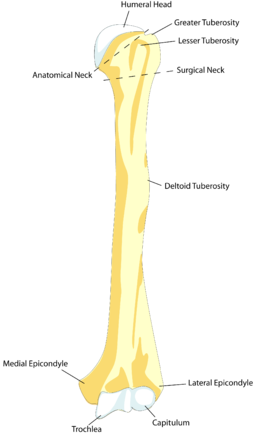
Breaking one or both of your forearm bones, particularly at the wrist, is fairly common; breaking your upper arm bone is much less common. If you do break your upper arm bone (humerus), it is most likely to break at the top - 6 times out of 10 this is where the upper arm bone breaks. It is called a proximal humerus fracture.
The next most common place for the upper arm bone to break is at the elbow. When it breaks here it is called a distal fracture (supracondylar or transcondylar), an intercondylar fracture or a condylar fracture, depending on where exactly the bone has broken.
The least common place for the upper arm bone to break is somewhere in the middle - this is called a shaft fracture.
How do you break your upper arm?
Upper arm fractures usually occur following a bad fall on to your elbow or shoulder or by something hitting it hard, such as being knocked down by a car. Falling on to your elbow or shoulder is likely to cause a broken upper arm (fractured humerus). You can also break your upper arm by falling on to your hand when your arm is straight, especially if it is out to your side.
Who is at risk?
Older people. If you are elderly, it is possible you have developed 'thinning' of the bones (osteoporosis). This makes it more likely that you will break your arm following a relatively minor fall or accident.
People with cancer. Occasionally, you can break your upper arm because you have developed a type of cancer that is affecting the bone and has made it so weak that it has cracked. This is called a pathological fracture.
Children. In very small children their upper arm, particularly the shaft, can be broken by someone abusing them, by hitting or throwing them.
Young people. Young people who break the top of their upper arm (proximal fracture) are more likely than older people to have also dislocated their shoulder. This is because the amount of force needed to break a young person's arm is large and therefore it is more likely to have done other damage too.
What are the symptoms of a broken upper arm?
If you have had a fall or hit your arm you might feel or hear a snap or a cracking sound.
The main symptom is pain, which will be worse if you try to move your arm. A broken upper arm (fractured humerus) can be extremely painful, so much so that you may feel sick, dizzy or faint.
Other symptoms of a broken upper arm are:
Inability to move. You will be unable to use your arm or there will be a much reduced range of motion.
Swelling. Your elbow or upper arm may be swollen.
Bruising. Your elbow or upper arm may bruise.
Deformation. If it is a very severe break, your arm may be a different shape.
Numbness. You may notice tingling or numbness.
Bleeding. There may be bleeding if the broken bone (or your fall) has damaged the skin.
If you have dislocated your shoulder at the same time as breaking your upper arm, you may also notice that your shoulder is out of place or deformed.
When should I contact a doctor?
If you think you have broken your upper arm you should get medical advice immediately. It is important to treat a broken upper arm (fractured humerus) as soon as possible, so that it can start to heal properly. You should go to your nearest Accident and Emergency (A&E) Department or Minor Injuries Unit. Putting your arm into a sling that goes under your arm and around the back of your neck before you go, will make the journey easier. If you haven't got a sling, you can make one out of a square scarf folded in half diagonally.
Sling folding method
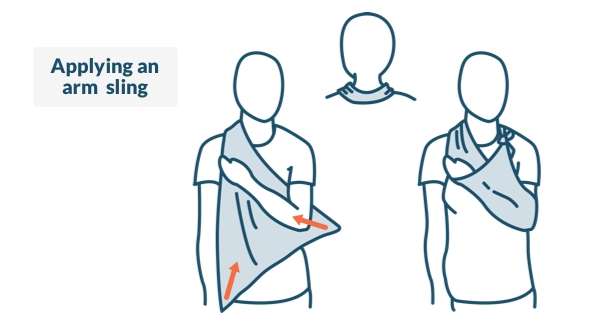
If it's a bad break, call 999/112/911 for an ambulance.
How is a broken upper arm diagnosed?
An X-ray test is used to diagnose an upper arm break (fractured humerus).
It is unusual for a fractured bone not to show up on an X-ray test but in difficult cases you might need to have a computerised tomography (CT) scan carried out as well.
If the doctors think you might have 'thinning' of the bones (osteoporosis) they might also need to arrange for you to have a special scan called dual-energy X-ray absorptiometry (DXA - formerly DEXA), which is used to help diagnose osteoporosis.
How is a broken upper arm treated?
The most important emergency treatment is to keep the arm as still as possible, by using a sling, and to be given strong painkillers. Treatment then depends on which part of the upper arm bone is broken. Any treatment will usually include physical therapy from a physiotherapist.
Break to the top of your upper arm (proximal humerus fracture)
8-9 times out of 10, proximal humerus fractures will heal simply by keeping your arm still using a sling or some other mechanism to keep the upper arm and shoulder from moving.
However, some people will require surgery to fix this type of fracture. Surgery will be needed if the ends of the broken bone have moved apart or are at an angle to one another.
Different operations are used:
The ends of the bones can be fixed by using pins that go through the skin into the bones (percutaneous fixation).
The ends of the bones are fixed together using screws or a metal plate (internal fixation).
The very top of the humerus (humeral head) is removed and replaced with an artificial humeral head (partial shoulder replacement).
Break to the bottom of your upper arm (distal, intercondylar or condylar fracture)
Most of these kinds of fractures need to be operated on. This is because the ends of the broken bones usually move away from each other (displaced or angled).
If the bones haven't moved (non-displaced), it can be treated in a plaster cast with your elbow bent to a right angle.
Sometimes, before any surgery is undertaken, a doctor will inject a needle into your elbow to remove blood that has got into the joint. This can relieve the worst of the pain.
Break to the middle of your upper arm (humeral shaft fracture)
This type of break is usually treated in a plaster cast. After 1-3 weeks the plaster cast is changed to a type of brace called a functional arm brace. This is a brace which you can remove yourself to do arm exercises, as guided by a physiotherapist.
If the broken bones have moved away from each other, you might need to be given a brief anaesthetic so that the doctors can move the bones into a good position for healing.
If moving the bones into a good position is not possible or if the bone is broken into more than two pieces, you will need an operation. The bones will be fixed together with screws or by using a piece of metal screwed across the break (metal plates).
What is the outlook?
How well a break to the upper arm (fractured humerus) usually heals does depend on things such as which part you have broken, how you broke it, how badly you have broken it and how old you are. Most breaks of the upper arm heal very well and a broken upper arm has usually healed within a month or two.
However, if you are very elderly and have broken your upper arm at the top (proximal humerus fracture), it is unlikely that you will get the full range of movement back in your arm and shoulder but the aim of treatment will be to get the movement good enough for you to be able to do everything that you need to do.
What are the possible complications?
Complications are rare. Complications are much more likely if the elbow or shoulder joint is affected by the fracture. There are several types of complications that can occur:
Malunion
When the two ends of the broken bones don't mend, this is called malunion. This is not always as bad as it sounds and may still allow you to use your arm almost normally. It is more common in older people.
Neurovascular injury
There are lots of important nerves and blood vessels that are very close to the bone of the upper arm. These can be injured when the upper arm is broken. This is called a neurovascular injury. Nerves and blood vessels may also be injured during surgery to mend the break. Your health carers will check you regularly after an upper arm break to make sure that there is no sign of any injury to a blood vessel or a nerve.
About 1 in 3 breaks of the top of the upper arm (proximal humerus fracture) will damage one of the nerves.
About 2 out of every 10 people who break the middle of their upper arm (humeral shaft fracture) will also damage a nerve called the radial nerve. It is particularly common if the break is in the lower part of the shaft. For 7 out of 10 of the people affected, it recovers completely without any need for surgery.
The brachial artery can be injured with a humeral shaft fracture but this is rare.
Avascular necrosis
If the blood supply to bone is damaged, that bit of bone dies. This is called avascular necrosis. It can happen if you have broken your upper arm right at the top, affecting the humeral head. Avascular necrosis is more common if the break has created several fragments. If affected, you will develop a painful and stiff shoulder. Eventually you may need to have surgery to replace your shoulder joint.
Associated shoulder dislocation
Dislocating your shoulder at the same time as breaking the top of your upper arm (proximal humerus fracture) is most likely if you are young.
Associated rotator cuff injury
The rotator cuff is a group of four muscles that are positioned around the shoulder joint. It helps to stop the shoulder from dislocating. It can be damaged when you break the top of your upper arm (proximal humerus fracture). Rotator cuff tears usually improve with physiotherapy but surgery may be needed.
Patient picks for Fractures
Bones, joints and muscles
Pelvic fractures
The pelvis is a ring of bone at hip level, made up of several separate bones. A fracture in the pelvis is a break in any one of those bones. A pelvic fracture usually involves more than one break; this is because of the shape of the pelvis - it is impossible to make one break in a circle. Sometimes a small crack on the edge of a pelvic bone can occur alone.
by Dr Toni Hazell, FRCGP

Bones, joints and muscles
Recovering from a pelvic fracture
A serious pelvic fracture is likely to need lengthy physical therapy and rehabilitation. Recovery times also depend on what other damage you experienced, particularly to the nerves that go to your legs.
by Dr Colin Tidy, MRCGP
Frequently asked questions
Can I put any weight on my arm if I have a break?
No, if you have a broken upper arm, it's very important to keep it as still as possible. You should avoid putting any weight on it.
What is the likelihood of surgery if I break my upper arm?
The need for surgery depends on where in the upper arm the break occurred and how severe it is. For breaks at the top of the upper arm (proximal humerus fracture), 8 or 9 out of 10 cases will heal with just a sling, but surgery is needed if the bone ends are significantly moved or angled. Most breaks at the bottom of the upper arm (distal, intercondylar or condylar fractures) typically require an operation. For breaks in the middle of the upper arm (humeral shaft fracture), a plaster cast is often used, but surgery might be needed if the bones cannot be aligned properly or if the bone is broken into many pieces.
Will a broken upper arm always heal with a full range of movement?
Most upper arm breaks heal very well, often within a month or two. However, if you are very elderly and have broken the top of your upper arm, it's unlikely you will get full movement back. In such cases, the treatment aims to restore enough movement for daily activities.
What exactly is a 'pathological fracture'?
A pathological fracture is when your upper arm breaks because a type of cancer affecting the bone has made it so weak that it cracks. This is different from a break caused by an injury.
Why would blood need to be removed from my elbow before surgery for a broken arm?
Sometimes, for breaks at the bottom of the upper arm, a doctor might inject a needle into your elbow to remove blood that has collected in the joint. This is done to relieve severe pain before any surgery is performed.
Further reading and references
- Fractures of the humerus; Wheeless' Textbook of Orthopaedics
- Monica J, Vredenburgh Z, Korsh J, et al; Acute Shoulder Injuries in Adults. Am Fam Physician. 2016 Jul 15;94(2):119-27.
- Amir S, Jannis S, Daniel R; Distal humerus fractures: a review of current therapy concepts. Curr Rev Musculoskelet Med. 2016 Jun;9(2):199-206. doi: 10.1007/s12178-016-9341-z.
- Vachtsevanos L, Hayden L, Desai AS, et al; Management of proximal humerus fractures in adults. World J Orthop. 2014 Nov 18;5(5):685-93. doi: 10.5312/wjo.v5.i5.685. eCollection 2014 Nov 18.
- Gallusser N, Barimani B, Vauclair F; Humeral shaft fractures. EFORT Open Rev. 2021 Jan 4;6(1):24-34. doi: 10.1302/2058-5241.6.200033. eCollection 2021 Jan.
- Hill CE, Cooke S; Common Paediatric Elbow Injuries. Open Orthop J. 2017 Nov 30;11:1380-1393. doi: 10.2174/1874325001711011380. eCollection 2017.
About the authorView full bio
Updated by

Dr Colin Tidy, MRCGP
General Practitioner, Medical Author
MBBS, MRCGP, MRCP (Paediatrics), DCH
Dr Colin Tidy is an NHS Doctor, based in Oxfordshire.
About the reviewerView full bio

Dr Doug McKechnie, MRCGP
Medical Writer
MA, MBBS, MSc, DRCOG, MRCP(UK), MRCGP(2021), FHEA
Dr Doug McKechnie is an NHS GP working in London. He works full-time clinically and is also the Deputy Lead for the Clinical and Professional Practice module at University College London Medical School.
Join the conversation
Share your thoughts or experiences with others in our patient communities.

Ask, share, connect.
Browse discussions, ask questions, and share experiences across hundreds of health topics.

Feeling unwell?
Assess your symptoms online for free
Sign up to the Patient newsletter
Your weekly dose of clear, trustworthy health advice - written to help you feel informed, confident and in control.
By subscribing you accept our Privacy Policy. You can unsubscribe at any time. We never sell your data.