Dermatofitose
Tinea infections
Revisado por Dr Philippa Vincent, MRCGPÚltima atualização por Dr Doug McKechnie, MRCGPÚltima atualização 27 Fev 2025
Atende aos diretrizes editoriais
- BaixarBaixar
- Compartilhar
- Language
- Discussão
- Versão em Áudio
- Adicionar às fontes preferidas no Google
Profissionais de Saúde
Os artigos de Referência Profissional são projetados para uso por profissionais de saúde. Eles são escritos por médicos do Reino Unido e baseados em evidências de pesquisa, diretrizes do Reino Unido e da Europa. Você pode encontrar o Infecção fúngica na virilha artigo mais útil, ou um dos nossos outros artigos de saúde.
What is dermatophytosis?1
Dermatophytosis (tinea) infections are fungal infections caused by dermatophytes - a group of fungi that invade and grow in dead keratin. Several species commonly invade human keratin and these belong to the Epidermophyton, Microsporum e Trichophyton genera. They tend to grow outwards on skin, producing a ring-like pattern - hence the term 'ringworm'. They are very common and affect different parts of the body. They can usually be successfully treated but success depends on the site of infection and on compliance with treatment.
Veja o separado Tinea capitis, Infecções fúngicas nas unhas, Pitiríase versicolor e Candidíase artigos.
Fisiopatologia23
Infection is limited to the dead layers of skin but encouraged by a damp and warm local environment.
The infection can be transmitted to humans by anthropophilic (between people), geophilic (from soil) and zoophilic (from animals) spread.
Os organismos mais comuns são:
Trichophytons rubrum, Trichophytons tonsurans, Trichophytons interdigitale e Trichophytons mentagrophytes.
Microsporum canis.
Epidermophyton floccosum.
Clinical classification is according to site:
Scalp - tinea capitis.
Feet - tinea pedis.
Hands - tinea manuum.
Nail - tinea unguium (or onychomycosis).
Beard area - tinea barbae.
Groin - tinea cruris.
Body including trunk and arms - tinea corporis.
How common is dermatophytosis? (Epidemiology)
Infection is very common all over the world. Some types are more common than others, with tinea pedis being most common in adults and tinea capitis the most common in children. Onychomycosis is also extremely common.
Dermatophytosis symptoms (presentation)2
História
Itching, rash and nail discolouration are the most common symptoms of tinea infection.
Hair loss occurs with tinea capitis (mainly a disease of children).
Complications such as secondary infection (cellulitis and impetigo) can lead to symptoms.
It is common in people who play contact sports.
It occurs in immunocompromised patients.
Exame
Tinea pedis:4
It particularly affects the web of the toe where skin may be macerated and erythematous.
It commonly affects the plantar surface of the foot. Erythema, vesicles and pustules can occur.
Tineas pedis - between toes
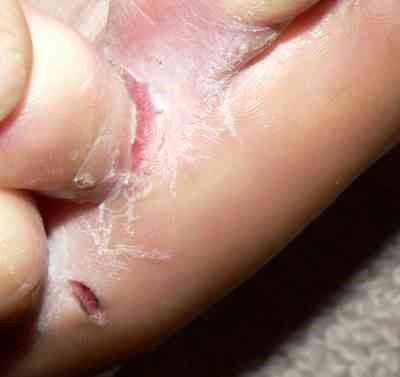
© User Falloonb on en.wikipedia, Public domain, via Wikimedia Commons
It can cause hair loss with broken hairs at the surface (as distinct from alopecia areata).
Clinical appearance is variable, including scaly, crusting, pustules and/or black dot alopecia.
Tinea unguium (onychomycosis):6
Onycholysis or separation of the nail from the nail bed commonly occurs.
Nail dystrophy with thickening and discolouration of the nail develops.
Tinea corporis:7
The skin lesions have annular scaly plaques with raised edges.
There may be vesicles and pustules.
Typically lesions are on exposed skin of the trunk, arms and legs (see 'Differential diagnosis', below).
More unusually the lesions can appear as overlapping concentric circles (tinea imbricate) or even herpetiform subcorneal vesicles or pustules (bullous tinea corporis).
Tinea corporis
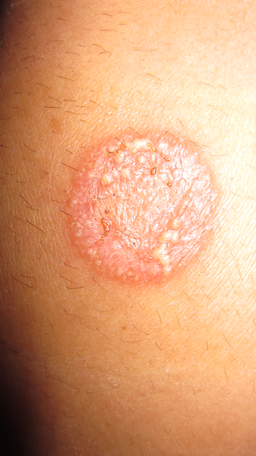
© Corina G., Public domain, via Wikimedia Commons
Tinea manuum:
Usually with tinea pedis.
Typically just affects one hand.
Scaling and redness are prominent.
Incorrect diagnosis and use of steroid may eventually exacerbate the infection.
Tinea cruris:8
Usually occurs in men.
Often tolerated for some time before presentation.
Typically erythematous with central clearing and raised edge.
Tinea barbae:9
Affects the beard area.
Redness, scaling and pustules are common.
Diagnóstico diferencial7
Other annular rashes are often confused with tinea infections. Eczema e psoríase are commonly confused with tinea. Pityriasis versicolor occurs all over the trunk while candida occurs as a flexural rash at extremes of age or in the immunocompromised, those with diabetes or patients on antibiotics.
Treatment with topical steroids often causes confusion, making tinea less scaly and more erythematous. Steroid use also makes the 'active' edge and the inactive centre less distinct (tinea incognito). Clinically the diagnosis can be difficult but, if it is a possibility, take scrapings for mycology. Other fungal infections look nothing like tinea. Other conditions to consider include:
Intertrigo.
Erythrasma.
Diagnosing dermatophytosis (investigations)10
Microscopy of skin and nail specimens may reveal hyphae and spores.
Fungal culture can identify the species but is not always reliable and it can take six weeks to obtain results.
Ultraviolet light (Wood's light) is useful for tinea capitis especially. Fluorescence is produced by the fungus. Fluorescence is not seen with tinea corporis or tinea cruris.
Rarely, a biopsy may be needed if the case is atypical or not responding to treatment.
Doenças associadas
Diabetes, immunocompromised states, atopy and Síndrome de Cushing have all been associated with fungal infections.
Management of dermatophytosis45610
Offer advice on hygiene measures:
Keep affected skin cool and dry.
Wear cotton, absorbent clothing.
Avoid scratching affected skin.
After washing, dry thoroughly.
Do not share towels, and wash frequently, to reduce the risk of transmission.
Cover feet in communal bathing pools, changing areas and gymnasiums if feet are affected.
Continue school and sporting activities.
Veja o separado Medicamentos antifúngicos artigo.
Topical agents containing a corticosteroid are not usually necessary. They may be used if there is a lot of skin inflammation. They should be used for a week only.
Referral may be needed if diagnosis is in doubt.
Complications of dermatophytosis
Secondary bacterial infection may occur. Hair loss is a complication of tinea capitis. Pain and difficulty with shoes can result from onychomycosis.
A dermatophytid (id) reaction may occur, especially after initiation of systemic antifungal treatment. This is thought to be a type IV hypersensitivity response, and causes a widespread pruritic rash, with papules, maculopapules, papulovesicles, or pustules at sites distinct from that of the original dermatophyte infection.11
Scarring is uncommon but more likely in people with pigmented skin. Scarring usually fades with time. Skin protection such as using a moisturiser cream and sunscreen can be helpful. Extensive or severe scarring may need further treatment, such as using laser therapy.
Dermatophytosis prognosis
Excellent with good compliance and subsequent precautions to avoid repeat infection.
Prevention of dermatophytosis
Good skin hygiene.
Good nail hygiene.
Avoiding prolonged wetting or dampness of the skin and feet.
Avoiding trainers, which can retain sweat and promote a warm, moist environment.
Treatment of tinea pedis - helps prevent onychomycosis.6
Wearing clean, loose-fitting underwear.
Atualizações exclusivas para profissionais de saúde
Mantenha-se informado com as últimas atualizações clínicas, insights profissionais e orientações baseadas em evidências. O boletim informativo Patient Pro seleciona conteúdo essencial para profissionais de saúde—entregue diretamente na sua caixa de entrada.
Ao se inscrever, você aceita nossos Política de Privacidade. Você pode cancelar a inscrição a qualquer momento. Nunca vendemos seus dados.
Leitura adicional e referências
- Dermatophytide reactions; DermNet NZ
- Sahoo AK, Mahajan R; Management of tinea corporis, tinea cruris, and tinea pedis: A comprehensive review. Indian Dermatol Online J. 2016 Mar-Apr;7(2):77-86. doi: 10.4103/2229-5178.178099.
- Ely JW, Rosenfeld S, Seabury Stone M; Diagnosis and management of tinea infections. Am Fam Physician. 2014 Nov 15;90(10):702-10.
- Martinez DA, Oliver BG, Graser Y, et al; Comparative genome analysis of Trichophyton rubrum and related dermatophytes reveals candidate genes involved in infection. MBio. 2012 Sep 4;3(5):e00259-12. doi: 10.1128/mBio.00259-12. Print 2012.
- The Cutaneous Mycoses; Mycology Online
- Hainer BL; Dermatophyte infections. Am Fam Physician. 2003 Jan 1;67(1):101-8.
- Fungal skin infection - foot; NICE CKS, junho de 2023 (acesso apenas no Reino Unido)
- Infecção fúngica da pele - couro cabeludo; NICE CKS, junho de 2023 (acesso apenas no Reino Unido)
- Infecção fúngica nas unhas; NICE CKS, agosto de 2023 (acesso apenas no Reino Unido)
- Infecção fúngica na pele - corpo e virilha; NICE CKS, julho de 2023 (acesso apenas no Reino Unido)
- Tinea Cruris; DermNet NZ
- Tinea barbae; DermNet NZ
- Infecções Fúngicas de Pele e Unhas: Diagnóstico e Investigação Laboratorial - Guia de Referência Rápida para Cuidados Primários; GOV.UK, 2017
- Leung AK, Lam JM, Leong KF, et al; Tinea corporis: an updated review. Drugs Context. 2020 Jul 20;9:2020-5-6. doi: 10.7573/dic.2020-5-6. eCollection 2020.
Sobre o autorVer biografia completa

Dr Doug McKechnie, MRCGP
Redator Médico
MA, MBBS, MSc, DRCOG, MRCP(UK), MRCGP(2021), FHEA
O Dr. Doug McKechnie é um médico do NHS que trabalha em Londres. Ele trabalha em tempo integral na prática clínica e também é o Vice-Líder do módulo de Prática Clínica e Profissional na Faculdade de Medicina da University College London.
Sobre o revisorVer biografia completa

Dr Philippa Vincent, MRCGP
Médico Generalista, Autor Médico
MB BS, Bsc, MRCGP (2000), DCH, DFSRH, DRCOG
Dra Philippa Vincent é um médico do NHS trabalhando no norte de Londres.
Histórico do artigo
As informações nesta página são escritas e revisadas por clínicos qualificados.
Artigo também disponível em Inglês, Alemão, Espanhol, Francês, Italiano, Português, Hindi, Hebraico, Árabe, e Sueco.
Próxima revisão prevista para: 26 Fev 2028
27 Fev 2025 | Última versão

Pergunte, compartilhe, conecte-se.
Navegue por discussões, faça perguntas e compartilhe experiências em centenas de tópicos de saúde.

Sentindo-se mal?
Avalie seus sintomas online gratuitamente
Mais em dermatologia
- Albinismo
- Tumores benignos da pele
- Síndrome de Chediak-Higashi
- Nevo pigmentado congênito
- Termos descritivos dermatológicos
- Psoríase gutata
- Hemangiomas da pele
- Cicatrizes queloides
- síndrome de Klippel-Trénaunay
- Micetoma
- Distúrbios e anormalidades das unhas
- Ameba de vida livre patogênica
- Erupções purpúricas
- Rubéola
- Sarna
- Nevo sebáceo
- Pele e nódulos subcutâneos
- Urticária
- Veias varicosas
- Problemas vulvares