
Lichen sclerosus
Peer reviewed by Dr Toni Hazell, FRCGPLast updated by Dr Colin Tidy, MRCGPLast updated 2 Jul 2024
Meets Patient’s editorial guidelines
- DownloadDownload
- Share
- Language
- Discussion
- Audio Version
- Add to preferred sources on Google
Lichen sclerosus is an uncommon skin condition. It most commonly affects the genital skin (vulva) of women. It can occur at any age.
At a glance
Lichen sclerosus is a skin condition that mainly affects the genital skin in women and men.
Symptoms include itch, soreness, and changes in the appearance of the affected skin.
Treatment with a steroid cream or ointment often helps ease the symptoms.
If left untreated, it can cause scarring and may increase the risk of certain cancers.
See a doctor for persistent itchiness to get a diagnosis and the right treatment.
What is lichen sclerosus?
Lichen sclerosus (pronounced 'lie-ken scler-roe-suss') is a skin condition that mainly affects the genital skin (vulva) in women and the penis in men. Lichen sclerosus affecting the penis is sometimes called balanitis xerotica obliterans.
Lichen sclerosus most commonly occurs in middle-aged women. Symptoms include itch, soreness and changes in the appearance of affected skin. Treatment with a steroid cream or ointment often eases the symptoms.
Lichen sclerosus
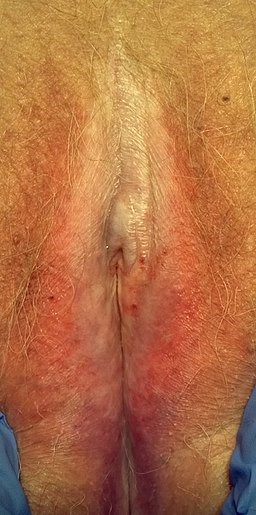
Symptoms of lichen sclerosus
The initial symptoms of lichen sclerosus typically include small pearly white spots, which are usually but not always itchy. The itch tends to be worse at night which can disturb sleep.
Women and girls - vulval and anal area
Typically, the small pearly white spots develop on the genital skin (vulva). In about 3 in 10 cases, the skin around the back passage (anus) is also affected. Sometimes only the skin around the anus is affected.
Sometimes soreness rather than itch is the main symptom. Lichen sclerosus is a skin condition only and does not extend into the vagina or inside the anus.
Over time, the white spots may become larger and join together. The whole vulva and/or anal skin may then become white and be more fragile than normal. The fragile skin may become damaged, inflamed, raw and prone to painful splitting and cracking. It may become painful to have sex. If the anal skin is affected, passing poo (faeces) may cause pain.
If left untreated, over months or years the vulva may shrink (doctors call this 'atrophy'). In some cases the changes of the vulval skin may make the entrance to the vagina narrower. This can make it difficult or painful to have sex. Also, thrush and other infections tend to be more common if the vulva is sore or cracked.
Symptoms may slowly get worse but not all the above symptoms may occur. It can take months or years from the first small spots to progress to more severe symptoms. At first the symptoms may be mistaken for thrush or other problems: often women have tried lots of creams from the chemist before being examined and having lichen sclerosus diagnosed.
Men and boys - penis
White spots develop on the foreskin and end of the penis. These can be sore. In time, the changes to the affected skin may cause difficulty in retracting the foreskin and in passing urine. Erections may become painful. The anal skin is rarely affected in men.
Other areas of skin
Sometimes small patches of lichen sclerosus occur on other parts of the body. These look like small pearly white areas on the skin. Sometimes they occur in people who also have genital lichen sclerosus. Sometimes they occur without genital problems. Away from the genital area, patches of lichen sclerosus usually do not cause itch or other symptoms.
When to see a doctor
See a doctor if you think you might have lichen sclerosus. It is very important to see a doctor if you have persistent itchiness so that the diagnosis can be confirmed and you receive the right treatment.
They will examine the affected area. They may also refer you to a specialist (a dermatologist, gynaecologist or urologist with interest in genital skin problems) to confirm the diagnosis.
Causes of lichen sclerosus
The cause of lichen sclerosus is not known. In lichen sclerosus, inflammation of the affected skin changes the structure of the skin.
Lichen sclerosus is probably an autoimmune disease. An autoimmune condition is one where the body's immune system accidentally attacks your own body. This causes inflammation and damage to the affected part of the body.
In people with lichen sclerosus the genital area of skin may be attacked by some parts of the immune system which then causes inflammation. However, this has not been proved and it is not really known what triggers lichen sclerosus to develop.
About 1 in 4 people with lichen sclerosus have another autoimmune disease such as thyroid disease, vitiligo, or pernicious anaemia. This is why it is thought that lichen sclerosus might be an autoimmune disease.
Risk factors
Although we don't know exactly what causes lichen sclerosus, several risk factors have been identified:
Gender. Lichen sclerosus is more common in women than in men.
Genetics. Lichen sclerosus seems to be more common in some families; it may be that some people inherit genes that make them more likely to develop lichen sclerosus after something else happens, such as an injury.
Age and hormones. Lichen sclerosus most commonly develops in women after the menopause, and, less commonly, girls who have not yet gone through puberty. Hormones, such as oestrogen and progesterone, are low in pre-pubertal girls and post-menopausal women, and may be linked to the condition.
How is lichen sclerosus diagnosed?
The appearance is often fairly typical, in which case no further tests are needed. If the diagnosis is in doubt, a small sample (biopsy) of affected skin may be taken under local anaesthetic.
The sample of skin is put under a microscope to look at the structure of the skin cells and tissues. This can confirm the diagnosis and rule out other disorders which can sometimes copy (mimic) this condition.
If lichen sclerosus is diagnosed it is usual also to do a routine blood test to check for an underactive thyroid gland. This is because of the association between lichen sclerosus and autoimmune diseases and, in particular, autoimmune thyroid disease. Up to 3 in 10 people with lichen sclerosus also have an underactive thyroid gland.
Lichen sclerosus treatment
Topical steroids
A strong steroid ointment or cream (topical steroid) is the main treatment (clobetasol or mometasone). Steroids reduce inflammation. It is usual to use the ointment or cream regularly for three months.
A common plan is to use a single application at night for four weeks, followed by alternate nights for four weeks and then twice a week for four weeks. You must use the steroid as directed by your doctor. Keep on with treatment for as long as advised.
Irritation tends to ease after two weeks or so, but the skin may take about three months of treatment to look and feel better.
The skin may return to normal if lichen sclerosus is diagnosed and treated with a topical steroid at an early stage. If the appearance of the skin has already changed a lot, the changes may not reverse much with topical steroid treatment even though symptoms of itch and soreness are often relieved.
After the initial regular treatment for about three months, you may then only need to use the ointment or cream once or twice every 1-2 weeks to keep symptoms away.
Topical calcineurin inhibitors (tacrolimus ointment or pimecrolimus cream) can be used instead of or in addition to topical steroids.
Some general measures
Use a moisturising (emollient) cream or ointment instead of soap to clean the genital area.
Avoid bubble baths, scented soap, detergents, perfumes, etc, to the genital skin (vulva) of women.
These may irritate the skin and make symptoms worse.
Lubricants are useful during sex if having sex is painful.
Other treatments that are sometimes used
Other medicines. In the small number of cases where topical steroids do not help, a skin specialist may advise other medicines to reduce inflammation.
A vaginal dilator may be advised if you have any narrowing of the vaginal opening. A vaginal dilator is a cylinder-shaped piece of plastic that you insert into the vagina to gently stretch the opening and the inside. You use it each day for a time as directed by your doctor.
Surgery. An operation to widen the opening of the vagina is occasionally needed in women with severe lichen sclerosus which has caused narrowing of the vaginal entrance. (But note: regular use of a dilator as described above may prevent the need for surgery.)
Foreskin removal (circumcision) may be needed in some affected men or boys.
Some men may need other operations to improve the narrowing and scarring of the water pipe (urethra) caused by this condition.
Are there any complications from lichen sclerosus?
The itch and discomfort may cause a lot of distress. If untreated, lichen sclerosis can cause scarring of the vulva, which can make it painful to pass urine. Scarring can make the vaginal opening narrower, which can make penetrative sex painful and sometimes impossible. Topical steroid treatment is effective at preventing scarring
Lichen sclerosus of anogenital sites is associated with an increased risk of vulval, penile or anal cancer (squamous cell carcinoma). Cancer is estimated to affect up to 1 in 20 women with vulval lichen sclerosus. In men there is a small increased risk of developing cancer of the penis. Again, the exact risk is unknown but it is thought that around 8 in 100 men with lichen sclerosus develop this cancer.
Will lichen sclerosus go away?
There is no permanent cure for lichen sclerosus. However, treatment with a topical steroid usually controls the symptoms of itch and soreness, and often prevents the condition from getting worse. Occasionally the condition clears away for good for no apparent reason. This is more common in young girls when the condition often goes during puberty.
Can you prevent lichen sclerosus?
The exact cause of lichen sclerosus is unknown, and we don't know of any way to prevent it from developing.
Patient picks for Vaginal and vulval problems
Women's health
Itchy vulva
Most women experience an itchy vulva and an itchy vagina from time to time. However, in pruritus vulvae, the itching is persistent and causes distress.
by Dr Rosalyn Adleman, MRCGP
Women's health
Preventing and treating bacterial vaginosis
Bacterial vaginosis (BV) often causes no symptoms, or the symptoms are mild. There is a good chance that BV will gradually clear without treatment.
by Dr Hayley Willacy, FRCGP
Frequently asked questions
Can lichen sclerosus affect areas of the body other than the genitals?
Yes, sometimes small patches of lichen sclerosus can appear on other parts of the body. These usually look like small pearly white areas on the skin and typically do not cause itching or other symptoms when they occur outside the genital area.
Does lichen sclerosus only affect adults?
No, while it most commonly affects middle-aged women and women after menopause, it can also occur in girls who have not yet gone through puberty, and in boys. When it occurs in young girls, the condition sometimes clears up permanently during puberty.
Is it possible for lichen sclerosus to spread to the vagina or inside the anus?
No, lichen sclerosus is a skin condition only. It does not extend into the vagina or inside the anus.
What should I do if I experience pain during sex because of lichen sclerosus?
Lubricants can be helpful during sex if pain is an issue. Additionally, an operation to widen the opening of the vagina might be occasionally needed in severe cases where the condition has caused narrowing. Regular use of a vaginal dilator, as directed by your doctor, may also help stretch the opening and prevent the need for surgery.
Is there a link between lichen sclerosus and other health conditions?
Yes, about 1 in 4 people with lichen sclerosus also have another autoimmune disease, such as thyroid disease, vitiligo, or pernicious anaemia. This association suggests that lichen sclerosus might itself be an autoimmune disease, where the body's immune system mistakenly attacks its own tissues.
Are there any specific cleaning products I should avoid if I have lichen sclerosus?
Yes, it is advisable to use a moisturising cream or ointment instead of soap to clean the genital area. You should also avoid bubble baths, scented soaps, detergents, and perfumes when cleaning the genital skin, as these can irritate the skin and worsen symptoms.
What is a vaginal dilator and how is it used?
A vaginal dilator is a cylinder-shaped piece of plastic that may be advised if you have any narrowing of the vaginal opening due to lichen sclerosus. You insert it into the vagina to gently stretch the opening and the inside. It is typically used daily for a period as directed by your doctor.
Can lichen sclerosus in men lead to difficulties with urination?
Yes, in men, changes to the affected skin on the penis can, over time, cause difficulty in retracting the foreskin and in passing urine. In some cases, operations may be needed to improve narrowing and scarring of the urethra (water pipe) caused by the condition.
Further reading and references
- Fruchter R, Melnick L, Pomeranz MK; Lichenoid vulvar disease: A review. Int J Womens Dermatol. 2017 Mar 27;3(1):58-64. doi: 10.1016/j.ijwd.2017.02.017. eCollection 2017 Mar.
- Lewis FM, Tatnall FM, Velangi SS, et al; British Association of Dermatologists guidelines for the management of lichen sclerosus, 2018. Br J Dermatol. 2018 Apr;178(4):839-853. doi: 10.1111/bjd.16241.
- Kirtschig G; Lichen Sclerosus-Presentation, Diagnosis and Management. Dtsch Arztebl Int. 2016 May 13;113(19):337-43. doi: 10.3238/arztebl.2016.0337.
- Krapf JM, Mitchell L, Holton MA, et al; Vulvar Lichen Sclerosus: Current Perspectives. Int J Womens Health. 2020 Jan 15;12:11-20. doi: 10.2147/IJWH.S191200. eCollection 2020.
- Lichen sclerosus; Primary Care Dermatology Society
- Lichen sclerosus; DermNet NZ
About the authorView full bio
Updated by

Dr Colin Tidy, MRCGP
General Practitioner, Medical Author
MBBS, MRCGP, MRCP (Paediatrics), DCH
Dr Colin Tidy is an NHS Doctor, based in Oxfordshire.
About the reviewerView full bio

Dr Toni Hazell, FRCGP
MBBS, BSc, FRCGP, DFSRH, Dip GU med, DRCOG, DCH (London, UK, 2000)
Dr. Toni Hazell qualified from St. Mary’s Hospital Medical School and did her VTS at Northwick Park Hospital.
Join the conversation
Share your thoughts or experiences with others in our patient communities.

Ask, share, connect.
Browse discussions, ask questions, and share experiences across hundreds of health topics.

Feeling unwell?
Assess your symptoms online for free
Sign up to the Patient newsletter
Your weekly dose of clear, trustworthy health advice - written to help you feel informed, confident and in control.
By subscribing you accept our Privacy Policy. You can unsubscribe at any time. We never sell your data.