Nasal polyps
Peer reviewed by Dr Colin Tidy, MRCGPLast updated by Dr Toni Hazell, FRCGPLast updated 23 Sept 2022
Meets Patient’s editorial guidelines
- DownloadDownload
- Share
- Language
- Discussion
- Audio Version
- Add to preferred sources on Google
Nasal polyps are fleshy swellings that grow inside the nose or sinuses. They are usually non-cancerous (benign). The most common symptoms they cause are a stuffy, runny nose. Steroid nasal drops are commonly used to shrink the polyps. Surgical removal of polyps is sometimes needed. Nasal polyps often return after treatment, so steroid nasal sprays can be used daily to prevent recurrence.
At a glance
Nasal polyps are soft, fleshy, common growths inside your nose, which may be yellowish, grey, or pink.
They can vary in size and may grow in bunches, or affect one or both nostrils.
Symptoms include a blocked or runny nose, reduced smell and taste, and changes to your voice.
If symptoms last longer than a cold or you have a bloody discharge from one nostril, see a doctor.
Treatment includes steroid nose drops or tablets, and may include surgery for large polyps.
Nasal polyps may return after treatment, so ongoing use of steroid nasal sprays may be advised.
What do nasal polyps look like?
Nasal polyps are soft fleshy swellings that grow inside your nose.
They may be yellowish, grey or pink in colour.
They are common.
Nasal polyps can vary greatly in size.
There may be only one but sometimes several nasal polyps grow like a small bunch of grapes on a stem.
Nasal polyps causes
In most cases the cause for nasal polyps is not known. It is thought that ongoing (chronic) inflammation in your nose causes swelling (oedema) of the lining of your nostril (nasal cavity). Due to gravity, this swelling hangs down (dependent oedema), forming the polyp. Nasal polyps usually affect both nostrils and can gradually enlarge, blocking your nose.
Nasal polyps can also grow in your sinuses. Your sinuses are air-filled spaces in your skull which drain into your nose. The biggest sinuses are called the maxillary sinuses. They are found under your eyes, behind your cheeks. The lining of your sinuses is the same as the lining of your nose, so this is why nasal polyps can also form in your sinuses.
The medical name for the inflammation of your nose and sinuses is rhinosinusitis. Often the cause is unknown but it can be due, in part, to sinus infection. Nasal polyps can be a part of this condition.
Certain conditions make nasal inflammation and nasal polyps more likely. These include asthma, an allergy to aspirin, cystic fibrosis and some rare conditions (such as allergic fungal sinusitis and nasal issues like Churg-Strauss syndrome).
Nasal polyps symptoms
With nasal polyps symptoms, initially you might think you have a cold. This is because a blocked or runny nose is a common symptom in viral infections like colds. Colds usually only last 2-14 days and the symptoms improve on their own. If you have nasal polyps, the symptoms will not get better without treatment.
Nose congestion.The main symptom of nasal polyps is a blocked feeling in your nose. You may find it difficult to breathe through your nose. You may then have to breathe through your mouth for much of the time. This is especially troublesome at night and your sleep may be affected.
Rhinorrhoea. Watering from the nose (rhinorrhoea) is common.
A postnasal drip may occur. This is the sensation of something continually running down the back of your throat. It is due to mucus coming from the back of the nose because of large nasal polyps.
Reduced sense of smell and taste. Your sense of smell and taste may be dulled or lost.
Voice changes. A blocked nose may make your voice sound different.
Headache. Larger nasal polyps may cause headaches and snoring.
Sinusitis.Sometimes nasal polyps block the drainage channel of the sinuses into the nose. This can make you more prone to infection of the sinuses (sinusitis).
Sleep apnoea. Large nasal polyps sometimes interfere with breathing at night and cause obstructive sleep apnoea. See the separate leaflet called Sleep apnoea for more details.
Face changes. Very large untreated nasal polyps can make your nose and front of your face enlarge. This is rare.
Double vision. In extremely rare cases, double vision can occur. This is due to huge nasal polyps changing the structure of the face and pressing on the nerves that send vision signals from the eyes to the brain.
Do I need any tests for nasal polyps?
GP examination
Your doctor might suspect that you have nasal polyps from your symptoms. Your doctor can examine the lower part of the nostrils, so might be able to see a large nasal polyp. You may be referred to an ear, nose and throat (ENT) surgeon if there is a suspicion of nasal polyps.
ENT surgeon examination
An ENT surgeon can usually diagnose nasal polyps based on your symptoms and on examination of your nose (and perhaps your sinuses). Large polyps may be easily visible through your nostrils. Smaller nasal polyps and polyps in the sinuses are not visible via the nostrils. In such cases, the ENT specialist will pass a small flexible telescope with a camera on it (an endoscope) into your nose. This procedure is called nasendoscopy. It allows the extent and location of the nasal polyps to be assessed.
CT scan and MRI scan
Occasionally a CT scan or an MRI scan may be needed. These scans may show more detail about where the polyps are and what effects they might have had on other parts of the face, sinuses and skull.
Can nasal polyps be cancerous?
Nasal polyps in one nostril only (unilateral) are unusual. In some cases they might be a sign of cancer (malignancy). They should be examined by an ENT surgeon to rule this out. Bloody discharge from one nostril is also a potentially worrying symptom. It can happen due to infection, nose picking or incorrect use of nasal sprays, all of which are generally harmless. However, if you have a bloody discharge from one side of the nose, you should see your doctor, as in rare cases it can be another sign of a malignant tumour.
Nasal polyps treatment
Everyone with nasal polyps should try treatment with medicines, before considering surgery (unless there is any doubt about whether there is a more serious problem, such as tumour).
Medicines for nasal polyps might be topical (for example, drops and sprays), or tablets.
Steroid nose drops
Steroid nose drops are the usual first-line treatment for nasal polyps.
Nose drops that contain steroid medicines reduce inflammation in the nose. Gradually, nasal stuffiness reduces and the polyps shrink. Drops may take a week or two to make any obvious difference to your nasal polyps symptoms. You will probably be advised to use them for at least 4-6 weeks.
It is important to use the drops exactly as prescribed every day for the best chance of success.
Betamethasone or fluticasone are the two steroid nose drops available on prescription only and there are other sprays available which combine a steroid and an antihistamine.
Diagram showing how to use nose drops
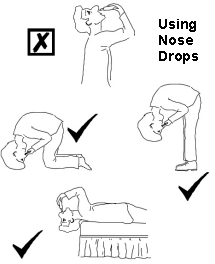
To insert the drops you should kneel, or stand and bend fully down and forwards (as if you were about to stand on your head). Stay with your head down for 3-4 minutes after putting in the drops. This will allow the drops to drain fully to the back of your nostrils. If this is difficult, you can put in the drops by lying on a bed with your head falling back off the edge of the bed.
Steroid tablets
Sometimes a course of steroid tablets (prednisolone) is prescribed for a week or so to reduce inflammation in your nose. This often works very well to shrink the polyps. A course of steroid tablets is a short-term solution, as taking steroid tablets long-term can have important side-effects. It is sometimes used to relieve symptoms when this is needed urgently - for example, if there is an important life event coming up, like an exam or a wedding. It should be used in combination with topical nose steroid drops or sprays.
Surgery
An operation may be advised if polyps are large, or if steroid nose drops or tablets have not worked.
Polypectomy involves removing the polyps with a surgical instrument. It can be done through your nostrils, either with local anaesthetic (awake), or under general anaesthetic. The type of anaesthetic might depend on the number and size of the polyps, where they are and how fit you are for an operation.
Endoscopic sinus surgery is done with a general anaesthetic. It might be done where the polyps are very large and numerous, or where they are seriously blocking your sinuses. The endoscope allows the surgeon to see into the sinuses with a camera and to do the operation in a place that is difficult to reach with normal surgical instruments.
Do nasal polyps come back after surgery?
Some people are prone to repeated nasal polyps. Steroid nasal sprays can be used regularly, long-term, to try to prevent nasal polyps from developing further. Steroid nasal sprays include beclometasone, budesonide, fluticasone, mometasone and triamcinolone. You can buy some of these sprays over the counter (OTC) from pharmacies, without a prescription.
It is best to see a doctor first, to have the correct diagnosis of nasal polyps, before buying medicines and treating yourself.
Regular use of a steroid nasal spray is safe. The amount of steroid in a spray is less than in the drops. Drops are better at clearing polyps if they do come back.
Side-effects of topical steroid medications
These include nasal irritation, sore throat and nosebleeds. About 1 in 10 people using these medications will experience one of these symptoms. Some people are sensitive to a preservative called benzalkonium chloride, found in all all nasal steroid treatments (drops and sprays), except for Flixonase Nasule and Rhinocort Aqua. This preservative can cause irritation of the lining of the nose.
Some side-effects are caused by not using the treatments correctly. It is important to follow the instructions carefully.
Patients who have raised pressure in the eye (glaucoma) should be monitored more closely when using steroid nose sprays or drops. This is because of a small chance of increasing the pressure within the eyes - raised intraocular pressure (IOP).
Other treatments for nasal polyps
Nasal decongestants are often bought from pharmacies to clear a blocked nose. They contain ephedrine or xylometazoline. They are not advised for the treatment of nasal polyps. If they are used for nasal blockage due to other causes (a cold or sinusitis, for instance), they should be stopped within 10 days. Prolonged use of these medicines can actually worsen your symptoms on stopping (so-called rebound). In some cases, inflammation of the nose (rhinitis), which also causes stuffiness and running of the nose, can be caused by such treatments (rhinitis medicamentosa).
Salt water (saline) nasal douches are a cheap and safe treatment which are sometimes used in combination with other treatments.
Are nasal polyps common?
Around 4 in 100 people will develop nasal polyps at some stage in their lives. Nasal polyps can affect anyone but most cases occur in people over the age of 40 years. They are twice as common in men as in women. Nasal polyps are uncommon in children. A child with nasal polyps should also be checked for cystic fibrosis, as cystic fibrosis is a risk factor for developing nasal polyps. (About half of people with cystic fibrosis have nasal polyps.)
Patient picks for Nose and sinuses

Ear, nose and throat
Acute sinusitis
Sinusitis - also known as a sinus infection - is the swelling of the sinuses, often caused by viral or bacterial infections. Most cases are mild and get better within a few weeks, but chronic sinusitis may require medical treatment. This leaflet explains the symptoms, causes, treatment, and prevention of acute sinusitis.
by Dr Surangi Mendis, MRCGP

Ear, nose and throat
Persistent rhinitis
Persistent rhinitis typically causes sneezing and a blocked, itchy and runny nose. An allergy is a common cause but there are also non-allergic causes. Treatment options include avoiding things that cause an allergy, an antihistamine nasal spray, antihistamine tablets and a steroid nasal spray. Other treatments are sometimes used.
by Dr Doug McKechnie, MRCGP
Frequently asked questions
Can a GP diagnose a nasal polyp?
Your GP might suspect you have nasal polyps based on your symptoms and may be able to see a large polyp in the lower part of your nostrils during an examination. However, for a definitive diagnosis, especially for smaller polyps or those located deeper in the sinuses, they will likely refer you to an ear, nose, and throat (ENT) surgeon.
What colour are nasal polyps?
Nasal polyps can be yellowish, grey, or pink in colour. They are soft, fleshy swellings that grow inside the nose.
Can nasal polyps cause nosebleeds?
Nosebleeds can be a side effect of using steroid nose drops or sprays, which are common treatments for nasal polyps. If you experience a bloody discharge from one nostril, it's important to consult your doctor, as this can rarely be a sign of a more serious issue, though it's often due to harmless causes like infection or nose-picking.
Do nasal polyps always look the same?
Nasal polyps can vary greatly in size and appearance. There might be just one, or several can grow together, sometimes resembling a small bunch of grapes on a stem. Their size and location influence whether they are visible from the outside or require an internal examination.
Can nasal decongestants help with polyps?
No, nasal decongestants that contain ephedrine or xylometazoline are not recommended for treating nasal polyps. While they might clear a blocked nose from other causes like a cold, their prolonged use can actually worsen symptoms when stopped, a phenomenon called 'rebound congestion'.
Further reading and references
- Manufacturer's PIL, Nasacort® Nasal Spray; Sanofi, The electronic Medicines Compendium. Dated September 2021.
- Manufacturer's PIL, Beconase Aqueous Nasal Spray; GlaxoSmithKline UK, The electronic Medicines Compendium. Dated October 2020.
- Nasal polyps; NHS 2023
About the authorView full bio

Dr Toni Hazell, FRCGP
MBBS, BSc, FRCGP, DFSRH, Dip GU med, DRCOG, DCH (London, UK, 2000)
Dr. Toni Hazell qualified from St. Mary’s Hospital Medical School and did her VTS at Northwick Park Hospital.
About the reviewerView full bio

Dr Colin Tidy, MRCGP
General Practitioner, Medical Author
MBBS, MRCGP, MRCP (Paediatrics), DCH
Dr Colin Tidy is an NHS Doctor, based in Oxfordshire.
Article history
Article also available in English, German, Spanish, French, Italian, Portuguese, Hindi, Hebrew, Arabic, and Swedish.
Next review due: 22 Sept 2027
23 Sept 2022 | Latest version
Join the conversation
Share your thoughts or experiences with others in our patient communities.

Ask, share, connect.
Browse discussions, ask questions, and share experiences across hundreds of health topics.

Feeling unwell?
Assess your symptoms online for free
Sign up to the Patient newsletter
Your weekly dose of clear, trustworthy health advice - written to help you feel informed, confident and in control.
By subscribing you accept our Privacy Policy. You can unsubscribe at any time. We never sell your data.
More in ear, nose and throat
- Acute sinusitis
- Blocked nose in babies
- Boil in the ear canal
- Decongestants
- Ears and flying
- Epiglottitis
- Globus sensation
- Glue ear
- Hearing loss of older people
- House dust mite and pet allergy
- Laryngitis
- Loss of taste and smell
- Nosebleed
- Otosclerosis
- Sore throat
- Steroid nasal sprays
- Stopping a nose bleed
- Tonsil stones
- Tonsillectomy
- Vestibular neuritis and labyrinthitis