Localised scleroderma
Morphoea
Peer reviewed by Dr Doug McKechnie, MRCGPLast updated by Dr Colin Tidy, MRCGPLast updated 18 Feb 2025
Meets Patient’s editorial guidelines
- DownloadDownload
- Share
- Language
- Discussion
- Audio Version
- Add to preferred sources on Google
Localised scleroderma causes one or more patches of hard skin. There are different types. The common plaque type usually causes no problems (apart from sometimes an unsightly appearance) and tends to fade in time. The linear type can cause problems to underlying tissues such as muscles and bones. Often no treatment is needed for the plaque type but treatment may be advised in more severe cases and for the linear type.
At a glance
Localised scleroderma is a condition that causes areas of skin to become harder than usual.
It only affects the skin, sometimes spreading to tissues underneath like muscles or bones.
The cause is not clear but involves cells making too much collagen in the skin.
Symptoms include thickened, discoloured skin patches, and hair loss in affected areas.
Different types exist, such as plaque morphoea, linear scleroderma, and en coup de sabre.
Treatment varies but may involve creams, light therapy, or medicines affecting the immune system.
What is localised scleroderma?
Scleroderma is a condition that causes areas of the skin to become harder than usual. Hence the name scleroderma, which means hard skin.
There are two kinds of scleroderma.
Localised scleroderma (also known as morphoea or morphea) only affects the skin. In some cases it can spread to the tissues underneath the skin, such as muscles and bones.
Systemic sclerosis affects the skin but may also involve the body's internal organs. See separate leaflet called Systemic sclerosis for more details.
The rest of this leaflet is only about localised scleroderma.
Types of localised scleroderma
There are different types of localised scleroderma. The most common types are:
Plaque morphoea.
Superficial morphoea.
Linear scleroderma.
En coup de sabre.
Generalised morphoea.
Symptoms of localised scleroderma
Localised scleroderma usually comes on gradually. Areas of the skin may be thickened and discoloured, and hair may be lost over the area of scleroderma.
Scleroderma
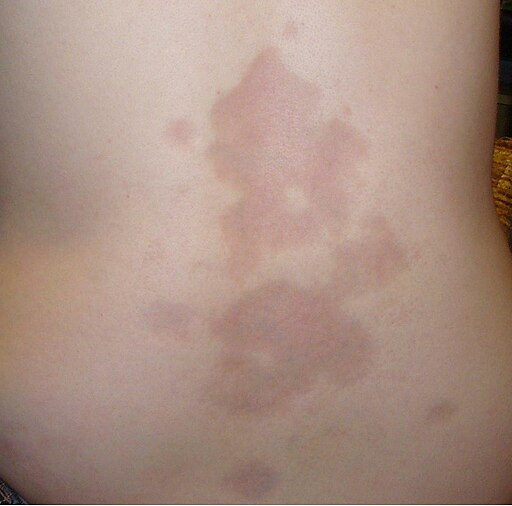
© Leith C Jones at English Wikipedia, CC BY 3.0, via Wikimedia Commons
Plaque morphoea symptoms
Plaque morphoea are oval patches that can range from 2-20 cm across. They start off mauve in colour, then gradually become white. Older patches may become brown. The surface is smooth, shiny and hairless. One to three plaques may develop in different areas of the skin. This type mainly affects adults and usually has no other symptoms or problems, although the affected skin can look unsightly.
Superficial morphoea symptoms
Superficial morphoea is similar to the plaque type. It is typically seen as symmetrical mauve-coloured patches, usually in skin folds of the groin, armpits or under breasts. This type is most commonly found in middle-aged women.
Linear scleroderma symptoms
Linear scleroderma usually occurs on an arm or leg of a child. It is a long, narrow area of thickened skin. In more severe cases the tissues just beneath the skin are affected which may cause scarring (contractures) underneath the skin.
En coup de sabre symptoms
En coup de sabre is a deep form of linear scleroderma affecting the scalp and temple. The name comes from its shape, meaning 'like a sword cut'. Hair is lost over the affected skin, and the skull bone may be shrunk underneath it.
Generalised morphoea symptoms
This is a rare type where there are more plaques spread around different areas of the body.
Causes of localised scleroderma
The cause is not clear. What is known is that cells called fibroblasts make too much of a protein called collagen. The collagen gets deposited in the skin, causing scarring and thickening (fibrosis).
It is not known why the fibroblasts produce too much collagen in the areas of affected skin. It is probably some fault with the immune system. It is sometimes seen after the development of diseases in which the immune system attacks the body's own cells (autoimmune conditions), such as lichen sclerosus and lichen planus. It can also occur after tick bites (Lyme disease), measles, radiotherapy, local injury to the skin and pregnancy. Most of the time, however, there is no obvious cause.
How common is localised scleroderma?
Localised scleroderma is uncommon. The exact number of people affected is not known. However, it is thought that quite a number of cases are not diagnosed. This is because many people who have a small plaque or two of localised scleroderma causing no symptoms may not report it to a doctor.
It is two or three times more common in women than in men. It can occur at any age and is as common in children as it is in adults. About 3 in a million children in the UK and Ireland develop localised scleroderma every year. Children are nine or ten times more likely to develop localised scleroderma than systemic sclerosis.
Diagnosing localised scleroderma
Localised scleroderma can usually be recognised by its appearance. The diagnosis can be confirmed by a biopsy.
A biopsy is a procedure in which a small sample of skin is removed under local anaesthetic and examined under the microscope. Sometimes blood tests can give a clue but there is not a specific blood test for this condition.
In some cases an ultrasound scan or a magnetic resonance imaging (MRI) scan may be used to assess whether the scleroderma is affecting tissues underneath the skin. X-rays are occasionally used to check that children's bones are growing properly.
Treatment for localised scleroderma
The most common form, plaque morphoea, does not always need treatment. This form often does not cause symptoms and often gradually improves or clears away after a number of years.
However, strong creams or ointments are sometimes used as they may help to stop it spreading.
Creams which may be used include:
Cream or ointment containing calcipotriol.
Tacrolimus ointment.
Imiquimod cream.
For other types of localised scleroderma, treatment will vary depending on the individual situation, the severity of the condition and whether underlying tissues are affected. One of the creams or ointments above may be used in some cases. If it is too widespread or too deep or too severe, one or more of the following treatments may be used:
Ultraviolet light therapy.
High-dose steroids.
Medicines affecting the immune system, such as methotrexate or mycophenolate mofetil. Other treatments sometimes used include hydroxychloroquine, ciclosporin, and penicillamine.
Physiotherapy or surgery may help if the skin is very tight or if there is a deformity or scar underneath the skin.
Complications of localised scleroderma
Usually, localised scleroderma does not cause any complications. It is not linked to the systemic sclerosis form of scleroderma and it does not involve internal organs.
Some types of localised scleroderma may affect not only the skin but the tissues directly underneath it such as bone or muscle. This only happens in the deeper types of scleroderma (linear scleroderma and en coup de sabre). In this situation, the scleroderma can affect growth in the underlying tissues and so may cause some degree of deformity. About one third of people with deep localised scleroderma have this type of problem. Rarely, if the affected skin is located on the head, the brain or eye can be affected.
What is the outlook (prognosis)?
Limited plaque morphoea tends to improve with time, often over 3-5 years, but some cases may last for many years with new lesions developing as old one's fade. Some improvement in generalised plaque morphoea is usually seen over a few years, although the condition may last for many years.
The affected areas of skin may gradually go back to normal. However, a brown stain may remain and sometimes a small depressed area of skin. In some cases the plaques remain for many years.
Linear-type localised scleroderma tends to persist for longer but may improve after several years. It may come and go and may flare up after a long time of being settled. However, linear-type localised scleroderma, especially the en coup de sabre subtype, may become more extensive with time. This may cause severe contractures that result in limited movement and permanent disability of an arm or leg. Damage to underlying brain and eye tissue is a potential, serious complication of the en coup de sabre subtype.
Patient picks for Immune system disorders

Allergies, blood and immune system
Henoch-Schönlein purpura
Henoch-Schönlein purpura (HSP) is a rare condition that is caused by inflammation of blood vessels (vasculitis). It particularly affects children. Blood vessels throughout the body are affected but HSP most often causes a skin rash, tummy (abdominal) pain and joint pains.
by Dr Hayley Willacy, FRCGP

Allergies, blood and immune system
Immune thrombocytopenic purpura
In immune thrombocytopenic purpura, antibodies are made against platelets. Once the antibodies have attached to platelets, the platelets do not work so well.
by Dr Colin Tidy, MRCGP
Frequently asked questions
What is the difference between localised scleroderma and systemic sclerosis?
Localised scleroderma, also known as morphoea or morphea, primarily affects only the skin. In some instances, it might extend to the tissues underneath the skin, like muscles and bones. In contrast, systemic sclerosis can affect the skin and may also involve the body's internal organs.
Are all types of localised scleroderma treated the same way?
No, treatment for localised scleroderma varies based on its type, severity, and whether underlying tissues are affected. For example, plaque morphoea often doesn't need treatment as it may improve on its own. Other types, especially if widespread, deep, or severe, might require stronger treatments like ultraviolet light therapy, high-dose steroids, or medicines that affect the immune system.
Can localised scleroderma affect children?
Yes, localised scleroderma can occur at any age and is as common in children as it is in adults. About 3 in a million children in the UK and Ireland develop this condition every year. Children are also nine or ten times more likely to develop localised scleroderma than the more severe systemic sclerosis.
Is localised scleroderma hereditary?
The article does not mention whether localised scleroderma is hereditary or runs in families. It states that the cause is not clear, but is thought to involve fibroblasts producing too much collagen, possibly due to an immune system fault.
Will the affected skin areas ever return to normal after having localised scleroderma?
The affected areas of skin may gradually return to normal over time, though a brown stain or a small depressed area of skin might remain. In some cases, the plaques can persist for many years. Linear-type localised scleroderma tends to last longer, and while it may improve after several years, it can also come and go or flare up again. The en coup de sabre subtype may become more extensive over time.
Further reading and references
- Morphoea; Primary Care Dermatology Society. July 2023.
- Morphoea; DermNet NZ
- Careta MF, Romiti R; Localized scleroderma: clinical spectrum and therapeutic update. An Bras Dermatol. 2015 Jan-Feb;90(1):62-73. doi: 10.1590/abd1806-4841.20152890.
- Wenzel D, Haddadi NS, Afshari K, et al; Upcoming treatments for morphea. Immun Inflamm Dis. 2021 Dec;9(4):1101-1145. doi: 10.1002/iid3.475. Epub 2021 Jul 17.
About the authorView full bio

Dr Colin Tidy, MRCGP
General Practitioner, Medical Author
MBBS, MRCGP, MRCP (Paediatrics), DCH
Dr Colin Tidy is an NHS Doctor, based in Oxfordshire.
About the reviewerView full bio

Dr Doug McKechnie, MRCGP
Medical Writer
MA, MBBS, MSc, DRCOG, MRCP(UK), MRCGP(2021), FHEA
Dr Doug McKechnie is an NHS GP working in London. He works full-time clinically and is also the Deputy Lead for the Clinical and Professional Practice module at University College London Medical School.
Article history
The information on this page is written and peer reviewed by qualified clinicians.
Article also available in English, German, Spanish, French, Italian, Portuguese, Hindi, Hebrew, Arabic, and Swedish.
Next review due: 17 Feb 2028
18 Feb 2025 | Latest version
Join the conversation
Share your thoughts or experiences with others in our patient communities.

Ask, share, connect.
Browse discussions, ask questions, and share experiences across hundreds of health topics.

Feeling unwell?
Assess your symptoms online for free
Sign up to the Patient newsletter
Your weekly dose of clear, trustworthy health advice - written to help you feel informed, confident and in control.
By subscribing you accept our Privacy Policy. You can unsubscribe at any time. We never sell your data.
More in allergies, blood and immune system
- Allergic conjunctivitis
- Behçet's disease
- Blood tests to detect inflammation
- Deep vein thrombosis
- Estimated glomerular filtration rate
- Food allergy and intolerance
- Glucose tolerance test
- Hyponatraemia
- Iron-deficiency anaemia
- Myasthenia gravis
- Polycythaemia rubra vera
- Porphyria
- PSA test
- Sickle cell disease
- Skin prick allergy test
- Stem cell transplant
- Thrombophilia
- Thyroid function tests
- Vaccines and egg allergies
- Vitiligo