Boils, carbuncles and furunculosis
Peer reviewed by Dr Doug McKechnie, MRCGPLast updated by Dr Colin Tidy, MRCGPLast updated 20 Jan 2025
Meets Patient’s editorial guidelines
- DownloadDownload
- Share
- Language
- Discussion
- Audio Version
- Add to preferred sources on Google
A boil (furuncle) is an infection of a hair follicle. A carbuncle occurs when a group of hair follicles next to each other become infected. It is like a multiple boil. Chronic furunculosis is a condition where you have crops of boils that occur over a longer period of time.
At a glance
A boil is a red, tender lump on the skin that fills with pus.
They commonly appear in hairy areas like the face, neck, and armpits.
Boils are caused by bacteria multiplying under the skin.
Small boils may clear up with warm compresses at home.
Larger boils and carbuncles often need a doctor to drain the pus.
Antibiotics may be prescribed to treat the infection.
See a doctor for recurring boils, which may indicate an underlying cause.
What is a boil?
Small boils are very common and often go away without any treatment. But they can be irritating and can also cause distress if they are in a prominent position such as on your face. Larger boils usually need treatment. If you get lots of boils that keep coming or don't go away then you may need some tests to check if there is any underlying cause.
Hidradenitis suppurativa is a long-term (chronic) skin condition, leading to painful and repeated lumps of pus (boils or abscesses).
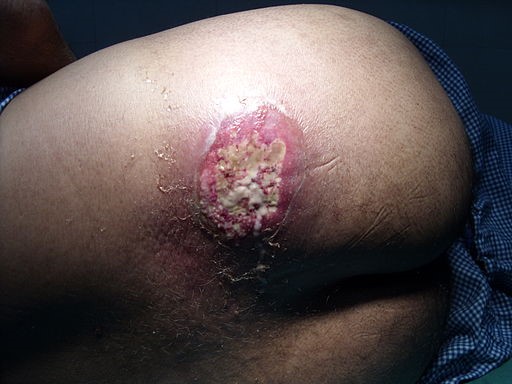
Buttock carbuncle
Sensitive or Graphic Content
Hover or click to display image
© Drvgaikwad, CC BY 3.0, via Wikimedia Commons
See the link for Dermnet NZ in Further Reading below for further images of boils.
What does a boil look like?
Red lump. A boil looks like a small red lump on the skin that is tender.
Swollen skin. The surrounding skin may be swollen and inflamed.
Pus. Thick, infected fluid called pus fills the centre of the boil.
Where do boils usually appear?
A boil on skin can develop in any hairy area of skin. In particular, in sites where there is friction, or where the skin is sweaty. For example, they can appear:
On the neck.
Face.
Armpits.
Arms.
Buttocks.
Around the back passage (anus).
A boil in the ear canal may be very painful.
Carbuncles most commonly develop on the back of the neck or on the thighs.
Risk factors
A boil or carbuncle can occur in anyone at any age. However, they are uncommon in children and most common in teenagers and young adults. You have a higher risk of developing a boil or carbuncle if you:
Skin conditions. Have other skin conditions that may cause you to scratch and damage the skin - for example, eczema or scabies.
Weight. Are very overweight (obese).
Weakened immune system. Have a poor defence against infections (immune system).
Illness. Have an illness making you frail or generally unwell.
Bacteria. Are a carrier of staphylococcal germs (bacteria).
What causes boils?
Germs. Boils are caused by germs (bacteria) multiplying below the skin surface.
Weakened immune system. Your immune system is important in helping you to fight off infection.
That means you have a higher risk of developing a boil or carbuncle if germs get under your skin and your immune system does not kill them quickly enough to stop them multiplying.
Recurring boils causes
If you develop recurring boils (chronic furunculosis), your doctor may suggest some tests to look for an underlying cause.
For example, to check if you have a poor immune system.
You may be prone to boils just because you're generally run down and tired.
But it's important to check there isn't any underlying problem, such as type 2 diabetes.
One cause of recurring boils if you are otherwise healthy is that you, or someone in your family or household, may be a carrier of a special type of staphylococcal germ (bacteria), which is called PVL staphylococcus. This means that a certain number of these bacteria live harmlessly on your skin, or in your nose. If you are a carrier, you tend to be more prone to skin infections and boils. In particular, these bacteria may quickly invade and multiply in broken skin following a minor cut or injury.
Treatment with antibiotics and/or antibiotic nasal cream may clear staphylococcal bacteria from carriers and reduce the chance of boils, or other types of skin infection, from coming back. Always wash your hands to help prevent spreading infection.
Boil treatment
No treatment. Small boils (furuncles) may subside and go without any treatment other than simple home treatment. You can ease pain by covering the boil with a flannel soaked in warm water. Do this for 30 minutes, 3-4 times a day. (Be very careful that the water is not too hot. It is important to avoid the risk of burns from hot water.)
Purulent drainage. Larger boils and carbuncles are best treated by letting the infected fluid (pus) out. Sometimes this is done by a doctor who drains the pus, using a needle and syringe. Sometimes a small cut in the skin is needed to let out the pus (incision and drainage). The wound is covered with a dressing until the skin heals. The skin usually heals quickly once the pus has been drained.
Antibiotics. A course of an antibiotic medicine, such as flucloxacillin, is sometimes prescribed to help clear the infection from the skin. Alternative antibiotics may be needed, such as when an infection is caused by methicillin resistant staphylococcus aureus (MRSA).
What will happen if I do nothing?
Boils. Typically, after several days (sometimes after a week or more) the boil will burst and pus will leak on to the skin. The pain tends to ease when the boil bursts. Once the pus has gone, the infection in the surrounding skin tends to fade away gradually over several days. A scar may be left at the site of the boil.
Carbuncles. A carbuncle tends to increase in size for a few days - up to 3-10 centimetres across, sometimes more. After 5-7 days, various pus-filled lumps appear on the surface and pus leaks on to the skin. It then may break down and form an ulcer on the skin surface before the infection gradually subsides. The skin then gradually heals leaving a deep scar.
While infection and pus are in the skin, there is a risk that some germs (bacteria) may spread in the bloodstream to cause infections in other parts of the body (sepsis). This is very uncommon but, if it happens, it can lead to serious infections of a bone, the brain, or other parts of the body.
Patient picks for Skin infections

Infections
Mpox virus
Mpox, previously known as monkeypox, is a viral infection caused by the mpox (monkeypox) virus. It is very similar to the smallpox virus but causes fewer deaths. It was previously thought not to be very infectious but it seems to be spreading more easily in recent years. There is an effective vaccine that works against smallpox which also works against mpox.
by Dr Philippa Vincent, MRCGP

Infections
Scabies
Scabies is a very itchy skin infestation caused by a tiny mite. It is spread by close contact, such as living with someone or sharing a bed.
by Dr Toni Hazell, FRCGP
Frequently asked questions
Can stress cause boils?
While stress isn't directly listed as a cause, the article mentions that if you are generally run down and tired, you may be more prone to boils. Stress can certainly contribute to feeling run down.
Why do I keep getting boils in the same spot?
Recurring boils, especially in the same spot, could be due to a few reasons. One possibility is that you, or someone in your household, might be a carrier of a specific type of staphylococcal germ (PVL staphylococcus). These bacteria can live harmlessly on your skin or in your nose, but if they enter a minor cut or injury, they can multiply and cause boils. Antibiotic treatment might be suggested to clear these bacteria and reduce the chance of boils returning.
Are boils a sign of being run down?
Yes, if you are generally run down and tired, you may be more prone to developing boils. While this can be a simple explanation, it's also important for your doctor to rule out any underlying medical problems, such as type 2 diabetes, if you experience recurring boils.
What is inside a boil?
A boil is filled with a thick, infected fluid known as pus. This pus collects in the centre of the boil, making it a tender and swollen lump on the skin.
Further reading and references
- Boils; DermNet NZ
- Folliculitis and boils (furuncles / carbuncles); The Primary Care Dermatology Society. Last updated May 2022.
- Boils, carbuncles, and staphylococcal carriage; NICE CKS, May 2024 (UK access only)
- Shallcross LJ, Hayward AC, Johnson AM, et al; Incidence and recurrence of boils and abscesses within the first year: a cohort study in UK primary care. Br J Gen Pract. 2015 Oct;65(639):e668-76. doi: 10.3399/bjgp15X686929.
About the authorView full bio

Dr Colin Tidy, MRCGP
General Practitioner, Medical Author
MBBS, MRCGP, MRCP (Paediatrics), DCH
Dr Colin Tidy is an NHS Doctor, based in Oxfordshire.
About the reviewerView full bio

Dr Doug McKechnie, MRCGP
Medical Writer
MA, MBBS, MSc, DRCOG, MRCP(UK), MRCGP(2021), FHEA
Dr Doug McKechnie is an NHS GP working in London. He works full-time clinically and is also the Deputy Lead for the Clinical and Professional Practice module at University College London Medical School.
Article history
The information on this page is written and peer reviewed by qualified clinicians.
Article also available in English, German, Spanish, French, Italian, Portuguese, Hindi, Hebrew, Arabic, and Swedish.
Next review due: 19 Jan 2028
20 Jan 2025 | Latest version
Join the conversation
Share your thoughts or experiences with others in our patient communities.

Ask, share, connect.
Browse discussions, ask questions, and share experiences across hundreds of health topics.

Feeling unwell?
Assess your symptoms online for free
Sign up to the Patient newsletter
Your weekly dose of clear, trustworthy health advice - written to help you feel informed, confident and in control.
By subscribing you accept our Privacy Policy. You can unsubscribe at any time. We never sell your data.
More in infections
- 6-in-1 vaccine
- Antifungal medication
- Head lice and nits
- Hepatitis A vaccine
- Hepatitis B vaccine
- HPV vaccine
- Immunisation
- Immunisation for flu
- Mpox virus
- Mucolytics
- Pityriasis versicolor
- Recurrent cystitis in women
- Scabies
- Strep A
- Symptoms of sepsis in children
- Typhoid vaccine
- Urine infection in children
- Urine infection in pregnancy
- Vestibular neuritis and labyrinthitis
- Yellow fever vaccine