Esclerodermia localizada
Morféia
Revisado por Dr Doug McKechnie, MRCGPÚltima atualização por Dr Colin Tidy, MRCGPÚltima atualização 18 Fev 2025
Atende aos diretrizes editoriais
- BaixarBaixar
- Compartilhar
- Language
- Discussão
- Versão em Áudio
- Adicionar às fontes preferidas no Google
Esclerodermia localizada causes one or more patches of hard skin. There are different types. The common plaque type usually causes no problems (apart from sometimes an unsightly appearance) and tends to fade in time. The linear type can cause problems to underlying tissues such as muscles and bones. Often no treatment is needed for the plaque type but treatment may be advised in more severe cases and for the linear type.
Em resumo
Localised scleroderma is a condition where areas of the skin become harder than usual.
It only affects the skin and sometimes the tissues underneath, but not internal organs.
Symptoms include thickened, discoloured skin patches, and hair loss in affected areas.
The cause is not fully clear, but it involves too much collagen being deposited in the skin.
Diagnosis is usually by appearance; a skin biopsy can confirm it.
Treatment depends on the type and severity; creams, light therapy, or medicines may be used.
Most types improve over time, but some deeper types can cause deformity.
Neste artigo:
Escolhas de vídeos para Problemas autoimunes
Continue lendo abaixo
What is localised scleroderma?
Scleroderma is a condition that causes areas of the skin to become harder than usual. Hence the name scleroderma, which means hard skin.
There are two kinds of scleroderma.
Localised scleroderma (also known as morphoea or morphea) only affects the skin. In some cases it can spread to the tissues underneath the skin, such as muscles and bones.
Esclerose sistêmica affects the skin but may also involve the body's internal organs. See separate leaflet called Systemic sclerosis for more details.
The rest of this leaflet is only about localised scleroderma.
Types of localised scleroderma
Voltar ao conteúdoThere are different types of localised scleroderma. The most common types are:
Plaque morphoea.
Superficial morphoea.
Linear scleroderma.
En coup de sabre.
Generalised morphoea.
Continue lendo abaixo
Symptoms of localised scleroderma
Voltar ao conteúdoLocalised scleroderma usually comes on gradually. Areas of the skin may be thickened and discoloured, and hair may be lost over the area of scleroderma.
Esclerodermia
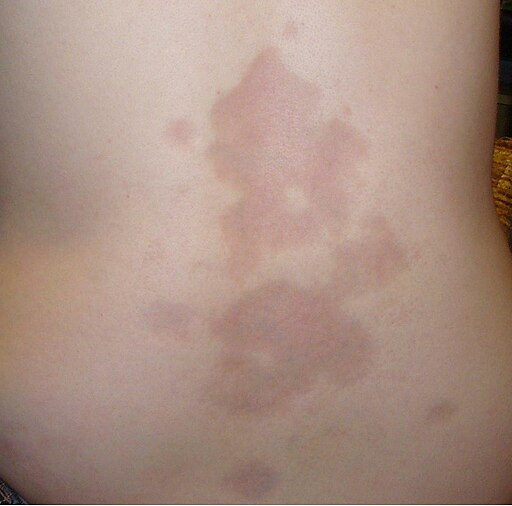
© Leith C Jones at English Wikipedia, CC BY 3.0, via Wikimedia Commons
Plaque morphoea symptoms
Plaque morphoea are oval patches that can range from 2-20 cm across. They start off mauve in colour, then gradually become white. Older patches may become brown. The surface is smooth, shiny and hairless. One to three plaques may develop in different areas of the skin. This type mainly affects adults and usually has no other symptoms or problems, although the affected skin can look unsightly.
Superficial morphoea symptoms
Superficial morphoea is similar to the plaque type. It is typically seen as symmetrical mauve-coloured patches, usually in skin folds of the groin, armpits or under breasts. This type is most commonly found in middle-aged women.
Linear scleroderma sintomas
Linear scleroderma usually occurs on an arm or leg of a child. It is a long, narrow area of thickened skin. In more severe cases the tissues just beneath the skin are affected which may cause scarring (contractures) underneath the skin.
En coup de sabre symptoms
En coup de sabre is a deep form of linear scleroderma affecting the scalp and temple. The name comes from its shape, meaning 'like a sword cut'. Hair is lost over the affected skin, and the skull bone may be shrunk underneath it.
Generalised morphoea symptoms
This is a rare type where there are more plaques spread around different areas of the body.
Causes of localised scleroderma
Voltar ao conteúdoThe cause is not clear. What is known is that cells called fibroblasts make too much of a protein called collagen. The collagen gets deposited in the skin, causing scarring and thickening (fibrosis).
It is not known why the fibroblasts produce too much collagen in the areas of affected skin. It is probably some fault with the immune system. It is sometimes seen after the development of diseases in which the immune system attacks the body's own cells (autoimmune conditions), such as líquen escleroso e líquen plano. It can also occur after tick bites (Lyme disease), sarampo, radioterapia, local injury to the skin and pregnancy. Most of the time, however, there is no obvious cause.
Continue lendo abaixo
How common is localised scleroderma?
Voltar ao conteúdoLocalised scleroderma is uncommon. The exact number of people affected is not known. However, it is thought that quite a number of cases are not diagnosed. This is because many people who have a small plaque or two of localised scleroderma causing no symptoms may not report it to a doctor.
It is two or three times more common in women than in men. It can occur at any age and is as common in children as it is in adults. About 3 in a million children in the UK and Ireland develop localised scleroderma every year. Children are nine or ten times more likely to develop localised scleroderma than systemic sclerosis.
Diagnosing localised scleroderma
Voltar ao conteúdoLocalised scleroderma can usually be recognised by its appearance. The diagnosis can be confirmed by a biópsia.
A biopsy is a procedure in which a small sample of skin is removed under local anaesthetic and examined under the microscope. Sometimes blood tests can give a clue but there is not a specific blood test for this condition.
In some cases uma ultrassonografia ou uma ressonância magnética (RM) may be used to assess whether the scleroderma is affecting tissues underneath the skin. X-rays are occasionally used to check that children's bones are growing properly.
Treatment for localised scleroderma
Voltar ao conteúdoThe most common form, plaque morphoea, does not always need treatment. This form often does not cause symptoms and often gradually improves or clears away after a number of years.
However, strong creams or ointments are sometimes used as they may help to stop it spreading.
Creams which may be used include:
Cream or ointment containing calcipotriol.
Tacrolimo ointment.
Imiquimod cream.
For other types of localised scleroderma, treatment will vary depending on the individual situation, the severity of the condition and whether underlying tissues are affected. One of the creams or ointments above may be used in some cases. If it is too widespread or too deep or too severe, one or more of the following treatments may be used:
Ultraviolet light therapy.
High-dose esteroides.
Medicines affecting the immune system, such as metotrexato or mycophenolate mofetil. Other treatments sometimes used include hydroxychloroquine, ciclosporin, and penicillamine.
Physiotherapy or surgery may help if the skin is very tight or if there is a deformity or scar underneath the skin.
Complications of localised scleroderma
Voltar ao conteúdoUsually, localised scleroderma does not cause any complications. It is not linked to the systemic sclerosis form of scleroderma and it does not involve internal organs.
Some types of localised scleroderma may affect not only the skin but the tissues directly underneath it such as bone or muscle. This only happens in the deeper types of scleroderma (linear scleroderma and en coup de sabre). In this situation, the scleroderma can affect growth in the underlying tissues and so may cause some degree of deformity. About one third of people with deep localised scleroderma have this type of problem. Rarely, if the affected skin is located on the head, the brain or eye can be affected.
Qual é a perspectiva (prognóstico)?
Voltar ao conteúdoLimited plaque morphoea tends to improve with time, often over 3-5 years, but some cases may last for many years with new lesions developing as old one's fade. Some improvement in generalised plaque morphoea is usually seen over a few years, although the condition may last for many years.
The affected areas of skin may gradually go back to normal. However, a brown stain may remain and sometimes a small depressed area of skin. In some cases the plaques remain for many years.
Linear-type localised scleroderma tends to persist for longer but may improve after several years. It may come and go and may flare up after a long time of being settled. However, linear-type localised scleroderma, especially the en coup de sabre subtype, may become more extensive with time. This may cause severe contractures that result in limited movement and permanent disability of an arm or leg. Damage to underlying brain and eye tissue is a potential, serious complication of the en coup de sabre subtype.
Escolhas do paciente para Problemas autoimunes

Alergias, sangue e sistema imunológico
Mastocitose e distúrbios de mastócitos
Um mastócito é um tipo de glóbulo branco. Existem várias formas de mastocitose. Em uma delas, há mastócitos em excesso no corpo; em outra, o número de mastócitos é normal, mas eles são muito ativos.
por Dr. Laurence Knott

Alergias, sangue e sistema imunológico
Doença de Behçet
A doença de Behçet (também conhecida como síndrome de Behçet) é uma condição rara que causa úlceras frequentes na boca e na área genital e pode afetar diferentes partes do corpo. Afeta mais comumente os olhos e a pele. É mais comum em pessoas de países mediterrâneos e também naquelas do Oriente Médio e da Ásia Oriental. Vários tratamentos estão disponíveis que ajudam a reduzir complicações a longo prazo.
por Dra. Rosalyn Adleman, MRCGP
Perguntas frequentes
Can localised scleroderma spread to other parts of my body or become systemic?
No, localised scleroderma only affects the skin, and sometimes the tissues directly underneath it like muscle or bone. It is explicitly stated that it is not linked to the systemic sclerosis form of scleroderma and does not involve internal organs.
Are specific types of localised scleroderma more common in certain age groups or genders?
Yes, plaque morphoea mainly affects adults, while superficial morphoea is most commonly found in middle-aged women. Linear scleroderma usually occurs on an arm or leg of a child. Overall, localised scleroderma is two or three times more common in women than in men and can occur at any age, being as common in children as in adults.
If I have localised scleroderma, will the changes to my skin be permanent?
Limited plaque morphoea often improves over 3-5 years, and some improvement is usually seen in generalised plaque morphoea over a few years, though new lesions can appear as old ones fade. While the affected areas may gradually return to normal, a brown stain or a small depressed area of skin might remain in some cases. Linear-type localised scleroderma can persist for longer, sometimes causing severe contractures or permanent disability, and the en coup de sabre subtype may become more extensive over time.
Is it possible for localised scleroderma to return after it has cleared up?
Yes, in some types like limited plaque morphoea, new lesions can develop even as older ones fade. Linear-type localised scleroderma may also come and go, and can flare up after being settled for a long time.
How can doctors tell the difference between localised scleroderma and other skin conditions?
Localised scleroderma can usually be recognised by its appearance. The diagnosis can be confirmed by a biopsy, which involves examining a small skin sample under a microscope. While blood tests can sometimes provide clues, there isn't a specific blood test for this condition.
Does having localised scleroderma increase my risk of developing other autoimmune conditions?
The article states that localised scleroderma is sometimes seen after the development of other autoimmune conditions like lichen sclerosus and lichen planus, suggesting a potential link or co-occurrence, but it doesn't explicitly state that having it increases the risk of developing others.
Leitura adicional e referências
- Morféia; Primary Care Dermatology Society. July 2023.
- Morféia; DermNet NZ
- Careta MF, Romiti R; Localized scleroderma: clinical spectrum and therapeutic update. An Bras Dermatol. 2015 Jan-Feb;90(1):62-73. doi: 10.1590/abd1806-4841.20152890.
- Wenzel D, Haddadi NS, Afshari K, et al; Upcoming treatments for morphea. Immun Inflamm Dis. 2021 Dec;9(4):1101-1145. doi: 10.1002/iid3.475. Epub 2021 Jul 17.
Continue lendo abaixo
Sobre o autorVer biografia completa

Dr Colin Tidy, MRCGP
Médico Generalista, Autor Médico
MBBS, MRCGP, MRCP (Paediatrics), DCH
Dr Colin Tidy é um médico do NHS, baseado em Oxfordshire.
Sobre o revisorVer biografia completa

Dr Doug McKechnie, MRCGP
Redator Médico
MA, MBBS, MSc, DRCOG, MRCP(UK), MRCGP(2021), FHEA
O Dr. Doug McKechnie é um médico do NHS que trabalha em Londres. Ele trabalha em tempo integral na prática clínica e também é o Vice-Líder do módulo de Prática Clínica e Profissional na Faculdade de Medicina da University College London.
Histórico do artigo
As informações nesta página são escritas e revisadas por clínicos qualificados.
Próxima revisão prevista: 17 Fev 2028
18 Fev 2025 | Última versão

Pergunte, compartilhe, conecte-se.
Navegue por discussões, faça perguntas e compartilhe experiências em centenas de tópicos de saúde.

Sentindo-se mal?
Avalie seus sintomas online gratuitamente
Inscreva-se no boletim informativo do Patient
Sua dose semanal de conselhos de saúde claros e confiáveis - escritos para ajudá-lo a se sentir informado, confiante e no controle.
Ao se inscrever, você aceita nossos Política de Privacidade. Você pode cancelar a inscrição a qualquer momento. Nunca vendemos seus dados.