Tear duct blockage in babies
Peer reviewed by Dr Toni Hazell, FRCGPLast updated by Dr Doug McKechnie, MRCGPLast updated 11 Aug 2025
Meets Patient’s editorial guidelines
- DownloadDownload
- Share
- Language
- Discussion
- Audio Version
- Add to preferred sources on Google
Tear duct blockage means that there is a blockage of the tiny channels (ducts) that drain tears from the inside corner of the eye into the side of nose. Many babies are born with blocked tear ducts. They usually open up without any treatment by the time they are one year old.
At a glance
A blocked tear duct is common in babies, affecting up to 1 in 5 newborns.
It happens when tear ducts haven't fully developed or opened yet.
Symptoms include watery eyes or a sticky discharge.
Most blocked tear ducts open on their own by the time a baby is one year old.
Gently massaging the tear duct can help drain tears.
See a doctor if your baby's eye is very red, inflamed, or if there is swelling.
What causes tear duct blockage in babies?
Many babies are born with a blocked tear duct. This happens when the tear ducts haven't fully developed and opened up yet. This can be due to:
A membrane (web of tissue) that hasn't yet broken down, and is blocking the tear duct.
A tear duct that is too narrow.
We don't know why this affects some babies and not others, although it's thought that some babies might inherit genetic variations that mean their tear ducts take a bit longer to fully develop.
It's also more likely to happen in babies who were born prematurely, and in babies with conditions that affect the shape of their face, such as Down's syndrome. But most babies with a blocked tear duct don't have any other health conditions.
Blocked tear ducts usually open after a bit more time for them to develop fully. For 9 out of 10 children, the tear duct opens up on its own by the time they are one year old.
Blocked tear ducts are common in babies and usually don't cause any serious problems. There are some rare complications to be aware of. See "When should you take your baby to see a doctor?" below for more.
In most babies, a blocked tear duct will simply get better with time, without causing any problems.
What are tear ducts for?
The surface of the eye is kept moist by watery fluid (tears). This is really important to prevent any damage to the sensitive surface of the eye. The tears help to remove any dust or dirt from the surface of the eye. The tears are made in glands called the lacrimal glands, which are just above the outside corner of the eye, below the eyebrow.
Close-up view
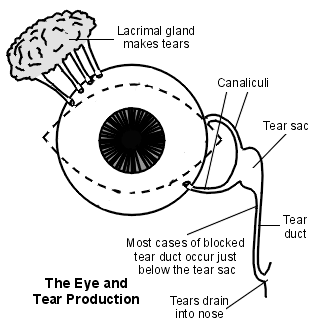
The lacrimal glands constantly make a small amount of tears which drains on to the eye.
When we blink, the eyelid spreads the tears all over the surface of the eye. Any excess tears drain out of the eye by passing through the small channels of the tear duct (nasolacrimal duct) and into the nose. (This is why your nose starts running if you are crying - the extra tears produced are going into your nose.)
There are also tiny glands (called meibomian glands) in the eyelids, which make a small amount of oily liquid. This oily liquid also helps to protect the surface of the eyes.
In babies with tear duct blockage, these tears don't drain into the nose properly. This means their tears back up in their eyes, and the can become more watery. The tears can also form a sticky discharge on, and around, the eyes.
How common is tear duct blockage in babies?
Blockage of the tear duct is common in babies, occurring in up to 1 in 5 newborns. It is usually because the tear duct has not completely developed by the time of the birth. The blockage of the tear duct can affect just one eye or both eyes.
Abnormalities of the eye or the eyelids can also cause a blockage of the tears in babies but this is very rare.
What are the symptoms of a blocked tear duct?
Tear duct blockage in babies can cause:
Watery eyes.
'Sticky eyes' - a white or yellowish discharge on the corner of the eyes, which might cause the eyelids to stick together.
Slight redness of the eyelids or eyes, if your child has been rubbing their eyes. (If the eye has become very red, it could be a sign of infection - see 'When should you take your baby to see a doctor?' below).
It may take until a week or two after birth before the tear glands (lacrimal glands) start to make tears. So, you may not notice your baby having watery eyes until they are a week or two old.
The symptoms are usually worse if your child has a cold, and can also be worse in cold weather.
You might notice that their eyes have a sticky discharge, particularly first thing in the morning. If their eye isn't red, this isn't due to an infection, but is just dried tear residue. It can be cleared away using clean water and cotton wool.
Complications of a blocked tear duct in babies
Most babies with tear duct blockages don't get any other problems.
Rarely, it can cause other issues. These include:
The duct not opening up on its own. For most babies, the tear ducts simply open up as they grow, and should have opened in most babies by the time they are one year old. If they haven't opened by the time they are one, a small procedure to open up the tear ducts may be required.
Infection of the outer part of the eye (infective conjunctivitis). This causes the eye to look inflamed and red, and may also cause a sticky discharge. This is not usually serious and can be easily treated.
Infection of the tear sac (dacryocystitis). This is rare. This causes redness and swelling between the inner corner of the eye and the nose. It is often treated with antibiotics.
Infection of the skin and soft tissues around the eye (preseptal cellulitis). This causes the skin around the eye to become swollen, red, and inflamed. It's rare, and usually a mild infection, but can occasionally lead to a more serious infection (orbital cellulitis), so usually needs antibiotic treatment.
A collection of fluid in the tear duct (a dacryocoele). This causes a swelling, usually blueish, between the nose and the corner of the eye. This can go away on its own, but often needs a small procedure to get rid of it.
When should you take your baby to see a doctor?
If your baby has a watery or sticky eye, you can usually treat it at home without seeing a doctor.
You should take your baby to see a doctor if:
Your baby's eye is inflamed, angry or red.
Your baby does not seem to want to open his or her eye, or light seems to hurt your baby's eye.
Your baby has swelling or redness between the inner corner of their eye and their nose.
Your baby has red or swollen skin around their eyes.
Your baby still has symptoms of a blocked tear duct when they are one year old, or older.
You are concerned or worried about your baby.
What treatment is there for a tear duct blockage?
In most babies, their tear duct opens up fully as they grow. It often happens in the first few months but can take up to a year.
So, for most babies, no treatment is needed, because the problem will go away on its own with time.
Simple massage of the tear duct of your baby can help drain the tears. Use gentle pressure with your finger on the outside of your baby's nose and then stroke downwards towards the point of the nose. This should be repeated regularly (5-10 times) each day. This can help to clear the excess tears that have become blocked. It may also help the tear duct to develop.
If your baby's eye seems sticky or crusty then this can be gently wiped away using a soft damp cloth or cotton pad. Moisten the cloth or pad with sterile water (use boiled water that has then cooled down).
If complications happen then other treatment may be required. This can include antibiotics and sometimes surgical procedures.
After 12 months of age
In most babies, the tear duct blockage clears by the time they are 12 months old.
If it hasn't cleared by this time, it is less likely to clear up on its own. So, if the problem is still there when they are 12 months old, your baby may be referred to an eye specialist.
The specialist may recommend a procedure (tear duct probing) to open up the tear ducts. This is a simple and safe operation that is very effective. It is done using a general anaesthetic and children can usually go home later in the day after the operation.
Your baby might also be referred to a specialist earlier if the blocked tear duct has caused a complication, or if it's thought that they might have a rare condition affecting the tear drainage that needs different treatment.
Patient picks for Baby and toddler

Children's health
Feeding your baby
This leaflet is about feeding your baby, from birth to 1 year old and onwards. It offers advice about various different approaches to your baby's nutrition. No single one of them is the only 'right' way to do things; all have advantages and disadvantages. In the end, how you feed your baby will be a personal choice for you which will depend on many factors individual to you, your baby and your family.
by Dr Mary Elisabeth Lowth, FRCGP

Children's health
Bottle-feeding your baby
Bottle-feeding is something you need to prepare for by buying equipment, choosing formula and making up bottles in advance of needing them.
by Dr Rachel Hudson, MRCGP
Frequently asked questions
What is the primary function of tear ducts and tears?
Tear ducts are part of the eye's drainage system. Tears, produced by lacrimal glands, keep the eye's surface moist, which is crucial for preventing damage. They also help remove dust and dirt from the eye. After lubricating the eye, excess tears drain through the tear ducts into the nose.
Why would my baby's nose run when they are crying due to a blocked tear duct?
When a baby with a blocked tear duct cries and produces extra tears, these tears will back up in their eyes. The tears that do manage to enter the drainage system still go into the nose, which is why your baby's nose might run during crying.
Does a sticky discharge in my baby's eye always mean an infection?
No, a sticky discharge, particularly first thing in the morning, isn't necessarily a sign of infection, especially if the eye isn't red. It can simply be dried tear residue due to the tears not draining properly. This can usually be cleared away with clean water and cotton wool.
Are there any rare but serious complications of a blocked tear duct that I should be aware of?
While most blockages are harmless, rare complications can include infection of the tear sac (dacryocystitis), which causes redness and swelling between the eye and nose, or preseptal cellulitis, an infection of the skin around the eye. Another rare issue is a dacryocoele, a bluish swelling between the nose and eye due to fluid collection in the tear duct.
Will a blocked tear duct affect both of my baby's eyes?
A blocked tear duct can affect just one eye or both eyes. It varies from baby to baby.
Further reading and references
- Takahashi Y, Kakizaki H, Chan WO, et al; Management of congenital nasolacrimal duct obstruction. Acta Ophthalmol. 2009 Jul 21.
- Resolution of congenital nasolacrimal duct obstruction with nonsurgical management; Arch Ophthalmol. 2012 Jun;130(6):730-4. doi: 10.1001/archophthalmol.2012.454.
- Petris C, Liu D; Probing for congenital nasolacrimal duct obstruction. Cochrane Database Syst Rev. 2017 Jul 12;7:CD011109. doi: 10.1002/14651858.CD011109.pub2.
- Vagge A, Ferro Desideri L, Nucci P, et al; Congenital Nasolacrimal Duct Obstruction (CNLDO): A Review. Diseases. 2018 Oct 22;6(4). pii: diseases6040096. doi: 10.3390/diseases6040096.
- Avram E; Insights in the treatment of congenital nasolacrimal duct obstruction. Rom J Ophthalmol. 2017 Apr-Jun;61(2):101-106. doi: 10.22336/rjo.2017.19.
About the authorView full bio

Dr Doug McKechnie, MRCGP
Medical Writer
MA, MBBS, MSc, DRCOG, MRCP(UK), MRCGP(2021), FHEA
Dr Doug McKechnie is an NHS GP working in London. He works full-time clinically and is also the Deputy Lead for the Clinical and Professional Practice module at University College London Medical School.
About the reviewerView full bio

Dr Toni Hazell, FRCGP
MBBS, BSc, FRCGP, DFSRH, Dip GU med, DRCOG, DCH (London, UK, 2000)
Dr. Toni Hazell qualified from St. Mary’s Hospital Medical School and did her VTS at Northwick Park Hospital.
Article history
The information on this page is written and peer reviewed by qualified clinicians.
Article also available in English, German, Spanish, French, Italian, Portuguese, Hindi, Hebrew, Arabic, and Swedish.
Next review due: 10 Aug 2025
11 Aug 2025 | Latest version
Join the conversation
Share your thoughts or experiences with others in our patient communities.

Ask, share, connect.
Browse discussions, ask questions, and share experiences across hundreds of health topics.

Feeling unwell?
Assess your symptoms online for free
Sign up to the Patient newsletter
Your weekly dose of clear, trustworthy health advice - written to help you feel informed, confident and in control.
By subscribing you accept our Privacy Policy. You can unsubscribe at any time. We never sell your data.
More in children's health
- Adrenarche
- BCG immunisation
- Bedwetting alarms
- Childhood leukaemias
- Congenital pulmonary airway malformation
- Constipation in children
- Duchenne muscular dystrophy
- Ehlers-Danlos syndrome
- Glycogen storage disorders
- Juvenile idiopathic arthritis
- Kawasaki disease
- Marfan syndrome
- Mumps
- Respiratory syncytial virus (RSV)
- Restricted growth
- Roseola
- Rotavirus
- Threadworms
- Whooping cough