Hipermetropia
Long-sightedness
Revisado por Dr Philippa Vincent, MRCGPÚltima atualização por Dr Colin Tidy, MRCGPÚltima atualização 12 Jan 2024
Atende aos diretrizes editoriais
- BaixarBaixar
- Compartilhar
- Language
- Discussão
- Versão em Áudio
Nesta série:Presbiopia
O nome médico para hipermetropia é hipermetropia, às vezes chamada de hiperopia. Problemas de visão, como hipermetropia, também são conhecidos como erros refrativos. A hipermetropia leva a problemas com a visão de perto (ver coisas que estão próximas) e os olhos podem comumente ficar cansados. A visão à distância (visão de longe) é, no início, boa. A hipermetropia pode ser corrigida com óculos, lentes de contato ou cirurgia ocular a laser.
Neste artigo:
Vídeos selecionados para Condições oculares
Continue lendo abaixo
O que é hipermetropia?
Hypermetropia (long-sightedness) is a refractive error and occurs when light from near objects is not quite brought to focus in time to hit the retina. The point of focus would in fact fall behind the retina, if the light could get that far.
The lens tries hard to change its thickness (becomes fatter or more rounded) in an attempt to bring the light into focus on the retina - a process called accommodation.
However, people with long sight cannot accommodate fully and so the light does not focus on the retina and vision is blurred. This occurs because the eyeball is too short, the cornea is too flat (and so bends the light rays less), or the lens cannot become round enough (and so lacks power).
People with a mild hypermetropia can usually see at distance, as this light does not need to be bent as much in order to focus it on the retina.
Their near sight may also be clear. However, they may get tiring of the eyes, often with a headache and vision discomfort, because the lens is having to work so hard. People with more severe hypermetropia are not able to see objects close to them clearly in focus.
Long sight means exactly what the term suggests: you can see objects which are a long distance from you quite clearly.
long sight
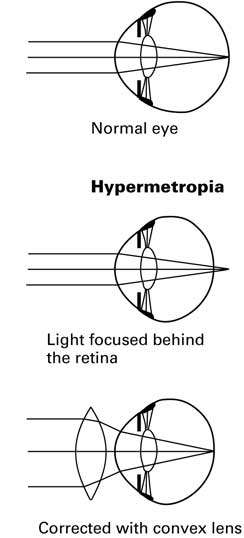
The diagram above shows the differences in focusing between a normal and a long-sighted (hypermetropic) eye.
O que é um erro refrativo?
Voltar ao conteúdoBefore we can understand hypermetropia, we need to understand refractive errors.
A refractive error is an eyesight problem. Refractive errors are the most common reason worldwide for reduced level of eyesight (visual acuity).
Corte transversal do olho
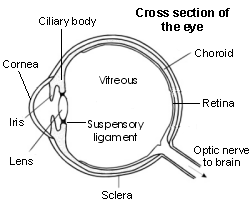
Refraction refers to the bending of light, in this case by the eye, in order to focus it. A refractive error means that the eye cannot focus light on to the retina properly. This usually occurs either due to abnormalities in the shape of the eyeball, or because age has affected the workings of the focusing parts of the eye.
Existem quatro tipos de erro refrativo:
Short-sightedness (miopia).
Long-sightedness (hypermetropia).
Age-related long sight (presbyopia).
Astigmatismo (a refractive error due to an unevenly curved cornea).
Para entender completamente os erros refrativos, é útil saber como enxergamos.
When we look at an object, light rays from the object pass through the eye to reach the retina. This causes nerve messages to be sent from the cells of the retina, down the optic nerve, to the vision centres in the brain. The brain processes the information it receives, resulting in an image that we can see.
Focando o olho
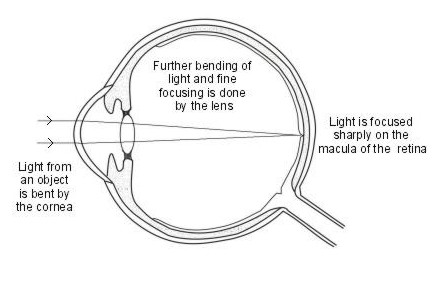
Light rays come off an object in all directions, as they result from the light around us bouncing back off the object. The part of this bounced light that come into the eye from an object needs to be focused on a small area of the retina. If this doesn't happen, what we look at will be blurred.
The cornea and lens have the job of focusing light. The cornea does most of the work, as it bends (refracts) the light rays which then go through the lens, which finely adjusts the focusing. The lens does this by changing its thickness. This is called accommodation. The lens is elastic and can become flatter or more rounded. The more rounded (convex) the lens, the more the light rays can be bent inwards.
The shape of the lens is varied by small muscles in the ciliary body. Tiny string-like structures called the suspensory ligaments are attached at one end to the lens and at the other to the ciliary body. This is a bit like a trampoline with the central bouncy bit being the lens, the suspensory ligaments being the springs and the ciliary muscles being the rim around the edge.
Quando os músculos ciliares no corpo ciliar se contraem, os ligamentos suspensores afrouxam, fazendo com que a lente fique mais espessa. Isso acontece para objetos próximos. Para olhar objetos distantes, o músculo ciliar relaxa, fazendo com que os ligamentos suspensores se tensionem, e a lente se afina.
Mais curvatura (refração) dos raios de luz é necessária para focar em objetos próximos, como ao ler. Menos curvatura da luz é necessária para focar em objetos distantes.
Continue lendo abaixo
What are the symptoms of hypermetropia?
Voltar ao conteúdoThe main symptom is a difficulty with near vision.
Other common symptoms of hypermetropia (long sight) include:
'Tiring' of the eyes (asthenopia).
Uncomfortable vision.
Difficulties seeing with both eyes (binocular vision).
Long-sighted people may have difficulty with depth perception (3-dimensional vision), as this needs two eyes to work together, more or less equally.
What causes hypermetropia?
Voltar ao conteúdoThe causes of hypermetropia (long sight) are usually hereditary (genetic). Long sight can occur at any age but it tends to become more noticeable above the age of 40 years.
In rare cases, long sight is caused by other conditions such as diabetes, small eye syndrome (microphthalmia), cancers around the eye and problems with the blood vessels in the retina.
Many babies and very young children tend to be slightly long-sighted but usually grow out of this by about 3 years of age.
A particular type of age-related long sight (presbyopia) occurs because the lens of the eye becomes more stiff with age.
Continue lendo abaixo
Complications of hypermetropia
Voltar ao conteúdoIf severe hypermetropia (long sight) is present from a very young age, lazy eye (amblyopia) can result. The eye with less good vision does not learn to see properly because the brain ignores its signals and concentrates only on the better eye.
Visual development in the brain occurs in the first few years of life and if this problem is not spotted until after vision has finished developing, the poorer eye will not fully develop its 'information route' into the brain, so will never see as well.
What is the treatment for hypermetropia?
Voltar ao conteúdoÓculos
The simplest, cheapest and safest way to correct long sight is with glasses. Convex prescription lenses (called plus lenses) are used to bend light rays slightly inwards to give a little bit of additional focusing power to the eye.
The light rays then have a lesser angle to bend travelling through the cornea and lens and the lens has less work to do. As a result, the light rays are able to focus on the retina. There is an enormous choice of spectacle frames available, to suit all budgets, faces, and personal styles.
Lentes de contato
These do the same job as glasses but they sit right on the surface of the eye. Many different types of contact lenses are available. Lenses may be soft or rigid gas-permeable.
They can be daily disposable, extended wear, monthly disposable, or non-disposable. Your optician can advise which type is most suitable for your eyes and your prescription.
Contact lenses tend to be more expensive than glasses. They require more care and meticulous hygiene. They provide good all-round vision and do not mist over (for example, while doings sports or in hot environments).
They do, however, require more care and meticulous hygiene, and should not be worn during swimming, showering or sleeping. They are more suitable for older teenagers and adults, rather than very young children.
Cirurgia ocular a laser
Cirurgia ocular a laser is an option for some people with long-sightedness. Generally, this type of surgery is not available on the NHS and can be expensive. Many private companies advertise laser eye surgery.
A resolução completa e permanente do erro refrativo é possível em várias pessoas. Outras têm uma melhoria significativa, mesmo que a visão perfeita não seja alcançada e óculos ou lentes de contato ainda possam ser necessários.
Esses geralmente melhoram com o tempo. A correção excessiva ou insuficiente da miopia também pode ocorrer.
As complicações incluem infecção ocular e olhos secos. A perda permanente da visão é muito rara; se isso acontecer, cerca de 1 em 5.000 pessoas precisam de um transplante de córnea para restaurar a visão. Até 1 em cada 10 pacientes pode precisar de cirurgia adicional para obter o melhor resultado.
For more information, see the leaflet on Laser Eye Surgery.
Cirurgia de lente
Troca de lente refrativa (RLE)
In this procedure, your eye's natural lens is replaced by a clear synthetic implant called an intraocular lens (IOL). It is essentially the same process as modern cataract surgery.
Multifocal IOLs aim to improve distance, intermediate, and close (near) vision, and can therefore be used to treat long-sightedness.
RLE is suitable for people over the age of 50 years who have a prescription that is higher than the normal range for laser eye surgery. RLE can correct almost any level of long-sightedness. It is generally preferred in older people because, as you get older, your eye's natural lens becomes less flexible and less clear, so there is more benefit in replacing it. It also eliminates the need to have cataract surgery later in life. However, you should discuss with your operating surgeon which treatment option is best for you.
The operation typically takes about 20 minutes per eye, is performed with eye-drop anaesthetics, and you can go home the same day. You can have both eyes done at the same time, or one eye at a time.
Os efeitos colaterais incluem desconforto ocular, efeitos visuais (como visão embaçada, halos ao redor das luzes e sombras ou arcos cintilantes nas bordas da visão) e hemorragias subconjuntivais. Estes geralmente melhoram com o tempo.
Permanent, serious loss of vision is much more common after RLE than after laser eye surgery. It affects approximately 1 in 500 patients. Other risks of the operation include bleeding, infection, and retinal detachment.
Com que frequência preciso fazer um exame de vista?
Voltar ao conteúdoO NHS recomenda que a maioria das pessoas faça um teste de visão a cada dois anos. As crianças serão rotineiramente oferecidas exames de vista em várias etapas, desde o nascimento até a idade escolar.
People at higher risk of sight problems need more frequent eyesight checks. You should check to see what your optician or doctor recommends about regular check-ups if you have:
Or a family history of these conditions.
Pessoas com mais de 70 anos e crianças que usam óculos podem precisar de exames de vista mais frequentes.
You não get seu eyes checked if você notice qualquer como um seu vision.
Some opticians offer a home visiting service to carry out sight tests for people who are unable to get out and about.
Dr. Mary Lowth é autora ou a autora original deste folheto.
Escolhas do paciente para Condições oculares

Saúde ocular
Hemorragia vítrea
Hemorragia vítrea é o sangramento no preenchimento semelhante a gel na parte posterior do seu olho. Essa substância é o humor vítreo. Ele ajuda o olho a manter sua forma e normalmente é transparente, permitindo que a luz do lado de fora passe por ele para alcançar a retina. A hemorragia vítrea varia de grau, desde leve, com 'flutuadores' e visão embaçada, até perda total da visão. É indolor e surge de forma bastante rápida. Geralmente, afeta apenas um olho. Embora seja muito assustadora, uma vez que o sangramento seja tratado, muitos casos se resolvem e a visão é restaurada ao estado anterior.
por Dr. Colin Tidy, MRCGP

Saúde ocular
Lentes de contato
As lentes de contato são dispositivos ópticos que ficam sobre a superfície frontal transparente do seu olho (a córnea). Elas são mais comumente usadas como uma alternativa aos óculos para corrigir problemas de visão. Elas precisam ser cuidadas com atenção.
por Dra. Mary Elisabeth Lowth, FRCGP
Leitura adicional e referências
- Cirurgia fotorrefrativa (laser) para correção de erro refrativo; Orientação sobre procedimentos intervencionistas do NICE, março de 2006
- Settas G, Settas C, Minos E, et al; Photorefractive keratectomy (PRK) versus laser assisted in situ keratomileusis (LASIK) for hyperopia correction. Cochrane Database Syst Rev. 2012 Jun 13;6:CD007112. doi: 10.1002/14651858.CD007112.pub3.
- Padrões Profissionais para Cirurgia Refrativa; Colégio Real de Oftalmologistas (Dez 2021)
- Li SM, Kang MT, Wang NL, et al; Cirurgia refrativa a laser excimer com frente de onda para adultos com erros refrativos. Cochrane Database Syst Rev. 2020 Dec 18;12(12):CD012687. doi: 10.1002/14651858.CD012687.pub2.
- Correção da Visão a Laser; Folheto de Informações para Pacientes do Colégio Real de Oftalmologistas
- Implantação de Lente Intraocular Fácica; Folheto de Informações para Pacientes do Colégio Real de Oftalmologistas
- Troca de Lente Refrativa; Folheto de Informações para Pacientes do Colégio Real de Oftalmologistas
Continue lendo abaixo
Histórico do artigo
As informações nesta página são escritas e revisadas por clínicos qualificados.
Next review due: 11 Jan 2029
12 Jan 2024 | Última versão

Pergunte, compartilhe, conecte-se.
Navegue por discussões, faça perguntas e compartilhe experiências em centenas de tópicos de saúde.

Sentindo-se mal?
Avalie seus sintomas online gratuitamente
Inscreva-se no boletim informativo do Patient
Sua dose semanal de conselhos de saúde claros e confiáveis - escritos para ajudá-lo a se sentir informado, confiante e no controle.
Ao se inscrever, você aceita nossos Política de Privacidade. Você pode cancelar a inscrição a qualquer momento. Nunca vendemos seus dados.