Hérnias femorais
Revisado por Dr Toni Hazell, FRCGPÚltima atualização por Dr Philippa Vincent, MRCGPÚltima atualização 10 Sept 2026
Atende aos diretrizes editoriais
- BaixarBaixar
- Compartilhar
- Language
- Discussão
- Ask Patient
- Versão em Áudio
- Adicionar às fontes preferidas no Google
Profissionais de Saúde
Os artigos de Referência Profissional são projetados para uso por profissionais de saúde. Eles são escritos por médicos do Reino Unido e baseados em evidências de pesquisa, diretrizes do Reino Unido e da Europa. Você pode encontrar o Hérnia artigo mais útil, ou um dos nossos outros artigos de saúde.
Contexto
Hernias in the groin are either inguinal or, less commonly, femoral in origin.
Hérnia inguinal
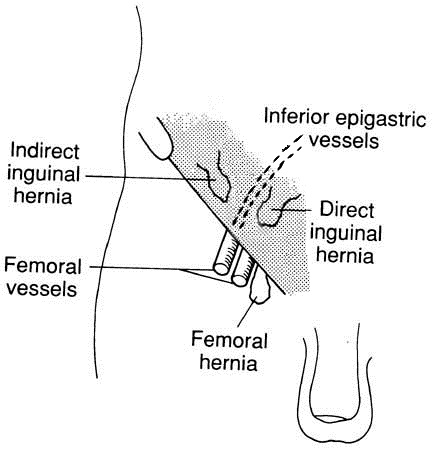
The femoral canal has the inguinal ligament as its anterior border, the pectineal ligament as its posterior border, the lacunar ligament as its medial border, and the femoral vein as its lateral border.
Epidemiologia1
Femoral hernias account for only around 3% of all groin hernias. The lifetime incidence of a groin hernia is 27% to 43% in men and 3% to 6% in women.
Femoral hernias are more common in women than in men, though inguinal hernias remain the most common groin hernias in women.
The prevalence of femoral hernias increases with age, as does the risk of complications.
10% of women with a femoral hernia and 50% of men with a femoral hernia will have a co-existing inguinal hernia.
Apresentação
Presentation is as a lump in the groin, lateral and inferior to the pubic tubercle. A large hernia may bulge over the inguinal ligament.
The femoral hernia often bulges more on coughing or straining, and reduces in size or disappears when relaxed or supine.
Femoral hernias are more common on the right (due to a developmental delay in closure of the processus vaginalis).
Pode haver um impulso de tosse.
Femoral hernias are more likely to strangulate than inguinal hernias.
Investigação
Diagnosis is largely clinical but ultrasound confirmation is often required before making a referral.
Imaging techniques are helpful. Ultrasound scanning is most commonly used but CT scans can be helpful in patients with incarceration or strangulation.1
Diagnóstico diferencial
Outras causas de caroços na virilha incluem:
Hidrocele (ao diferenciar de uma hérnia inguinoescrotal, observe que é possível palpar acima de um hidrocele durante o exame).
Hidrocele do cordão espermático.
Enlarged lymph node.
Abscesso ou bursa do psoas.
Variz safena.
Hematoma.
Complicações
Femoral hernias are at a 12 times higher risk of strangulation than inguinal hernias.
The risk of strangulation in a femoral hernia is 22% at 3 months and 45% at 21 months.
Femoral hernias may not be noticed by the patient prior to strangulation, especially in those who have obesity.
One study reported that 45.9% of patients required femoral hernia repair as an emergency.2
If strangulation occurs, the lump may become red and tender as well as tense and irreducible. Other features include colicky abdominal pain, distension and vomiting, indicating bowel obstruction.
Gestão3
In view of the higher risk of strangulation, it is recommended that femoral hernias should be repaired; referral should be made for elective repair as soon as the diagnosis is made.4 In many parts of the UK, there is a hernia pathway which includes all femoral hernias (confirmed by ultrasound scan) but only includes other hernias that are symptomatic.
Femoral hernias may be repaired using a standard inguinal approach, an open preperitoneal approach, or a minimally invasive (laparoscopic or robotic-assisted laparoscopic) approach.15Laparoscopy does not appear to lead to more complications,67 but there is no consensus on the best approach, particularly as these often present in an acute situation and are therefore dealt with by junior surgeons.8
Emergency femoral hernia repair (for a strangulated hernia) is associated with a significantly higher risk of complications, including bowel resection, and a higher mortality than elective repairs.2
Prognóstico
The mortality for elective hernia repair is low, regardless of age. However, after emergency surgery, mortality is increased seven-fold.9
Studies report that the overall operative mortality rate for strangulated hernias ranges from 1.4-13.4% but there is limited recent data.
Recurrence rates for femoral hernias are between 1 and 10%. They are more common in smokers and people with obesity, increased intra-abdominal pressure, coexisting infection, collagen tissue disorders, diabetes, and poor nutritional state.1
Chronic pain has been reported in up to 15% of people after femoral hernia repair.1
Atualizações exclusivas para profissionais de saúde
Mantenha-se informado com as últimas atualizações clínicas, insights profissionais e orientações baseadas em evidências. O boletim informativo Patient Pro seleciona conteúdo essencial para profissionais de saúde—entregue diretamente na sua caixa de entrada.
Ao se inscrever, você aceita nossos Política de Privacidade. Você pode cancelar a inscrição a qualquer momento. Nunca vendemos seus dados.
Leitura adicional e referências
- Goethals A, Azmat CE, Patel PJ, et al; Femoral Hernia.
- Humes DJ, Radcliffe RS, Camm C, et al; Estudo populacional sobre a apresentação e os desfechos adversos após cirurgia de hérnia femoral. Br J Surg. 2013 Dez;100(13):1827-32. doi: 10.1002/bjs.9336.
- Development of an Acute Femoral Hernia Treatment Algorithm: Insights From the ACHQC National Database; I Kim et al; The American Surgeon
- Femoral hernia: Treatment delay and cause of death – A case report and an integrative review; Y Hassan et al; Muller Journal of Medical Sciences and Research
- Open Surgical Repair of Adult Inguinal and Femoral Hernias: Contemporary Techniques and Clinical Outcomes; N Subhan; Journal of Society Medicine
- Coelho JCU, Hajar FN, Moreira GA, et al; FEMORAL HERNIA: UNCOMMON, BUT ASSOCIATED WITH POTENTIALLY SEVERE COMPLICATIONS. Arq Bras Cir Dig. 2021 Oct 15;34(2):e1603. doi: 10.1590/0102-672020210002e1603. eCollection 2021.
- Incarerated femoral hernia in women – A critical view on approach options; L Pietrogiovanna et al; International Journal of Surgery Case Reports
- An Update on the Management of Femoral Hernias: Narrative Review Article; H Kumar; SAR Journal of Surgery
- Nilsson H, Stylianidis G, Haapamaki M, et al; Mortalidade após cirurgia de hérnia inguinal. Ann Surg. 2007 Abr;245(4):656-60.
Sobre o autorVer biografia completa
Atualizado por

Dr Philippa Vincent, MRCGP
Médico Generalista, Autor Médico
MB BS, Bsc, MRCGP (2000), DCH, DFSRH, DRCOG
Dra Philippa Vincent é um médico do NHS trabalhando no norte de Londres.
Sobre o revisorVer biografia completa

Dr Toni Hazell, FRCGP
MBBS, BSc, FRCGP, DFSRH, Dip GU med, DRCOG, DCH (London, UK, 2000)
A Dra. Toni Hazell se formou na Escola de Medicina do Hospital St. Mary e fez seu VTS no Hospital Northwick Park.
Acesso simples a tratamentos confiáveis e serviços de saúde online.
Common conditions
Get help with common conditions through the NHS, without a GP appointment.
 Sinusite aguda
 Amigdalite bacteriana
 Impetigo
 Mordidas de insetos
 Herpes zosterInfecção do trato urinário (ITUs)
Mais em história e exame
- Massas abdominais
- Dor abdominal
- abdômen agudo
- Dor abdominal aguda em crianças
- Anemia de doença crônica
- Ascite
- Taquicardias de complexo largo
- Síndrome de Caplan
- Distúrbios cerebelares
- Deformidade torácica
- Dor no peito
- Tosse crônica em crianças
- Dor crônica
- Cefaleias em salvas
- Cianose
- Crescimento deficiente em crianças
- Testes de audição
- Obesidade em adultos
- Proctalgia fugaz e dor anal
- Histórico reumatológico, exame e investigações