Prurigo nodular
Revisado por Dr Toni Hazell, FRCGPÚltima atualização por Dr Philippa Vincent, MRCGPÚltima atualização 30 Out 2026
Atende aos diretrizes editoriais
- BaixarBaixar
- Compartilhar
- Language
- Discussão
- Ask Patient
- Versão em Áudio
- Adicionar às fontes preferidas no Google
Profissionais de Saúde
Os artigos de Referência Profissional são projetados para uso por profissionais de saúde. Eles são escritos por médicos do Reino Unido e baseados em evidências de pesquisa, diretrizes do Reino Unido e da Europa. Você pode encontrar um dos nossos artigos de saúde mais útil.
Synonyms: nodular prurigo, Hyde's disease, picker nodules, lichen corneus obtusus, nodular lichen simplex chronicus, nodular neurodermatitis circumscripta
What is prurigo nodularis?
Prurigo nodularis, also known as nodular prurigo, is a chronic, recalcitrant inflammatory skin condition characterised by pruritic nodules. The nodules are usually skin-coloured though can be darker and are usually located on the extensor surfaces of the extremities.1
Prurigo nodularis aetiology234
The exact cause of the condition is unknown. It is accepted that the itch-scratch cycle plays a role in the development of the condition, but the sequence of events driving this is unclear. It is thought to develop as a reaction to repeated scratching in patients with chronic prurigo of various aetiologies, including dermatological, systemic, infectious, and neuropsychiatric, but there have been claims of an underlying infectious trigger. 1
The constant scratching leads to the development of discrete, excoriated, nodular, hyperpigmented/purpuric lesions with crusted or scaly surfaces. These lesions contain a higher number of Merkel cells and dermis papillary dermal nerve cells; these alterations are not seen in other pruritic skin lesions such as lichen simplex chronicus. There is also a higher density of neutrophils and mast cells as well as products of eosinophils. 1
The pruritus in prurigo nodularis seems to be a result of cutaneous neurogenic inflammation, caused by increased dermal levels of neuropeptides such as substance P, calcitonin gene-related peptide and nerve growth factor, as well as an excess of eosinophils and mast cells.15
Prurigo nodularis epidemiology1
Prurigo nodularis appears to be relatively common, particularly among patients who have some of the associated/precipitating conditions; however, its exact incidence is unknown.
The majority of patients with prurigo nodularis present between the ages of 51 and 65 though it does occur at any age.
It occurs in both males and females but seems to be more severe and frequent in women.
It presents earlier in patients with atopy.
American studies have suggested it is up to 4 times more common in Black patients than White. It is likely that this relates to wider determinants of health rather than a true ethnic variation,6 although other recent studies suggest a genetic predisposition.7
Malignancies, chronic renal failure, untreated HIV, and psychiatric conditions have all been reported as risk factors.
Apresentação
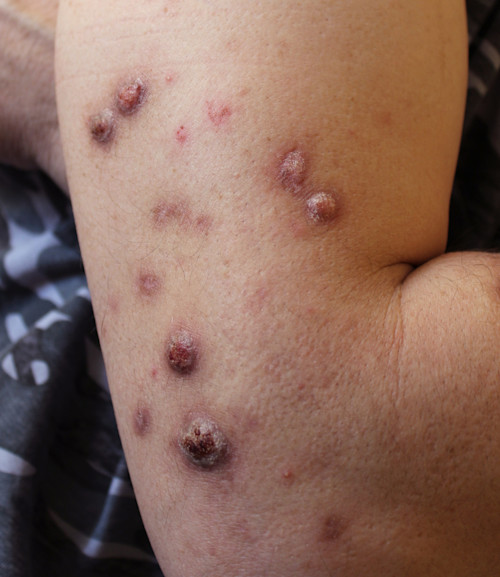
Prurigo nodular
Prurigo nodularis symptoms1
The patient presents with nodules which can vary in size from a few mm to a few cm across. They can be skin-coloured or hyperpigmented.
Initially the skin may appear normal or keratotic; the dome-shaped nodule develops after constant itching of the area.
Nodules do not resolve spontaneously and tend to increase in number over time.
Nodules are most common on the extensor surfaces of the arm and legs where they tend to be found symmetrically. They also occur on the occipital region of the scalp, the upper back, the abdomen, and the sacrum. They tend not to occur in areas that are hard to reach - for example the upper mid back. This sparing pattern is known as the "butterfly sign". The palms, soles, face, and flexures also tend to be spared.
There may be a history of one of the associated conditions (see 'Associated diseases', below).
Anxiety about the nature of the lesion and the itching is common. The itching is often severe and distressing. It can be worse in warm conditions or with sweating.
Diagnóstico diferencial18
There is a wide-ranging differential:
Amiloidose, nodular localised cutaneous.
Atypical fibroxanthoma.
Cutaneous horn.
Dermatological manifestations of gastrointestinal disease.
Dermatological manifestations of haematological disease.
Dermatological manifestations of renal disease.
Hyperkeratosis lenticularis perstans (Flegel's disease).
Knuckle pads.
Lymphocytoma cutis.
Papulose linfomatoide.
Mastocitose (urticaria pigmentosa).
Milker's nodules.
Multicentric reticulohistiocytosis.
Mycobacterium marinum infection of the skin (from cleaning out tropical fish tanks).
Papulonecrotic tuberculids.
Pilomatrixoma.
Pretibial myxoedema.
Xanthomas.
Doenças associadas8
Prurigo nodularis has been associated with:
Atopy.
Drugs that produce chronic itch such as antimalarials, opioids, and targeted cancer treatments.
Internal diseases such as:
Câncer.
Doença hepática.
Untreated teste de HIV.
The role of these illnesses as precipitants or comorbidities is unclear. They may just be a range of conditions which induce a propensity to skin irritation and unmask a tendency to localised itchiness of the skin.
Investigações8
Prurigo nodularis is a clinical diagnosis. Tests are not always necessary.
Pruritus screening blood tests (such as FBC, CRP, iron studies, U&Es, LFTs, TFTs, serum calcium, glucose, HIV test) may help to detect any underlying illness.
Biopsy of the lesions may be recommended to confirm the diagnosis.
Patch testing to look for evidence of a contact sensitivity precipitant may be carried out in a dermatology clinic.
Dermoscopy may be helpful in differentiating various nodular pruritic conditions.9
Direct immunofluorescence looking for antibody deposition in the skin may be necessary to differentiate from bullous pemphigoid if blisters develop.
Prurigo nodularis treatment and management13810
All treatment is aimed at reducing the itch-scratch cycle. Treatment is multi-faceted and includes education to reduce scratching and picking at the skin. Any underlying cause of itch should be diagnosed and treated. There are no high-powered randomised controlled trials looking at any of the treatment options.
General treatment:
Keep nails very short.
Wear long sleeves and gloves to reduce the risks of itching. Consider bandaging the lesions if clothing is an insufficient barrier.
Use emollients regularly throughout the day to keep the skin well-moisturised.
Use lotions containing calamine, camphor, or menthol to provide itch relief.
Try to reduce time spent in hot environments and try to reduce stress.
Topical treatment:
As well as emollients, the following have been used:
Topical corticosteroids- for example, clobetasol dipropionate 0.05% ointment, applied under occlusion with plastic wrap once at nighttime for at least 2 to 4 weeks.
Intralesional corticosteroids - for example, triamcinolone acetonide, in concentrations of 10 mg/mL to 20 mg/mL, has been shown to flatten lesions and reduce itch.11
Pimecrolimus 1% has shown benefit.12
Calcipotriol has shown some benefit in clearing lesions more quickly than moderately-potent steroids. 13
Antihistamines:
High doses of non-sedating antihistamines during the day, combined with sedating antihistamines at night may help reduce the itch.
Fexofenadine and montelukast have been shown to be beneficial 14 although this study was carried out before the psychiatric side effects of montelukast became evident. 1516
Other studies suggest that there is little benefit from antihistamines. 3
Phototherapy:
Phototherapy has shown benefit in prurigo nodularis. The combination of PUVA and narrow-band UVB has been shown to be more beneficial than PUVA alone.17
Immunosuppressants:
In severe recalcitrant disease, oral immunosuppressants have been tried.
There have been reports of improvement using cyclosporin, methotrexate, azathioprine, cyclophosphamide, and oral tacrolimus.
IV immunoglobulins have also showed some benefit.
Newer treatments:3
Thalidomide and lenalidomide have showed some benefits; lenalidomide appears to have lower risks of peripheral neuropathy.
SSRIs and tricyclic anti-depressants have both been shown to reduce itch.
Naloxone and naltrexone both have been shown to reduce itch.
Dupilumab is the first systemic treatment which has been approved by both the FDA in the United States and the European Medicines Agency for the treatment of prurigo nodularis, following phase 2 trials.6 However, this is not available in the UK under current NICE guidance.18 Phase 3 trials appear to show significant reduction in itch.19
At the time of writing, studies are underway into nemolizumab, benralizumab, vixarelimab, and barzolvolimab.7
Complicações6
Prurigo nodularis is a benign condition. However, it can cause severe functional impairment and morbidity due to poor control of the itching/scratching and psychological symptoms. Some lesions may become permanently pigmented or show scarring.
Secondary infection can occur, due to scratching of the lesions, leading to ulceration, abscess formation, and cellulitis.
Prognóstico10
It is unusual for lesions to resolve spontaneously. They may lessen in severity with treatment but tend to persist over time.
Atualizações exclusivas para profissionais de saúde
Mantenha-se informado com as últimas atualizações clínicas, insights profissionais e orientações baseadas em evidências. O boletim informativo Patient Pro seleciona conteúdo essencial para profissionais de saúde—entregue diretamente na sua caixa de entrada.
Ao se inscrever, você aceita nossos Política de Privacidade. Você pode cancelar a inscrição a qualquer momento. Nunca vendemos seus dados.
Leitura adicional e referências
- Mullins TB, Sharma P, Riley CA, et al; Prurigo Nodularis.
- Prurigo Nodularis and the Pain Cascade: Understanding the Pathogenesis and Approach to Management; J Bershtein et al; Journal of Clinical and Aesthetic Dermatology
- The State of the Art in Chronic Prurigo Nodularis; E Serra-Baldrich et al; Springer Nature
- Molecular mechanisms of pruritus in prurigo nodularis; Y Shao et al; Frontiers in Immunology
- Zeidler C, Stander S; The pathogenesis of Prurigo nodularis - 'Super-Itch' in exploration. Eur J Pain. 2016 Jan;20(1):37-40. doi: 10.1002/ejp.767. Epub 2015 Sep 28.
- Prurigo nodularis: disease burden, clinical features and approach to management; S Kwatra et al; British Journal of Dermatology
- Prurigo Nodularis: Pathogenesis and the Horizon of Potential Therapeutics; H J Yook and J H Lee; International Journal of Molecular Sciences
- Prurigo nodular; DermNet NZ
- Errichetti E, Stinco G; The practical usefulness of dermoscopy in general dermatology. G Ital Dermatol Venereol. 2015 Oct;150(5):533-46. Epub 2015 Jun 18.
- Nodular prurigo; Associação Britânica de Dermatologistas
- Qureshi AA, Abate LE, Yosipovitch G, et al; A systematic review of evidence-based treatments for prurigo nodularis. J Am Acad Dermatol. 2019 Mar;80(3):756-764. doi: 10.1016/j.jaad.2018.09.020. Epub 2018 Sep 25.
- Siepmann D, Lotts T, Blome C, et al; Evaluation of the antipruritic effects of topical pimecrolimus in non-atopic prurigo nodularis: results of a randomized, hydrocortisone-controlled, double-blind phase II trial. Dermatology. 2013;227(4):353-60. doi: 10.1159/000355671. Epub 2013 Nov 23.
- Kowalski EH, Kneiber D, Valdebran M, et al; Treatment-resistant prurigo nodularis: challenges and solutions. Clin Cosmet Investig Dermatol. 2019 Feb 28;12:163-172. doi: 10.2147/CCID.S188070. eCollection 2019.
- Shintani T, Ohata C, Koga H, et al; Combination therapy of fexofenadine and montelukast is effective in prurigo nodularis and pemphigoid nodularis. Dermatol Ther. 2014 May-Jun;27(3):135-9. doi: 10.1111/dth.12094. Epub 2013 Sep 17.
- Montelukast (Singulair): reminder of the risk of neuropsychiatric reactions; Gov.UK
- Analysis of Neuropsychiatric Diagnoses After Montelukast Initiation; T Paljarvi et al; Journal of the American Medical Association
- Hammes S, Hermann J, Roos S, et al; UVB 308-nm excimer light and bath PUVA: combination therapy is very effective in the treatment of prurigo nodularis. J Eur Acad Dermatol Venereol. 2011 Jul;25(7):799-803. doi: 10.1111/j.1468-3083.2010.03865.x. Epub 2010 Oct 15.
- NICE TA955: Dupilumab for treating moderate to severe prurigo nodularis
- Ramcke T, Kaplan DH; From neuroimmune circuits to targeted therapy of chronic pruritus. Pharmacol Rev. 2026 Mar;78(2):100121. doi: 10.1016/j.pharmr.2026.100121. Epub 2026 Jan 29.
Sobre o autorVer biografia completa
Atualizado por

Dr Philippa Vincent, MRCGP
Médico Generalista, Autor Médico
MB BS, Bsc, MRCGP (2000), DCH, DFSRH, DRCOG
Dra Philippa Vincent é um médico do NHS trabalhando no norte de Londres.
Sobre o revisorVer biografia completa

Dr Toni Hazell, FRCGP
MBBS, BSc, FRCGP, DFSRH, Dip GU med, DRCOG, DCH (London, UK, 2000)
A Dra. Toni Hazell se formou na Escola de Medicina do Hospital St. Mary e fez seu VTS no Hospital Northwick Park.
Acesso simples a tratamentos confiáveis e serviços de saúde online.
Common conditions
Get help with common conditions through the NHS, without a GP appointment.
 Sinusite aguda
 Amigdalite bacteriana
 Impetigo
 Mordidas de insetos
 Herpes zosterInfecção do trato urinário (ITUs)
Mais em dermatologia
- Acne vulgar
- Alopecia
- Filariose da cavidade corporal
- Pemfigoide bolhoso
- Dermatofibroma
- Alergia a medicamentos
- Eritema crônico migratório
- Eritema multiforme
- Eritrodermia
- Pênfigo benigno familiar
- Infecções fúngicas nas unhas
- Doença do verme da Guiné
- Nevo juncional
- Fasciíte necrosante
- Pemfigo
- Dermatose purpúrica pigmentada
- Psoríase das mãos e pés
- Herpes zoster
- Síndrome das unhas amarelas