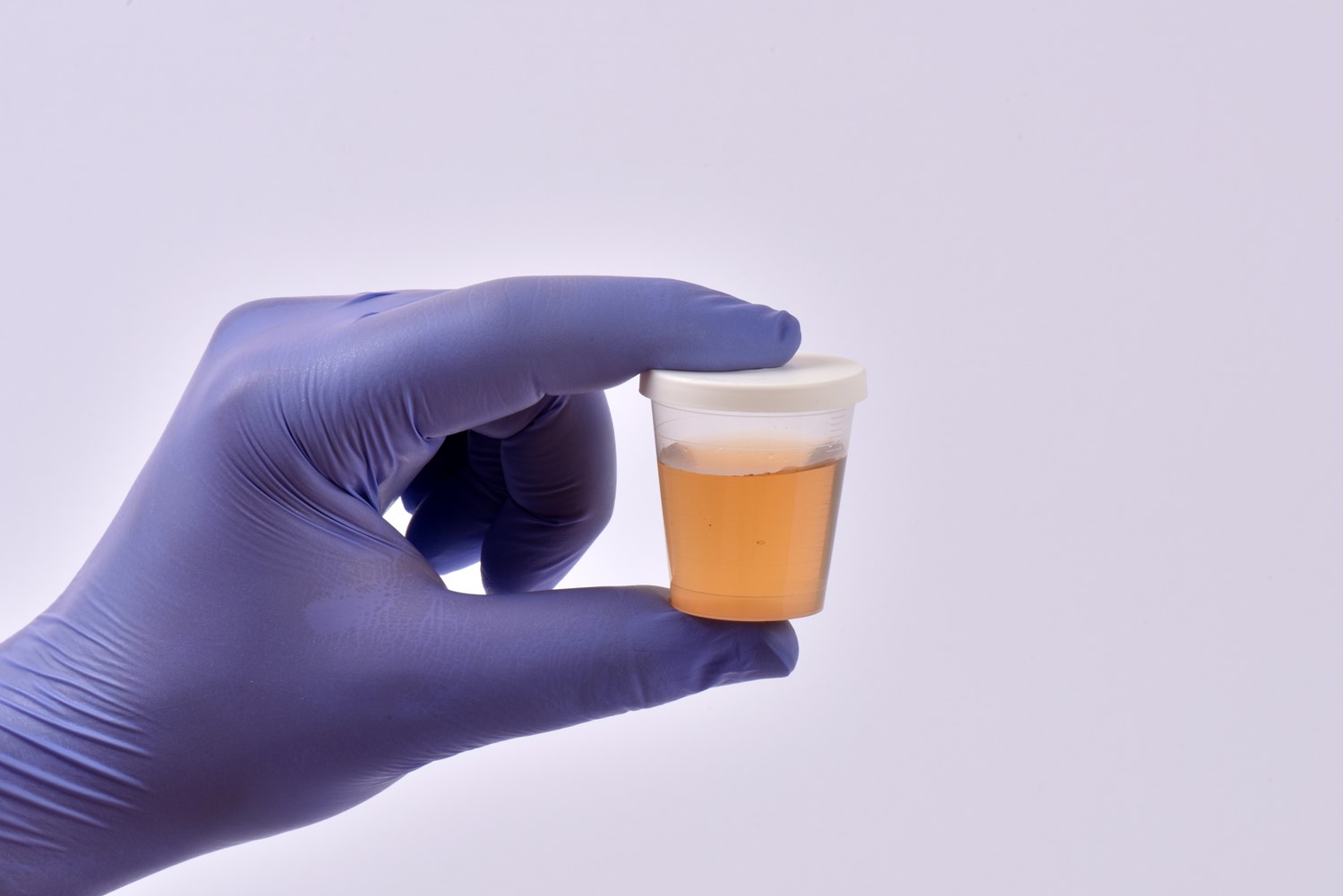
Infecção urinária em homens
Revisado por Dr Philippa Vincent, MRCGPÚltima atualização por Dr Rosalyn Adleman, MRCGPÚltima atualização 15 Set 2024
Atende aos diretrizes editoriais
- BaixarBaixar
- Compartilhar
- Language
- Discussão
- Versão em Áudio
- Adicionar às fontes preferidas no Google
Most urine infections in men are caused by germs (bacteria) which come from your own bowel. They cause no harm in your bowel but can cause infection if they get into other parts of your body. Some bacteria lie around your back passage (anus) after you pass a stool (faeces).
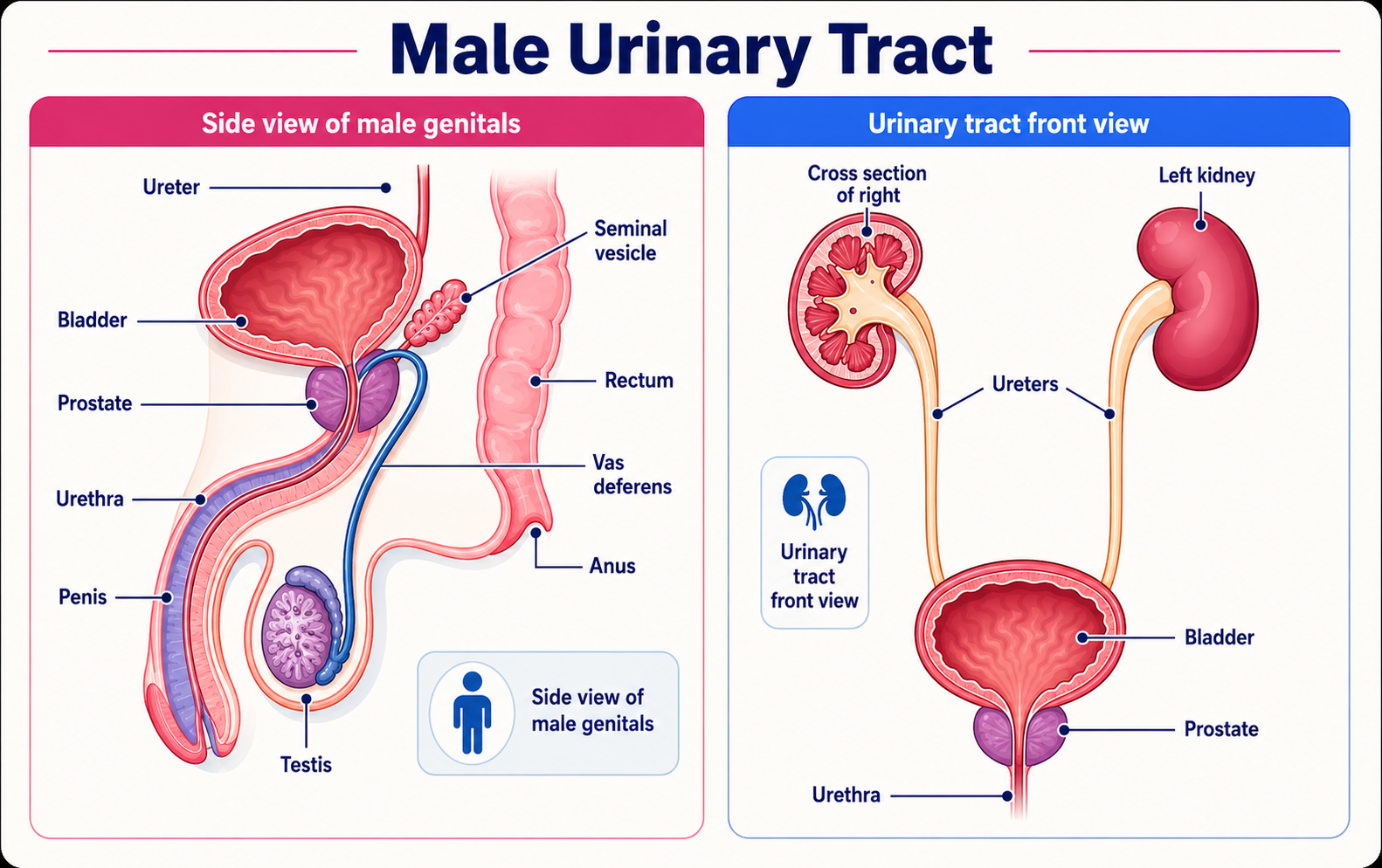
These bacteria sometimes travel to the tube which passes urine from your bladder (the urethra) to the outside. Some bacteria thrive in urine and multiply quickly to cause infection.
A urine infection is often called a urinary tract infection (UTI) by doctors. When the infection is just in the bladder and urethra, this is called a lower UTI, or cystitis. If it travels up to affect one or both kidneys as well then it is called an upper UTI or pyelonephritis. This can be more serious than lower UTIs, as the kidneys can become damaged by the infection.
Em resumo
Urine infections are uncommon in men under 50 but become more common in older men.
An enlarged prostate, bladder issues, or kidney problems can increase the risk.
Symptoms can include painful or frequent urination, lower tummy pain, or a fever.
Kidney infection symptoms include loin pain, fever, and feeling or being sick.
A urine test can confirm the diagnosis and identify the bacteria causing the infection.
Treatment usually involves a course of antibiotics for about seven days.
Precisa de tratamento para uma infecção urinária?
Inicie rapidamente uma consulta do NHS Pharmacy First online através do Patient.info.
- Online e disponível 24 horas por dia, 7 dias por semana, o tratamento muitas vezes pode ser entregue no dia seguinte.
- Serviço gratuito, just pay the NHS prescription charge online if required.
- Basta responder a algumas perguntas e, em seguida, escolher um horário para uma ligação com um profissional de saúde.
Desenvolvido pela Evaro, um serviço de saúde regulamentado no Reino Unido que atende mais de 2 milhões de pacientes. Revisado por profissionais de saúde registrados no Reino Unido.

Male genitals side view and urinary tract cross-section diagram
How common are urine infections in men?
UTIs are rare in men aged under 50. They become more common in older men. Urine infection is much more common in women.
What causes a urine infection in men?
In some cases an underlying problem can increase the risk of developing a UTI in men. These include the following:
Bladder problems. For example conditions that make it difficult to completely empty the bladder.
Problemas renais. For example, kidney stones.
Having a urinary catheter.
In other cases the UTI occurs for no apparent reason.
Symptoms of a urine infection in men
Symptoms of a UTI in men will depend on where the infection occurs.
Infection in the bladder (cistite) symptoms:
Pain on emptying the bladder
Passing urine more frequently.
Passing small amounts of urine.
Pain in the lower tummy (abdomen).
Urine may become cloudy, bloody or smelly.
Infection in the kidneys symptoms:
Pain in a loin (the side of the lower back over the kidney).
Uma temperatura alta (febre).
Feeling or being sick (vomiting).
Sentindo-se geralmente indisposto.
In some elderly men, the only symptoms may be a recent onset of confusion or just feeling generally unwell or unsteady, even without any actual urinary symptoms.
Diagnosing a urine infection in men
A teste de urina can confirm the diagnosis and identify the germ (bacterium) causing the infection. Further tests are not usually necessary if otherwise well with a one-off infection. However, a doctor may advise tests of the kidney, prostate gland or bladder if an underlying problem is suspected.
An underlying problem is more likely if the infection does not clear with an antibiotic medicine, or if there are:
Symptoms that suggest a kidney is infected (not just the bladder).
Recurring urine infections, for example, two in a six-month period.
Problems with the kidney in the past, such as cálculos renais or a damaged kidney.
Symptoms that suggest an obstruction to the flow of urine.
Blood-stained urine which persists after treatment with antibiotics.
UTI tests may include:
An examination of the prostate gland by examination of the back passage (rectum).
Blood tests which may include kidney function tests and a specific blood test to check on the prostate, called prostate specific antigen, or PSA.
A scan of the kidneys or bladder such as an ultrassonografia.
Uma raio-X or CT scan to look for kidney stones.
A look inside the bladder with a special camera (cystoscopy).
Tests to see how well the bladder is working, called urodynamic tests.
What is the treatment for a urine infection in men?
A short course of antibióticos will usually clear the infection quickly. This is usually for seven days in men. Medical advice should be sought if the symptoms are not gone, or nearly gone, after the course of antibiotics is completed, or if the symptoms are getting worse whilst on the treatment.
Paracetamol will usually ease any pain, discomfort, or high temperature (fever).
Have plenty to drink to help prevent a lack of fluid in the body (desidratação).
Preventing a urine infection in men
The following can help prevent urine infections in men:
Drinking enough fluids to avoid dehydration.
Emptying the bladder when needed and not "holding on".
Passing urine soon after sexual intercourse.
Sometimes preventive antibiotics are recommended to prevent recurrent UTIs. These are usually given daily at a low dose for several months. The antibiotics are often rotated to prevent antibiotic resistance from occurring. The antibiotics used include: nitrofurantoin, trimethoprim, cefalexin and amoxicillin.
Qual é a perspectiva (prognóstico)?
The vast majority of men improve within a few days of starting treatment. If symptoms do not improve despite taking an antibiotic medicine, then an alternative antibiotic might be needed. This is because some germs (bacteria) are resistant to some types of antibiotics. This can be identified from tests done on the urine sample.
Occasionally the infection may spread and cause you more significant symptoms. Infection in the bladder (cystitis) may spread to the kidney (pyelonephritis).
Infection may also spread to involve the prostate gland, causing infection of the prostate gland (prostatitis).
Recurring urine infection in men
Recurrent urine infections are defined as two or more infections in six months or three or more infections in a year. It is unusual for men to have recurring urine infections.
Men with recurring infections may be referred to a urology specialist for further tests to try and establish why they are occurring.
Blood tests to assess the kidney and prostate gland, and ultrasound scans to look at the kidneys, bladder and prostate gland, will often be organised before seeing the urology specialists.
Precisa de tratamento para uma infecção urinária?
Inicie rapidamente uma consulta do NHS Pharmacy First online através do Patient.info.
- Online e disponível 24 horas por dia, 7 dias por semana, o tratamento muitas vezes pode ser entregue no dia seguinte.
- Serviço gratuito, just pay the NHS prescription charge online if required.
- Basta responder a algumas perguntas e, em seguida, escolher um horário para uma ligação com um profissional de saúde.
Desenvolvido pela Evaro, um serviço de saúde regulamentado no Reino Unido que atende mais de 2 milhões de pacientes. Revisado por profissionais de saúde registrados no Reino Unido.
Escolhas do paciente para Problemas urinários em homens
Rim e trato urinário
Retenção urinária
Retenção urinária significa que você está tendo problemas para esvaziar completamente a bexiga. Pode ocorrer de repente (retenção urinária aguda) ou pode se desenvolver ao longo de um período mais longo (retenção urinária crônica). A retenção urinária aguda é uma emergência médica. A retenção urinária é mais comum em homens do que em mulheres. Torna-se mais comum à medida que você envelhece. Em homens na faixa dos 70 anos, a retenção urinária ocorre em cerca de 1 em cada 100 homens. Para homens na faixa dos 80 anos, a retenção urinária ocorre em cerca de 3 em cada 100 homens. Você pode precisar de exames para ajudar a encontrar a causa da sua retenção urinária. O tratamento e o resultado para retenção urinária aguda e crônica dependerão da causa subjacente. Você deve consultar um médico imediatamente se não conseguir urinar quando sua bexiga estiver cheia e dolorida.
por Dra. Rosalyn Adleman, MRCGP
Saúde do homem
Sintomas do trato urinário inferior em homens
Lower urinary tract symptoms (LUTS) are a very common problem, especially in men over the age of 65 years. They can be caused by various conditions. These symptoms may include slowing of the urine stream and needing to get up to pass urine at night. There are different causes of LUTS and the treatment will depend on the cause. Some men choose not to have treatment if their symptoms are not too bothersome and the cause is not serious.
por Dra. Philippa Vincent, MRCGP
Perguntas frequentes
If my urine infection doesn’t clear up, what might be the next steps?
If an initial course of antibiotics doesn't clear the infection, an alternative antibiotic might be needed as some bacteria are resistant to certain types. This can often be identified through tests on the urine sample. If an underlying problem is suspected, a doctor may advise further tests of the kidney, prostate gland, or bladder.
What kind of tests might be done if my doctor suspects an underlying problem is causing my urine infection?
If an underlying problem is suspected, several tests might be performed. These could include an examination of the prostate gland, blood tests (including kidney function tests and a PSA test for the prostate), scans of the kidneys or bladder like an ultrasound, or an X-ray or CT scan to look for kidney stones. Sometimes, a look inside the bladder with a special camera (cystoscopy) or tests to see how well the bladder is working (urodynamic tests) may also be carried on.
What is the typical outlook after being treated for a urine infection?
Most men improve within a few days of starting antibiotic treatment. It's important to complete the full course of antibiotics, and to seek medical advice if symptoms don't improve or worsen during treatment. Occasionally, an infection might spread to other areas, such as the kidneys (pyelonephritis) or the prostate gland (prostatitis).
When are preventive antibiotics recommended to avoid future urine infections?
Preventive antibiotics are sometimes recommended for men who experience recurrent UTIs. These are usually given daily at a low dose for several months. Different antibiotics may be used in rotation to help prevent bacteria from developing resistance to the medication.
How will my doctor define if my urine infections are recurring?
Recurring urine infections in men are defined as having two or more infections within a six-month period, or three or more infections within a year. It's considered unusual for men to experience recurring urine infections.
If I have recurring urine infections, will I need to see a specialist?
Men with recurring urine infections may be referred to a urology specialist for further investigation. Before seeing the specialist, blood tests to assess the kidney and prostate gland, and ultrasound scans of the kidneys, bladder, and prostate gland, are often arranged to help establish the cause of the recurring infections.
Leitura adicional e referências
- Infecção do trato urinário (inferior): prescrição de antimicrobianos; Orientação NICE (Outubro 2018)
- Smithson A, Ramos J, Nino E, et al; Characteristics of febrile urinary tract infections in older male adults. BMC Geriatr. 2019 Nov 29;19(1):334. doi: 10.1186/s12877-019-1360-3.
- Infecções urológicas; Associação Europeia de Urologia (2022 - atualizado 2024)
- Infecção do trato urinário (inferior) - homens; NICE CKS, dezembro de 2024 (acesso apenas no Reino Unido)
Sobre o autorVer biografia completa
Atualizado por

Dra. Rosalyn Adleman, MRCGP
MRCGP
A Dra. Rosalyn Adleman é uma médica do NHS que trabalha no norte de Londres.
Sobre o revisorVer biografia completa

Dr Philippa Vincent, MRCGP
Médico Generalista, Autor Médico
MB BS, Bsc, MRCGP (2000), DCH, DFSRH, DRCOG
Dra Philippa Vincent é um médico do NHS trabalhando no norte de Londres.
Participe da conversa
Compartilhe seus pensamentos ou experiências com outros em nosso comunidades de pacientes.

Pergunte, compartilhe, conecte-se.
Navegue por discussões, faça perguntas e compartilhe experiências em centenas de tópicos de saúde.

Sentindo-se mal?
Avalie seus sintomas online gratuitamente
Inscreva-se no boletim informativo do Patient
Sua dose semanal de conselhos de saúde claros e confiáveis - escritos para ajudá-lo a se sentir informado, confiante e no controle.
Ao se inscrever, você aceita nossos Política de Privacidade. Você pode cancelar a inscrição a qualquer momento. Nunca vendemos seus dados.