
Kidney infection
Pyelonephritis
Peer reviewed by Dr Toni Hazell, FRCGPLast updated by Dr Rosalyn Adleman, MRCGPLast updated 4 Aug 2024
Meets Patient’s editorial guidelines
- DownloadDownload
- Share
- Language
- Discussion
- Audio Version
- Add to preferred sources on Google
A kidney infection (pyelonephritis) is an unpleasant illness which is sometimes serious. Treatment usually involves medicines called antibiotics and also painkillers. If the kidney was previously healthy then you are likely to make a full recovery. Complications occur in some cases. Complications include kidney damage or a spread of infection around the body (sepsis).
At a glance
A kidney infection is a urinary tract infection (UTI) where bacteria travel from the bladder to one or both kidneys.
Symptoms often develop quickly and can include loin pain, high temperature, nausea, vomiting, or sometimes just feeling unwell.
Women are more prone to kidney infections because they are more at risk of bladder infections.
Diagnosis involves a urine test, and antibiotics are usually prescribed to clear the infection.
Drink plenty of fluids, and paracetamol can help with pain and fever.
Seek medical advice if symptoms do not improve after 24 hours of home treatment, especially if very unwell.
Kidney infections can cause complications, such as blood poisoning, if not treated promptly.
Need treatment for a UTI?
Start a quick NHS Pharmacy First consultation online through Patient.info.
- Online and available 24/7, treatment can often be delivered next day.
- Free service, just pay the NHS prescription charge online if required.
- Just answer a few questions then choose a time for a clinician call.
Powered by Evaro, a UK regulated healthcare service supporting over 2 million patients. Reviewed by UK registered clinicians.

What is a kidney infection?
A kidney infection (pyelonephritis) is a type of urinary tract infection (UTI). It is caused by bacteria travelling from your bladder into one or both of your kidneys and causing an infection there.
This leaflet only deals with sudden-onset (acute) kidney infection in adults. The medical term for this is acute pyelonephritis. This leaflet does not deal with chronic pyelonephritis, which is a condition where the kidney is scarred as a result of repeated infections.
Kidney infection symptoms
Symptoms usually develop quickly, over a few hours or so, and may include:
Pain in a loin or flank. (This is the area at the side of your back where the kidney is located).
High temperature (fever) which may cause shivers.
Feeling sick (nausea) and/or being sick (vomiting).
Diarrhoea.
Blood in the urine.
There will also usually be symptoms of a bladder infection - for example, pain on passing urine, and going to the toilet often.
Not all of the symptoms may develop, and sometimes a kidney infection can just cause vague symptoms. For example, just feeling generally unwell but not being able to say why.
In older people a kidney infection may cause confusion. This is why a urine test is often done when an elderly person suddenly becomes confused or appears generally unwell.
Causes of a kidney infection
Most kidney infections develop from a bladder infection (cystitis). Bacteria travel up the tube between the bladder and kidney (ureter) to infect a kidney. These bacteria are usually those normally living in the bowel - eg, E. coli. Most people with cystitis don't get a kidney infection.
Some kidney infections develop without a bladder infection. This is sometimes due to a problem in the kidney. For example, people are more prone to kidney infections if they have a kidney stone or an abnormality of the kidney.
It is usually only one kidney that develops an infection. A kidney infection can occur at any age. It is much more common in women. This is because women are more at risk of developing a bladder infection (which can spread to the kidneys).
In women, the urethra is closer to the anus, which makes it easier for bacteria to get from the bowel to the urethra. The urethra is also shorter in women than in men, so bacteria can reach the bladder more easily.
Kidney infections are also more common in children, during pregnancy and in older people. They are uncommon in healthy men.
How common are kidney infections?
Kidney infections are much less common than infections in the bladder. However, although they are uncommon in adults, about 1 in 30 girls and 1 in 100 boys will have had a kidney infection (acute pyelonephritis) by the time they are 7 years old.
Kidney infection risk factors
You are more likely to develop a kidney infection if you:
Are female.
Have a UTI in the bladder (cystitis).
Have had a UTI during the past 12 months.
Are pregnant.
Have reflux of urine from the bladder back towards the kidneys (vesicoureteral reflux), which is more common in children.
Have diabetes.
Have a weakened immune system.
Have a spinal cord injury or a nerve problem affecting the bladder, such as multiple sclerosis.
Have difficulty emptying your bladder completely (urinary retention), eg, because of a prostate problem (such as an enlarged prostate) in men.
Diagnosing a kidney infection
A simple test that your doctor can do is called a dipstick urine test. This involves testing a sample of your urine with a special testing strip to look for signs of infection. This test will show if a kidney infection is likely or not.
However, it is important to confirm the diagnosis and also to find out which germ (bacterium) is causing the infection. This will enable a doctor to prescribe the correct antibiotic. For this, your doctor will need to send your urine sample to the laboratory so that the bacterium can be identified and tests can be done to see which antibiotics will kill it.
As this may take some days for the results, treatment is usually started straightaway. A urine sample may be the only test that is needed if you are a woman who is otherwise healthy, but develop cystitis which progresses to a kidney infection.
Further tests may be advised in some situations - for example, if you have a kidney stone or if a kidney abnormality is suspected. Tests are also usually advised if you are a man, or if you have recurring kidney infections. If further tests are needed, an ultrasound scan is often the first one which is done. Sometimes a CT scan may also be done.
How to treat a kidney infection
Antibiotics will usually clear the infection. Commonly used antibiotics for kidney infections include cefalexin, co-amoxiclav or trimethoprim.
Painkillers such as paracetamol can ease pain and reduce a high temperature (fever). Non-steroidal anti-inflammatory painkillers such as ibuprofen are not usually recommended for a person with a kidney infection. This is because they may possibly cause problems with the working of the kidney during a kidney infection.
Plenty of fluid should be taken to prevent lack of fluid in the body (dehydration).
In many cases, the kidney infection is not too severe, treatment can be taken at home and the infection will clear with a course of antibiotic tablets. If treatment is to be home-based, a doctor should be called if the symptoms are not improving after 24 hours, or the person is feeling more unwell.
However, some people need to be admitted to hospital - for example if:
The infection is severe and causing you to be very unwell.
You are unable to take any fluids or their medicines (due to being too unwell or due to vomiting).
Symptoms do not settle quickly with antibiotics.
You are a pregnant woman.
You are otherwise ill or frail.
You have underlying kidney problems.
You have diabetes.
In hospital, antibiotics can be given straight into the vein (intravenously) for a more immediate effect. If the person is dehydrated, they may also need a drip (where fluid is put straight into a vein).
Complications of a kidney infection
Most people who develop a kidney infection make a full recovery if treatment is given promptly. Possible complications which occur in a small number of cases include:
Sometimes germs (bacteria) from a kidney infection get into the bloodstream, particularly if treatment is delayed. This may cause blood poisoning (sepsis). This can be serious or even life-threatening.
In pregnant women who develop pyelonephritis occasionally, it may result in the baby being born early or with a lower birth weight.
A kidney abscess can (rarely) develop. This is a collection of pus that forms within the kidney.
The infection can sometimes cause some permanent damage to kidney tissues.
These complications are uncommon but may be more likely if:
You become severely ill with the kidney infection.
You already have a problem with your kidneys, such as polycystic kidney disease or chronic kidney disease.
You have a condition where instead of just flowing one way, your urine can backtrack from the bladder back up to the kidney (vesicoureteric reflux).
You have kidney stones.
Your immune system is suppressed - for example, if you have cancer, if you are taking medication such as steroids or chemotherapy, or if you have AIDS.
You have poorly controlled diabetes.
You are an older person (over the age of 65 years).
You are pregnant.
Can a kidney infection be prevented?
Most kidney infections are caused by germs (bacteria) travelling up from a bladder infection. So the same things that can help to reduce your chances of bladder infection should reduce your chances of kidney infection.
Drink plenty of fluids so you stay well hydrated.
Wiping from front to back after passing urine.
Constipation increases the risk of a urine infection, so constipation should be treated promptly. See the separate leaflet called Constipation for more details.
If you are diabetic, good sugar control reduces your chance of a urine infection.
If you have kidney stones, your doctor will treat these as they can increase the risk of kidney infection.
Pregnant women are at increased risk of kidney infections. They are regularly tested for urine infections and given antibiotic treatment even if they don't have symptoms.
In some cases people who have recurring urine infections are treated with a low dose of antibiotic continually. This may help to prevent recurrences and to prevent spread to the kidney.
Some doctors recommend taking cranberry products (juice, tablets or capsules) to prevent urine infections. There is evidence that this works for some people.
Understanding the kidneys and urinary tract
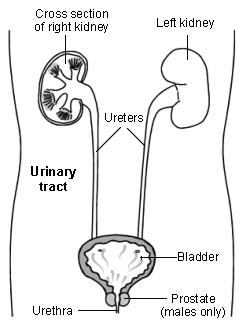
There are two kidneys, one on each side of the tummy (abdomen), towards the back. They make urine which drains down the tubes between the bladder and kidney (ureters) into the bladder. Urine is stored in the bladder and is passed out through the tube from the bladder (the urethra) from time to time when we go to the toilet.
The urinary tract
Patient picks for Urinary tract and kidney infections

Senior health
Urinary tract infection in older people
If you have a urine infection, you have germs (bacteria) in your bladder, kidneys or the tubes of your urinary system. Urine infections, also called bladder infections, are more common in older people, and there is more likely to be an underlying cause.
by Dr Toni Hazell, FRCGP

Kidney and urinary tract
Urinary tract infections
Women are generally at much higher risk of developing a urinary tract infection (UTI) than men, and UTIs are also more common in older adults. If a UTI is limited to the bladder, it can be painful but is almost always not serious. However, if a UTI spreads up the urinary system to the kidneys and causes a kidney infection (called pyelonephritis) then this can make you very unwell and can be serious.
by Dr Colin Tidy, MRCGP
Frequently asked questions
Can I have a kidney infection without a bladder infection?
Yes, some kidney infections can develop without a preceding bladder infection. This is sometimes due to an underlying problem in the kidney, such as having a kidney stone or an abnormality of the kidney wall.
Does trimethoprim treat kidney infection?
Yes, trimethoprim is one of the commonly used antibiotics prescribed to clear a kidney infection. Other antibiotics include cefalexin or co-amoxiclav.
What should I do if my symptoms don't improve after starting home treatment for a kidney infection?
If you are being treated for a kidney infection at home, you should call your doctor if your symptoms are not improving after 24 hours, or if you start to feel more unwell.
How quickly do kidney infection symptoms usually appear?
Symptoms of a kidney infection usually develop fairly quickly, often over just a few hours.
Are there particular groups of people who are more likely to get kidney infections?
Yes, kidney infections are more common in women, children, during pregnancy, and in older people. They are uncommon in healthy men. Various risk factors can also increase the likelihood, such as diabetes, a weakened immune system, or certain bladder issues.
Further reading and references
- Pyelonephritis (acute): antimicrobial prescribing; NICE Guidance (October 2018)
- Urological infections; European Association of Urology (2022 -updated 2024)
- Pyelonephritis - acute; NICE CKS, December 2024 (UK access only)
About the authorView full bio
Updated by

Dr Rosalyn Adleman, MRCGP
MRCGP
Dr Rosalyn Adleman, is an NHS GP working in north London.
About the reviewerView full bio

Dr Toni Hazell, FRCGP
MBBS, BSc, FRCGP, DFSRH, Dip GU med, DRCOG, DCH (London, UK, 2000)
Dr. Toni Hazell qualified from St. Mary’s Hospital Medical School and did her VTS at Northwick Park Hospital.
Join the conversation
Share your thoughts or experiences with others in our patient communities.

Ask, share, connect.
Browse discussions, ask questions, and share experiences across hundreds of health topics.

Feeling unwell?
Assess your symptoms online for free
Sign up to the Patient newsletter
Your weekly dose of clear, trustworthy health advice - written to help you feel informed, confident and in control.
By subscribing you accept our Privacy Policy. You can unsubscribe at any time. We never sell your data.