Eustachian tube dysfunction
Peer reviewed by Dr Caroline Wiggins, MRCGP Last updated by Dr Toni Hazell, FRCGPLast updated 30 Mar 2026
Meets Patient’s editorial guidelines
- DownloadDownload
- Share
- Language
- Discussion
- Audio Version
- Add to preferred sources on Google
In this series:EaracheMiddle ear infection (otitis media)Outer ear infection (otitis externa)Fungal ear infectionBoil in the ear canalBarotrauma to the ear
Eustachian tube dysfunction (ETD) can cause dulled hearing and a feeling of pressure or fullness in the affected ear. It usually lasts for a few weeks during and after a cold.
Key points
Eustachian tube dysfunction happens when the tube connecting the ear to the back of the nose does not open properly, causing pressure to build up in the ear.
Common symptoms include a feeling of fullness or pressure in the ear, muffled hearing, popping or crackling sounds, and sometimes discomfort or mild pain.
It can be caused by colds, sinus infections, or allergies, and often gets better on its own.
Home remedies and medicines such as decongestants and steroid nasal sprays or drops may be needed if symptoms don't improve.
What is the Eustachian tube?
The Eustachian tube is a narrow tube that connects the space behind the ear (the middle ear) with the back of the nose. In adults it is about 3-4 cm long. The middle ear is normally filled with air. A well-functioning Eustachian tube is closed most of the time, but opens when we swallow, yawn, or chew.
What is Eustachian tube dysfunction?
Eustachian tube dysfunction occurs when the Eustachian tube in the ear is blocked or does not open properly. It can affect one or both ears.
When the tube is blocked air cannot enter the middle ear, causing the air pressure on the outer side of the eardrum to become greater than the air pressure in the middle ear. This pushes the eardrum inwards.
The eardrum then becomes tense and cannot vibrate normally, leading to symptoms such as ear fullness, pain, discomfort, and muffled hearing.
Eustachian tube dysfunction
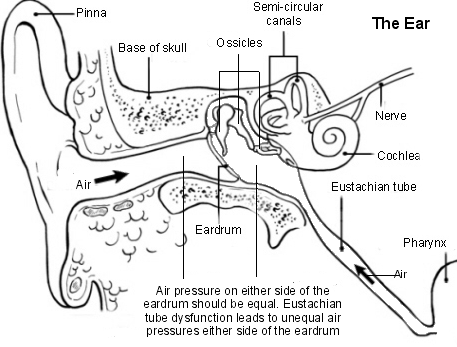
Types of Eustachian tube dysfunction
There are three types of Eustachian tube dysfunction, these are:
Obstructive - the Eustachian tube stays closed and doesn't open when it should. Sounds travel through the Eustachian tube to your middle ear and you therefore hear your voice too loudly, which can feel like an inner echo of your voice.
Baro-challenge induced - the Eustachian tube doesn't open when it should, but it only really affects you if you have a change in altitude, for example, when flying.
Patulous - the Eustachian tube stays open all the time. This is the least common type.
Symptoms of Eustachian tube dysfunction
The most common symptoms of ETD are:
Dulled or muffled hearing.
A sensation of popping in the ear.
Ear pressure or mild pain.
Ringing or buzzing in the ear (tinnitus).
Mild dizziness may occur.
Some people may experience ear pain (earache) caused by the eardrum becoming tense and stretching. This pain may come and go; however Eustachian tube dysfunction rarely causes constant or severe ear pain.
How long do symptoms last?
Symptoms may last from just a few hours to several weeks or more, depending on the cause. In many cases, the cause is a common cold and the symptoms are likely to go within a week or so.
As it improves, it is common to hear popping noises in the ear. It is also common for hearing to go back to normal suddenly but then become dulled again before going completely back to normal.
What causes Eustachian tube dysfunction?
ETD happens if the Eustachian tube becomes blocked, if the lining of the tube swells, or if the tube does not open fully to allow air to travel into the middle ear.
Things that can cause the Eustachian tube to become blocked or swollen include:
Common cold - this is the most common cause of ETD.
Ear, nose, throat or sinus infections.
Altitude change.
Smoking.
Blockages - such as enlarged adenoids in children.
Allergies.
What causes long-term Eustachian tube dysfunction?
Some common causes of long-term (chronic) ETD are:
Chronic sinusitis - up to half of people with chronic Eustachian tube dysfunction.
Smoking-related changes to the nose and throat.
Allergies - such as persistent rhinitis and hay fever.
In around 1 in 5 people who have long-term Eustachian tube dysfunction, no cause is found. There is no evidence that there is a genetic cause and it does not appear to run in families. However, some conditions which cause ETD (such as glue ear) do run in families.
Diagnosing Eustachian tube dysfunction
If your symptoms have continued for more than six weeks you should see your doctor to make sure there is no underlying problem. This is especially important if your hearing is getting worse, particularly on one side.
You doctor might:
Examine your ears and also your throat and nose.
Suggest some of the treatments listed below - many cases of ETD can be managed by the GP, with no need for referral.
Refer you to an Ear, Nose and Throat (ENT) specialist.
Further tests that may then be done include:
A hearing test (called an audiogram).
Tympanogram, to test the pressure levels behind your eardrum.
Nasopharyngoscopy, in which a small flexible camera is used to look at the back of your nose (the nasopharynx) to see the opening of the Eustachian tube directly.
Treatment for Eustachian tube dysfunction
The treatment options for Eustachian tube dysfunction depends on how badly you are affected and what has caused it. In most cases no particular medical treatment is needed and the symptoms often soon go.
If treatment is needed it might include home remedies, medicines, or surgery.
Home remedies
There are some things you can do get air to flow into the Eustachian tube, these are:
Swallowing, yawning, or chewing.
The Valsalva manoeuvre - take a breath in, then breathe out gently with your mouth closed and pinching your nose.
If you do this you may feel your ears go 'pop' as air is forced into the middle ear. This sometimes eases the problem. Occasionally doing this can make you dizzy so make sure you are sitting down.
Over-the-counter medicine
If you have a cold or other cause of nasal congestion, such as an allergy, you can try:
Decongestant nasal sprays or drops.
Antihistamine tablets and nasal sprays.
These are available to buy from a pharmacy and do not require a prescription, but be careful how long you use them for. In particular, using decongestant nasal sprays for more than one week can cause the condition rhinitis medicamentosa, where symptoms worsen with more use of the spray and it is then difficult to stop.
Prescribed medicine
If an allergy or other cause of persistent inflammation, such as chronic sinusitis or persistent rhinitis, is suspected your doctor may prescribe:
Steroid nasal spray (these can also be bought over the counter).
Steroid nose drops such as betamethasone nose drops.
These should only be used for the length of time you doctor has prescribed them for.
Surgery
If symptoms continue or the cause of the ETD is not clear, you may be referred to an ear specialist for assessment and potential surgery.
Surgical options include:
A grommet - a small plastic tube is inserted through the eardrum, under an anaesthetic, to allow air to get into the middle ear.
Balloon dilatation - a tiny tube with a small balloon on the end is inserted into the Eustachian tube through the nose. The balloon is filled with salt water and left in place for a few minutes in order to stretch the Eustachian tube.
Can Eustachian tube dysfunction be prevented?
It is not possible to completely prevent Eustachian tube dysfunction from occurring. However the risk can be reduced by:
Wearing ear plugs whilst ascending or descending in a plane - these should be a brand specifically designed for use on a plane, which help the pressure to equalise.
Drinking the recommended amount of water per day, 2-3 litres for adults, to keep the fluid lining the nose and throat passages thin.
Frequently asked questions
How long does Eustachian tube dysfunction last?
If there is a short-term cause (such as a sinus infection), it may go within a week or two. If there is a cause that needs medical care (for example, surgery for glue ear), it might not go until you have that treatment.
Can you fly with Eustachian tube dysfunction?
People with ETD do fly regularly but should take care - there is a risk of damage to the ear if pressure can't be equalised, especially when landing, but this risk is less if you do repeated Valsalva manoeuvres or suck on a sweet or an upturned teaspoon - children could suck on a baby bottle. If uncertain, seek advice from a private travel medicine clinic or your consultant - your GP is unlikely to be able to advise.
Can Eustachian tube dysfunction go away on its own?
Yes, this often happens, particularly if the cause (such as a cold or sinusitis) gets better.
With thanks to Dr Clare Hunter, MB BS DAvMed MRAeS MRCGP(2009) DOccMed, occupational and aviation physician, for her input into the advice on flying.
Patient picks for Hearing problems

Ear, nose and throat
Cholesteatoma
Cholesteatoma is the name given to a collection of skin cells that form a pearly-white greasy-looking lump deep in the ear, usually at the top of the area behind the eardrum.
by Dr Doug McKechnie, MRCGP
Ear, nose and throat
Hearing loss
In this article we talk about the different causes of hearing loss, their different characteristics and what you can do about them. Hearing loss is common. It can be very distressing, particularly if it is getting worse or if it affects both ears. Everyone's hearing gets worse as they get older. However, there are many types of hearing loss and not all are restricted to older people.
by Dr Surangi Mendis, MRCGP
Further reading and references
- Bal R, Deshmukh P; Management of Eustachian Tube Dysfunction: A Review. Cureus. 2022 Nov 13;14(11):e31432. doi: 10.7759/cureus.31432. eCollection 2022 Nov.
- Otitis media with effusion; NICE CKS, November 2025 (UK access only)
- Balloon dilation for chronic eustachian tube dysfunction; NICE HealthTech guidance, Dec 2019
- Hamrang-Yousefi S, Ng J, Andaloro C; Eustachian Tube Dysfunction.
About the authorView full bio
Updated by

Dr Toni Hazell, FRCGP
MBBS, BSc, FRCGP, DFSRH, Dip GU med, DRCOG, DCH (London, UK, 2000)
Dr. Toni Hazell qualified from St. Mary’s Hospital Medical School and did her VTS at Northwick Park Hospital.
About the reviewerView full bio

Dr Caroline Wiggins, MRCGP
General Practitioner, Medical Author
MBBS Honours (with Distinction), MRCGP (2016), MSc.SEM (with Distinction), BSc (Hons)
Dr Caroline Wiggins is a GP locum currently in the South-West of England.
Join the conversation
Share your thoughts or experiences with others in our patient communities.

Ask, share, connect.
Browse discussions, ask questions, and share experiences across hundreds of health topics.

Feeling unwell?
Assess your symptoms online for free
Sign up to the Patient newsletter
Your weekly dose of clear, trustworthy health advice - written to help you feel informed, confident and in control.
By subscribing you accept our Privacy Policy. You can unsubscribe at any time. We never sell your data.