Threadworms
Peer reviewed by Dr Toni Hazell, FRCGPLast updated by Dr Philippa Vincent, MRCGPLast updated 11 Feb 2025
Meets Patient’s editorial guidelines
- DownloadDownload
- Share
- Language
- Discussion
- Audio Version
- Add to preferred sources on Google
Medical Professionals
Professional Reference articles are designed for health professionals to use. They are written by UK doctors and based on research evidence, UK and European Guidelines. You may find the Threadworms article more useful, or one of our other health articles.
What are threadworms?
Threadworms are a very common nematode which infect the large intestine. These infections occurs throughout the world. They are also known as pinworms (in most of the world, the UK, Australia and New Zealand being the exceptions) or enterobiasis, as the Latin name for threadworms is Enterobius vermicularis.
What do threadworms look like?
The male threadworm is about 4 mm long and is rarely seen. The female is bigger at 1 cm long and a little under 1 mm in diameter. It is white and pointed at each end. It may be seen at night emerging from the anus to lay eggs. It does not appear to have any natural host other than humans and so family pets are not to blame. The image below shows two female pinworms next to a ruler. The markings on the ruler are 1 mm apart.
Threadworms
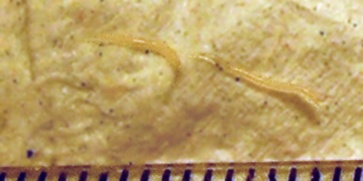
© Erich gasboy, Public Domain, via Wikimedia Commons
Where do you get threadworms?
Female threadworms lay an average of 11,000 tiny eggs, which are invisible to the naked eye. She lays these eggs outside the anus, or, in girls, around the vagina and urethra. Eggs are usually laid at night whilst the child sleeps. The eggs are accompanied by an irritant mucus, which causes intense pruritus and scratching. The eggs get on to the hands and from there to the mouth to re-infect.
Eggs are swallowed and exposed to digestive juices in the upper intestinal tract. Infection or re-infection can occur by directly swallowing, or by inhaling and then swallowing, the eggs. Occasionally, infection may occur when the eggs hatch on the mucosa and the larvae migrate back up the rectum.
Following ingestion of the eggs, the larvae hatch in the small intestine and establish themselves in the colon, reaching maturity in approximately two weeks. Adult worms live for up to six weeks.
How common are threadworms? (Epidemiology)
This is the most common helminthic infection in the UK. An average GP practice of 10,000 patients would expect about 40 consultations a year for threadworms but many more simply buy medication from a pharmacist. It tends to affect family groups or institutions.
Prevalence is highest between the ages of 5 and 9 years but all ages may be affected. Studies in asymptomatic children suggest that between 18 and 34% of children have threadworms.1
Symptoms of threadworms (presentation)1 2
The presenting feature is often pruritus ani or pruritus vulvae, especially at night. Loss of sleep can cause behavioural problems. Girls presenting before puberty with vaginal discharge, urinary tract infection, or nocturnal enuresis should be treated for threadworm.
Worms can be easily missed and may not move much, simply looking like flakes of skin. A parent may have seen something like a tiny piece of white cotton moving in the anal or vulval region, but often they are not seen and treatment is based on symptoms rather than a confirmed diagnosis.
Differential diagnosis
Perianal itching may be due to irritation by deodorants, tight nylon underclothes, haemorrhoids or perianal eczema. Deodorants and haemorrhoids are rather more a problem of adults than of children.
A number of skin diseases may cause pruritus. Psoriasis is said not to itch but it may in the anogenital region.
Vulvovaginitis is very common in young girls and can cause itching as well as soreness.
In some cases the possibility of sexual abuse must be considered - if there is a suspicion of sexual abuse then immediate referral to a paediatrician is essential.
Diagnosing threadworms (investigations)3
Often the diagnosis is clear and no investigation is required. There is no need to see the threads and treatment can be given on the basis of symptoms.
If parents want to confirm the presence of threadworms then they can use the adhesive tape test for eggs. Transparent wide hypo-allergenic adhesive tape is applied to the perianal skin first thing in the morning, before wiping or bathing. It does not have to be left on overnight. Many tiny eggs are usually seen adherent to the tape although they are so small they can be difficult to detect.
Another test is to apply some thick cream such as Sudocrem over the anus and vulva before bed. If tight underwear is worn all night then worms can often be seen in the cream on the underwear the next morning.
However, as above, the diagnosis does not need to be confirmed by seeing the worms, and successful treatment is often confirmation enough.
Management of threadworms2 3
Mebendazole is the drug of choice in adults and in children older than 2 years. It is given as a single oral dose, and is best repeated after two to three weeks in case re-infection has occurred. Mebendazole kills the worms.1
This can be bought over the counter but can also be prescribed.
Other possible drugs include albendazole and pyrantel pamoate.
All the family should be treated together if possible as asymptomatic infection is common, and transmission may occur through handling of contaminated food, clothing and bed linen.
The drugs do not harm threadworm eggs, which may remain viable for up to two weeks. To avoid re-infection it is important to clear the environment of viable worm eggs on the day that drug treatment is started.
Hygiene measures include:
Wear tight underwear at night.
Have a bath or shower each morning and wash around the anus.
Change and wash underwear, nightwear and, if feasible, bed linen and towels each day for the week after treatment. Do not shake them as this spreads eggs. Do not share towels.
Keep fingernails short and clean. Wash hands and scrub under the nails first thing in the morning, after using the toilet or changing nappies, and before eating or preparing food.
Children with threadworm do not need to be kept off school or nursery but good hygiene within these establishments should be encouraged.
Drug treatment is not recommended for children under the age of 6 months. In babies, scrupulous attention to the above hygiene measures for six weeks will lead to the adult worms dying without having had the chance to re-infect.
Mebendazole can be used in pregnancy or breastfeeding but the hygiene advice for babies is also true for women who want to avoid medication. 4
Complications of threadworms
Scratching of the perianal skin may cause inflammation, laceration and secondary infection.
Persistent or very heavy infestation can cause loss of appetite, weight loss, insomnia, enuresis and irritability.
Ectopic lesions means infestation outside the alimentary tract. Very occasionally worms are found in the ears and nose. Rarely, worms invade the abdominal cavity, causing granulomas of the liver, ovary, kidney, spleen and lung. Chronic pelvic peritonitis and ileocolitis have been described.
Prognosis
Re-infection is common.
Prevention of threadworms
Prevention relies on good hygiene, especially washing of hands before eating or preparing food. Sucking fingers or biting nails is to be discouraged. Treatment is very effective and it should be repeated to assure complete eradication.
Exclusive updates for healthcare professionals
Stay informed with the latest clinical updates, professional insights, and evidence-based guidance. The Patient Pro newsletter curates essential content for healthcare professionals—delivered straight to your inbox.
By subscribing you accept our Privacy Policy. You can unsubscribe at any time. We never sell your data.
Further reading and references
- Parasites A-Z; Centers for Disease Control and Prevention
- Wendt S, Trawinski H, Schubert S, et al; The Diagnosis and Treatment of Pinworm Infection. Dtsch Arztebl Int. 2019 Mar 29;116(13):213-219. doi: 10.3238/arztebl.2019.0213.
- Rawla P, Sharma S; Enterobius Vermicularis. StatPearls, May 2021
- Khubchandani IT, Bub DS; Parasitic Infections. Clin Colon Rectal Surg. 2019 Sep;32(5):364-371. doi: 10.1055/s-0039-1687832. Epub 2019 Sep 6.
- Best Use of Medicines in Pregnancy: Mebendazole
About the authorView full bio

Dr Philippa Vincent, MRCGP
General Practitioner, Medical Author
MB BS, Bsc, MRCGP (2000), DCH, DFSRH, DRCOG
Dr Philippa Vincent is an NHS GP working in North London.
About the reviewerView full bio

Dr Toni Hazell, FRCGP
MBBS, BSc, FRCGP, DFSRH, Dip GU med, DRCOG, DCH (London, UK, 2000)
Dr. Toni Hazell qualified from St. Mary’s Hospital Medical School and did her VTS at Northwick Park Hospital.
Article history
The information on this page is written and peer reviewed by qualified clinicians.
Article also available in English, German, Spanish, French, Italian, Portuguese, Hindi, Hebrew, Arabic, and Swedish.
Next review due: 10 Feb 2028
11 Feb 2025 | Latest version

Ask, share, connect.
Browse discussions, ask questions, and share experiences across hundreds of health topics.

Feeling unwell?
Assess your symptoms online for free
More in infectious disease
- Acquired immune deficiency syndrome
- Actinomycosis
- Bartonellosis
- Cat scratch disease
- Croup
- Erythema chronicum migrans
- Fungal lung infections
- Fungal nail infections
- Genital herpes simplex
- Human immunodeficiency virus
- Oral herpes simplex
- Parvovirus infection
- Pityriasis rosea
- Pseudomembranous colitis
- Psittacosis
- Pyelonephritis
- Relapsing fever
- Sepsis
- Vaginal discharge
- West Nile virus