Croup
Peer reviewed by Dr Colin Tidy, MRCGPLast updated by Dr Toni Hazell, FRCGPLast updated 29 Jan 2023
Meets Patient’s editorial guidelines
- DownloadDownload
- Share
- Language
- Discussion
- Audio Version
- Add to preferred sources on Google
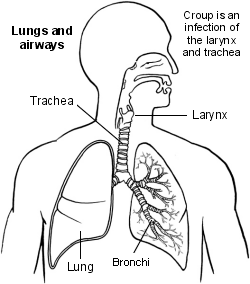
Croup is an infection of the voice box (larynx) and windpipe (trachea). These are the upper and lower parts of the breathing tube that connects the mouth to the top of the lungs. The usual cause of croup is a viral infection.
At a glance
Croup mainly affects young children between 6 months and 3 years old.
Common symptoms include a harsh, barking cough and noisy breathing.
Most cases are mild and get better on their own.
Seek medical help if breathing gets worse, if the child becomes restless or unusually pale.
Call an ambulance if the child is blue, unusually sleepy, struggling to breathe, or drooling.
Croup often causes mild symptoms that get better quickly. Sometimes the symptoms can be more serious and include problems with breathing. If you are concerned about your child and you think they may have croup, they should be seen by a doctor. Children with croup who have difficulty with breathing may need urgent admission to hospital.
Lungs and airways croup
How common is croup?
Croup is common in young children, especially between the ages of 6 months and 3 years. Some children have two or more bouts of croup in their childhood.
Is croup contagious?
The viral infection can pass from person to person, especially if there is close contact. Croup often occurs in outbreaks or epidemics in the winter.
Can adults get croup?
Croup is uncommon after 6 years of age. Older children can get the same viruses but the breathing tube becomes wider and stronger so the virus doesn't usually cause croup. However, teenagers and, very rarely, adults can get croup.
What are the symptoms of croup?
The symptoms of croup include:
Cough
This is usually a harsh and barking cough. This croupy cough is due to inflammation and swelling of the vocal cords in the voice box (larynx).
Breathing symptoms
The infection causes inflammation on the inside lining of the breathing tube. There may also be a lot of thick mucus. A combination of these can cause narrowing of the breathing tube. The narrowed tube may cause a noisy sound when breathing which is called stridor. Breathing may become difficult if the narrowing becomes worse.
Other symptoms
This may include a runny nose, hoarse voice and sore throat. Cases of croup may follow a cold but can also appear without any earlier illness. Other cold or flu-type symptoms may also occur. For example, a high temperature (fever), feeling unwell, being off food and general aches and pains.
The symptoms are often worse at night. Typically, during the day a child may have a croupy cough with cold symptoms but not be too unwell. However, at night the cough and breathing symptoms often become worse.
Symptoms usually peak after 1-3 days and then improve. A mild but irritating cough may last a further week or so.
An infection by a virus that causes croup in a young child may cause a cough or sore throat in an older child or adult but is unlikely to cause the breathing symptoms of croup (described below). However, rarely, symptoms of croup can occur in teenagers or adults.
How serious is croup?
Symptoms are often fairly mild but sometimes become severe. Many children just get a croup cough with some cold symptoms. Any breathing difficulty is often mild. Parents can expect to have one or two disturbed nights nursing a coughing child. Most children with croup remain at home and soon recover.
The main concern is if severe narrowing of the breathing tube develops. If this occurs then breathing can become difficult. About 1 in 10 children with croup are admitted to hospital for observation. This is usually if symptoms suggest a narrowing of the breathing tube. Most children admitted to hospital come home within 24 hours as symptoms usually improve quickly. In a small number of cases, a ventilator is needed to help the child to breathe. This is just for a short period whilst the infection and inflammation settle down.
When should you seek medical help?
Always consult a doctor or nurse if you have any concerns about your child. Most children with croup have mild symptoms and soon get better. However, a small number of children with croup need to be admitted to hospital. In particular, see a doctor quickly if:
Breathing symptoms get worse. (Breathing is often noisy with mild croup but it's difficulty in breathing that is worrying.) Signs that breathing is getting worse include:
Rapid breathing.
Needing more effort to breathe - you may see the chest or neck muscles being pulled in with each breath.
The child becomes restless or agitated.
The child looks unusually pale.
A high temperature (fever) lasts longer than five days.
Call for an emergency ambulance if the child is:
Blue (cyanosed).
Unusually sleepy.
Struggling to breathe.
Drooling and unable to swallow.
How to treat croup
What can you do to help your child with croup?
Always consult a doctor or nurse if you have any concerns about your child. A doctor will normally advise on what to do, or whether hospital admission is needed. The sort of advice your doctor may give is as follows:
Be calm and reassuring. A small child may become distressed with croup. Crying can make things worse. Sit the child upright on your lap if their breathing is noisy or difficult. Let the child find a comfortable position.
Lower the high temperature (fever). If a child has a fever their breathing is often faster and they may be more agitated and appear more ill. To lower a fever, give paracetamol liquid (for example, Calpol®) or ibuprofen liquid.
Give the child lots of cool drinks (if they are happy to take them).
Cool air. Some people find that it is helpful to have a stroll outdoors, carrying the child upright in the cool fresh air.
What doesn't help?
DO NOT give cough medicines which contain ingredients that can make a child drowsy. This will not help a child who may need extra effort to breathe. There is no evidence anyway that cough medicines and decongestants help in croup. Also cough medicines are not suitable for children under the age of 6 years.
Antibiotic medicines are not usually prescribed as croup is normally caused by a virus. Antibiotics do not kill viruses.
Steam used to be commonly advised as a treatment. It was thought that steam may loosen the mucus and make it easier to breathe. However, there is little evidence that steam does any good. Also, some children have been scalded by steam whilst being treated for croup. Therefore, steam is not recommended.
Do not make a child with breathing difficulty lie down or drink fluids if they don't want to, as this can make their breathing worse.
Do not attempt to look in your own child's throat. Very rarely, the symptoms of croup may in fact be due to a rarer condition called epiglottitis, in which looking in the throat can cause further swelling and be dangerous. Let the healthcare professional decide if a throat examination is needed.
Other treatments
A steroid medicine such as dexamethasone is usually prescribed. Steroid medicines help to reduce inflammation. A single dose often eases symptoms within a few hours. Steroid medicines do not shorten the length of the illness but they are likely to reduce the severity of breathing symptoms.
Inhaled adrenaline (epinephrine) is sometimes used in hospital to decrease the swelling of the windpipe (trachea) for children with moderate or severe difficulty with breathing. Inhaled adrenaline (epinephrine) often improves croup symptoms 30 minutes after the treatment is given. However, the improvement usually disappears two hours after treatment.
Patient picks for Childhood infections

Children's health
Coughs and colds in children
Coughs and colds are usually caused by infection with a germ called a virus. They normally clear away on their own. Antibiotic medicines don't help, and can cause harms, such as diarrhoea and vomiting. Paracetamol or ibuprofen may ease some of the symptoms. Make sure the child has enough to drink.
by Dr Doug McKechnie, MRCGP

Children's health
Head lice and nits
Head lice are small insects that live in human hair and feed on blood from the scalp. Their eggs are called nits.
by Dr Colin Tidy, MRCGP
Frequently asked questions
Can teenagers get croup?
While uncommon after 6 years of age, teenagers can, very rarely, get croup. They can contract the same viruses that cause croup in younger children, but usually their wider and stronger breathing tubes prevent the typical breathing symptoms of croup.
Does croup have mucus?
Yes, the infection in croup can cause inflammation inside the breathing tube, and there may also be a lot of thick mucus. This combination can contribute to the narrowing of the breathing tube and cause noisy breathing.
Does croup go away on its own?
Croup symptoms usually peak after 1-3 days and then start to improve on their own. A mild, irritating cough might linger for about another week after the main symptoms subside. Most children recover at home without complications.
What virus causes croup?
Croup is caused by a viral infection. The article doesn't specify which particular virus, but it states that these viruses can spread from person to person, often leading to outbreaks during winter.
Can adults carry croup?
Adults can carry the viruses that cause croup. While these viruses might lead to a cough or sore throat in an adult, they are unlikely to cause the specific breathing symptoms of croup due to the adult's wider and stronger breathing tube. However, adults can pass these viruses on to others, including young children who may then develop croup.
How common is croup?
Croup is common in young children, particularly those between 6 months and 3 years of age. Some children might experience multiple episodes of croup during their childhood.
How long does croup last?
The main symptoms of croup typically peak within 1 to 3 days and then begin to improve. A mild, lingering cough might last for an additional week or so.
Further reading and references
- Russell KF, Liang Y, O'Gorman K, et al; Glucocorticoids for croup. Cochrane Database Syst Rev. 2011 Jan 19;(1):CD001955.
- Bjornson CL, Johnson DW; Croup in children. CMAJ. 2013 Oct 15;185(15):1317-23. doi: 10.1503/cmaj.121645. Epub 2013 Aug 12.
- Croup; NICE CKS, May 2022 (UK access only)
- Aregbesola A, Tam CM, Kothari A, et al; Glucocorticoids for croup in children. Cochrane Database Syst Rev. 2023 Jan 10;1(1):CD001955. doi: 10.1002/14651858.CD001955.pub5.
About the authorView full bio

Dr Toni Hazell, FRCGP
MBBS, BSc, FRCGP, DFSRH, Dip GU med, DRCOG, DCH (London, UK, 2000)
Dr. Toni Hazell qualified from St. Mary’s Hospital Medical School and did her VTS at Northwick Park Hospital.
About the reviewerView full bio

Dr Colin Tidy, MRCGP
General Practitioner, Medical Author
MBBS, MRCGP, MRCP (Paediatrics), DCH
Dr Colin Tidy is an NHS Doctor, based in Oxfordshire.
Article history
Article also available in English, German, Spanish, French, Italian, Portuguese, Hindi, Hebrew, Arabic, and Swedish.
Next review due: 28 Jan 2028
29 Jan 2023 | Latest version
Join the conversation
Share your thoughts or experiences with others in our patient communities.

Ask, share, connect.
Browse discussions, ask questions, and share experiences across hundreds of health topics.

Feeling unwell?
Assess your symptoms online for free
Sign up to the Patient newsletter
Your weekly dose of clear, trustworthy health advice - written to help you feel informed, confident and in control.
By subscribing you accept our Privacy Policy. You can unsubscribe at any time. We never sell your data.
More in children's health
- Bedwetting alarms
- Blocked nose in babies
- Bronchiolitis
- Bullying
- Childhood gastro-oesophageal reflux
- Feeding premature babies
- Food poisoning in children
- Head lice and nits
- Hirschsprung's disease
- Klinefelter's syndrome
- Meningitis
- MMR vaccination
- Muscular dystrophy
- Neuroblastoma
- Pyloric stenosis
- Restricted growth
- Spina bifida
- Teething
- Undescended testicles
- Urine infection in children