Furúnculos, carbúnculos e furunculose
Revisado por Dr Doug McKechnie, MRCGPÚltima atualização por Dr Colin Tidy, MRCGPÚltima atualização 20 Jan 2025
Atende aos diretrizes editoriais
- BaixarBaixar
- Compartilhar
- Language
- Discussão
- Versão em Áudio
Um furúnculo é uma infecção de um folículo piloso. Um carbúnculo ocorre quando um grupo de folículos pilosos próximos uns dos outros fica infectado. É como um furúnculo múltiplo. A furunculose crônica é uma condição em que você tem surtos de furúnculos que ocorrem por um período mais longo de tempo.
Neste artigo:
Vídeos selecionados para Infecções de pele
Continue lendo abaixo
What is a boil?
Small boils are very common and often go away without any treatment. But they can be irritating and can also cause distress if they are in a prominent position such as on your face. Larger boils usually need treatment. If you get lots of boils that keep coming or don't go away then you may need some tests to check if there is any underlying cause.
Hidradenite supurativa is a long-term (chronic) skin condition, leading to painful and repeated lumps of pus (boils or abscesses).
Buttock carbuncle
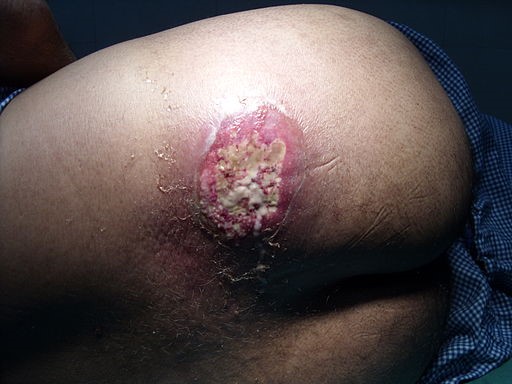
© Drvgaikwad, CC BY 3.0, via Wikimedia Commons
See the link for Dermnet NZ in Further Reading below for further images of boils.
What does a boil look like?
Voltar ao conteúdoRed lump. A boil looks like a small red lump on the skin that is tender.
Swollen skin. The surrounding skin may be swollen and inflamed.
Pus. Thick, infected fluid called pus fills the centre of the boil.
Where do boils usually appear?
A boil on skin can develop in any hairy area of skin. In particular, in sites where there is friction, or where the skin is sweaty. For example, they can appear:
On the neck.
Rosto.
Axilas.
Arms.
Buttocks.
Around the back passage (anus).
Um boil in the ear canal may be very painful.
Carbuncles most commonly develop on the back of the neck or on the thighs.
Fatores de risco
A boil or carbuncle can occur in anyone at any age. However, they are uncommon in children and most common in teenagers and young adults. You have a higher risk of developing a boil or carbuncle if you:
Skin conditions. Have other skin conditions that may cause you to scratch and damage the skin - for example, eczema ou sarna.
Peso. Are very overweight (obese).
Weakened immune system. Have a poor defence against infections (immune system).
Illness. Have an illness making you frail or generally unwell.
Bacteria. Are a carrier of staphylococcal germs (bacteria).
Continue lendo abaixo
What causes boils?
Voltar ao conteúdoGerms. Boils are caused by germs (bacteria) multiplying below the skin surface.
Weakened immune system. Your immune system is important in helping you to fight off infection.
That means you have a higher risk of developing a boil or carbuncle if germs get under your skin and your immune system does not kill them quickly enough to stop them multiplying.
Recurring boils causes
If you develop recurring boils (chronic furunculosis), your doctor may suggest some tests to look for an underlying cause.
For example, to check if you have a poor sistema imunológico.
You may be prone to boils just because you're generally run down and tired.
But it's important to check there isn't any underlying problem, such as diabetes tipo 2.
One cause of recurring boils if you are otherwise healthy is that you, or someone in your family or household, may be a carrier of a special type of staphylococcal germ (bacteria), which is called PVL staphylococcus. This means that a certain number of these bacteria live harmlessly on your skin, or in your nose. If you are a carrier, you tend to be more prone to skin infections and boils. In particular, these bacteria may quickly invade and multiply in broken skin following a minor cut or injury.
Treatment with antibiotics and/or antibiotic nasal cream may clear staphylococcal bacteria from carriers and reduce the chance of boils, or other types of skin infection, from coming back. Always wash your hands to help prevent spreading infection.
Boil treatment
Voltar ao conteúdoNenhum tratamento. Small boils (furuncles) may subside and go without any treatment other than simple home treatment. You can ease pain by covering the boil with a flannel soaked in warm water. Do this for 30 minutes, 3-4 times a day. (Be very careful that the water is not too hot. It is important to avoid the risk of burns from hot water.)
Purulent drainage. Larger boils and carbuncles are best treated by letting the infected fluid (pus) out. Sometimes this is done by a doctor who drains the pus, using a needle and syringe. Sometimes a small cut in the skin is needed to let out the pus (incision and drainage). The wound is covered with a dressing until the skin heals. The skin usually heals quickly once the pus has been drained.
Antibióticos. A course of an antibiotic medicine, como flucloxacilina, is sometimes prescribed to help clear the infection from the skin. Alternative antibiotics may be needed, such as when an infection is caused by methicillin resistant staphylococcus aureus (MRSA).
Continue lendo abaixo
What will happen if I do nothing?
Voltar ao conteúdoBoils. Typically, after several days (sometimes after a week or more) the boil will burst and pus will leak on to the skin. The pain tends to ease when the boil bursts. Once the pus has gone, the infection in the surrounding skin tends to fade away gradually over several days. A scar may be left at the site of the boil.
Carbuncles. A carbuncle tends to increase in size for a few days - up to 3-10 centimetres across, sometimes more. After 5-7 days, various pus-filled lumps appear on the surface and pus leaks on to the skin. It then may break down and form an ulcer on the skin surface before the infection gradually subsides. The skin then gradually heals leaving a deep scar.
While infection and pus are in the skin, there is a risk that some germs (bacteria) may spread in the bloodstream to cause infections in other parts of the body (sepse). This is very uncommon but, if it happens, it can lead to serious infections of a bone, the brain, or other parts of the body.
Escolhas do paciente para Infecções de pele
Infecções
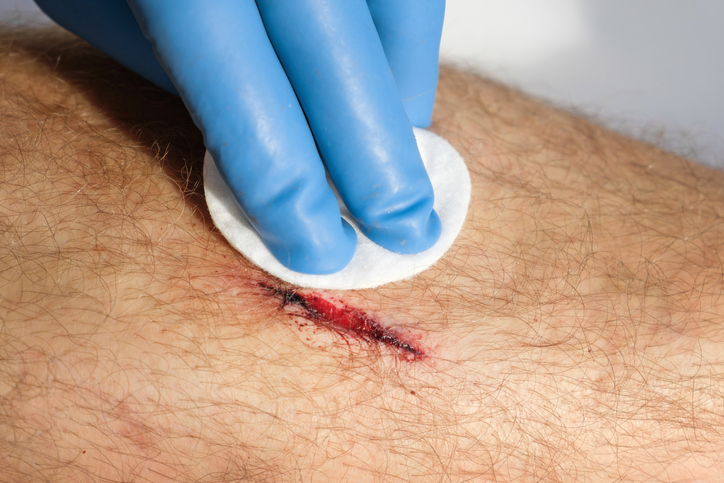
Feridas infectadas
A infecção pode ocorrer em qualquer tipo de ferida - seja um pequeno corte, de um procedimento cirúrgico ou uma lesão acidental. Os sinais de que uma ferida está infectada incluem dor que piora, inchaço e vermelhidão que se espalha, aumento de calor ao redor da ferida e pus. Este folheto discute os sintomas que você deve observar, tratamentos e quando procurar ajuda médica.
por Dra. Philippa Vincent, MRCGP
Infecções
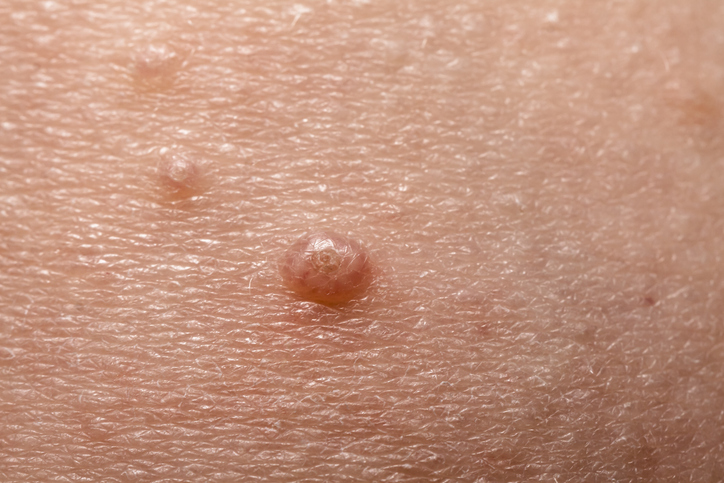
Molusco contagioso
Molluscum contagiosum é uma condição comum onde pequenas protuberâncias verrugosas (moluscos) aparecem na pele. É causada por um vírus que pode ser transmitido por contato com a pele ou por toalhas, panos, brinquedos de pelúcia contaminados, etc. Não é grave e geralmente desaparece dentro de 12 a 18 meses sem qualquer tratamento.
por Dr. Doug McKechnie, MRCGP
Leitura adicional e referências
- Boils; DermNet NZ
- Folliculitis and boils (furuncles / carbuncles); The Primary Care Dermatology Society. Last updated May 2022.
- Boils, carbuncles, and staphylococcal carriage; NICE CKS, maio de 2024 (acesso apenas no Reino Unido)
- Shallcross LJ, Hayward AC, Johnson AM, et al; Incidence and recurrence of boils and abscesses within the first year: a cohort study in UK primary care. Br J Gen Pract. 2015 Oct;65(639):e668-76. doi: 10.3399/bjgp15X686929.
Continue lendo abaixo
Histórico do artigo
As informações nesta página são escritas e revisadas por clínicos qualificados.
Próxima revisão prevista: 19 Jan 2028
20 Jan 2025 | Última versão

Pergunte, compartilhe, conecte-se.
Navegue por discussões, faça perguntas e compartilhe experiências em centenas de tópicos de saúde.

Sentindo-se mal?
Avalie seus sintomas online gratuitamente
Inscreva-se no boletim informativo do Patient
Sua dose semanal de conselhos de saúde claros e confiáveis - escritos para ajudá-lo a se sentir informado, confiante e no controle.
Ao se inscrever, você aceita nossos Política de Privacidade. Você pode cancelar a inscrição a qualquer momento. Nunca vendemos seus dados.