Abnormal heart rhythms
Arrhythmias
Peer reviewed by Dr Hayley Willacy, FRCGP Last updated by Dr Colin Tidy, MRCGPLast updated 19 Nov 2022
Meets Patient’s editorial guidelines
- DownloadDownload
- Share
- Language
- Discussion
- Audio Version
- Add to preferred sources on Google
In this series:Heart palpitationsBradycardiaWolff-Parkinson-White syndromeSupraventricular tachycardia
An arrhythmia is an abnormal rate and/or rhythm of the heartbeat due to some problem with the electrical conducting system of the heart.
At a glance
An arrhythmia is an abnormal heart rate or rhythm caused by a problem with the heart's electrical system.
Symptoms can include palpitations, a fast, slow, or irregular pulse, dizziness, shortness of breath, and chest pains.
Some arrhythmias are more serious than others, with ventricular fibrillation being life-threatening.
Causes can be heart conditions like coronary heart disease or high blood pressure, or non-heart issues like certain medicines.
Treatments vary by type and can include medication, catheter ablation, cardioversion, pacemakers, or implantable cardioverter defibrillators.
An electrocardiogram (ECG) is a common test to diagnose arrhythmias.
What is an arrhythmia?
An arrhythmia is an abnormal rate and/or rhythm of the heartbeat. There are various types but all are due to some problem with the electrical conducting system of the heart. Some arrhythmias are more serious than others. Some come and go (are intermittent); others are permanent unless treated.
Tachycardia means a faster heart rate than usual - more than 100 beats per minute (bpm). This can be due to one of many different factors, such as exercise, fear, fever, anaemia or an overactive thyroid gland. Bradycardia means an irregular heartbeat which is slower than usual (fewer than 60 bpm).
For more information about how the heart works, including the electrical system that regulates the heartbeat, see also Anatomy of the heart and blood vessels.
What are the symptoms of arrhythmias?
Symptoms can vary, depending on the severity of the condition. If the abnormal heart rhythm (arrhythmia) comes and goes (is intermittent), the symptoms develop suddenly and can go just as suddenly. Symptoms of arrhythmias include:
The sensation of having a 'thumping heart' (palpitations). Note: sensations of palpitations are also common in people who do not have an arrhythmia. This is why it is important to see a doctor for correct diagnosis.
An abnormally fast, slow, or irregular pulse.
Dizziness or feeling faint.
Shortness of breath.
Chest pains which sometimes develop.
Some arrhythmias are more serious than others. A heart rate that is very fast or very slow can result in too little blood flowing through the heart. In some cases this can lead to heart failure, or you may collapse.
It can be very difficult to detect an arrhythmia in a young child, when the only clue may be a change in behaviour or a problem with feeding.
What are the treatments for arrhythmias?
Each type of abnormal heart rhythm (arrhythmia) has specific treatment options. Also, treating any underlying cause - such as coronary heart disease, or high blood pressure (hypertension) - may also be important in controlling certain arrhythmias. The sort of treatments which may be considered include:
Medication
The medication used will depend on the type of arrhythmia.
Catheter destruction (ablation) treatment
A small wire (catheter) is passed via a large vein in your leg into the chambers of your heart. The tip of the catheter can destroy a tiny section of heart tissue that is the source or trigger of abnormal electrical impulses.
Cardioversion
This may be an option for some types of tachycardia. Whilst under anaesthetic, you are given an electrical shock over the heart to restore a normal regular heartbeat. This may revert the abnormal rhythm back to normal.
Artificial pacemakers
These are used in cases of complete heart block and in certain other situations. An artificial pacemaker is a small device which is inserted just under the skin on the upper chest. The pacemaker can then stimulate the heart to maintain a regular normal heartbeat.
Implantable cardioverter defibrillators (ICDs)
They are small devices which are similar to pacemakers and are inserted under the skin in the upper chest. The device monitors the heartbeat. If it detects a change to an abnormal rhythm, the device can send a short electrical shock to the heart to stop the abnormal rhythm.
What are the different types of arrhythmias?
The main types of arrhythmia include the following:
Ectopic beats: these are extra heartbeats which occur out of rhythm with the normal heartbeat. They are very common and are usually harmless. You do not normally notice them. Sometimes you may notice them as a slight thud in the chest if you are lying still in bed. Caffeine in tea or coffee, and alcohol may cause you to have more ectopic beats than usual.
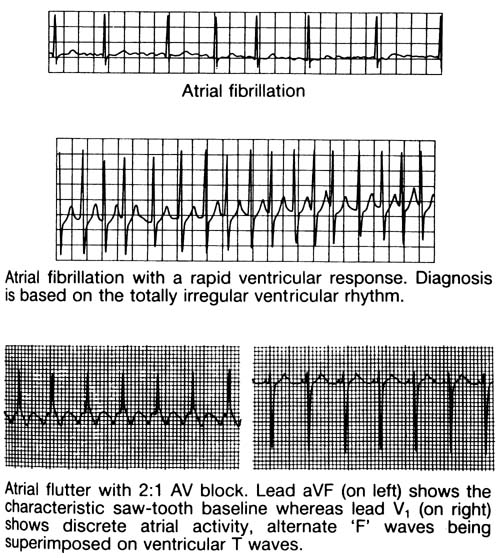
Atrial flutter is similar to atrial fibrillation (AF). The atria contract at about 300 bpm but the ventricles are unable to beat that quickly and so beat at between 75 and 150 bpm.
Ventricular tachycardia is an uncommon arrhythmia. The ventricles beat faster than normal (between 120 and 200 bpm). The rate in the atria is normal. There is a trigger of electrical impulses somewhere in the ventricles which overrides the normal impulses coming down from the atria.
Ventricular fibrillation (VF): many random electrical impulses 'fire off' from different parts of the ventricles. This is called fibrillation. This means the heart muscles only weakly contract and this is not enough to push blood out of the heart. This is life-threatening and a common cause of the heart stopping (cardiac arrest). It is fatal unless corrected within a few minutes.
Heart block occurs when the electrical impulses are partially or fully blocked between the atria and the ventricles. The SA node in the right atrium 'fires' at the normal rate but the rate at which the ventricles contract (pulse rate) depends on how many impulses get through to the ventricles:
First-degree heart block means there is a slight delay in each impulse going from the atria to the ventricles. But, each impulse does get through and the resting heart rate is normal.
Second-degree heart block means that some impulses from the atria are not conducted through to the ventricles. The rate that the ventricles contract can then be slow.
Third-degree, or complete, heart block means that no impulses are conducted through. The ventricles then contract at their own in-built rate of about 20-40 bpm. So, you have a very slow pulse.
Sick sinus syndrome: the heart's natural pacemaker (called the sinus node or sinoatrial node) - becomes damaged. The heart then tends to beat slowly or miss a few beats. But, in some cases, the heart alternates between beating slowly for a while and then fast for a while.
What causes an arrhythmia??
There are various causes of abnormal heart rhythms (arrhythmias). They include the following:
Heart conditions
Many arrhythmias occur as a complication of a heart condition. For example:
Coronary heart disease (which causes angina and heart attacks).
Ageing (age-related degeneration) around the conducting fibres may cause complete heart block.
A disorder of the heart muscle (cardiomyopathy). See the separate leaflets called Dilated Cardiomyopathy and Hypertrophic Cardiomyopathy.
Congenital abnormalities in the electrical pathways. Congenital means the abnormality is present from birth.
Non-heart causes
Certain medicines and excess thyroid hormone (hyperthyroidism) can sometimes trigger an arrhythmia. In some cases the cause is not clear. For example, some cases of AF and SVT occur out of the blue in otherwise healthy hearts. A section of the conducting fibres just becomes faulty and can trigger fast impulses.
Are arrhythmias dangerous?
Whether an arrhythmia is dangerous depends on the type of arrhythmia you have and any underlying cause for the arrhythmia. The most dangerous arrhythmia is ventricular fibrillation.
Any significant change in your heart rhythm may mean that your heart is not able to pump blood efficiently throughout your body and this may lead to heart failure. An arrhythmia may also cause a clot to form in your heart and the clot may flow to your brain to cause a stroke.
However, most arrhythmias are not life-threatening and can be treated, such as with one or more medicines, or by catheter ablation. In catheter ablation, a thin tube (catheter) is inserted through a blood vessel to your heart. This allows abnormal tissue to be destroyed and proper function to your heart to be restored.
How do they test for arrhythmia?
Sometimes a doctor can easily diagnose that you have an abnormal heart rhythm (arrhythmia) by taking your pulse and examining you.
Some people have dizzy spells, or fainting attacks which may be due to an intermittent arrhythmia. Tests can help to confirm if you have an arrhythmia and to find which type it is. The tests will include a heart tracing (electrocardiogram, or ECG).
If you have an intermittent arrhythmia, this may not be detected by a standard ECG done at one particular time. You may then be advised to have an ambulatory ECG. This test records the electrical signals of your heart when you are walking about (ambulatory) and doing your normal activities.
Sometimes an ECG is taken whilst you exercise on a treadmill or bike to try to provoke symptoms which may be an intermittent arrhythmia.
Other more sophisticated tests may be advised.
Patient picks for Heart palpitations
Heart health and blood vessels
Atrial fibrillation
Atrial fibrillation (AF) is an abnormal fast irregular heartbeat. An abnormal heartbeat rhythm is called an arrhythmia. A normal heart rate is between 60 and 100 beats a minute (bpm) when you're resting. In AF the heart rate can sometimes be very fast (often between 140 and 180 bpm) as well as being irregular.
by Dr Doug McKechnie, MRCGP
Heart health and blood vessels
Postural tachycardia syndrome
Postural tachycardia syndrome (PoTS) is an abnormal response of your body when you are upright (usually when standing). Your heart rate increases too much after getting up from lying or sitting down. It is caused by a problem with the nervous system which controls the autonomic functions in the body. This part of the nervous system is called the autonomic nervous system. The symptoms of PoTS occur when you are upright and are relieved when lying down. These symptoms are associated with an abnormally high and persistent increase in heart rate within ten minutes of standing. Lifestyle adjustments are usually very effective for the treatment of PoTS but some people with PoTS need medication to control the symptoms. The outcome (prognosis) is very good for most people with PoTS but some may have severe long-term difficulties with normal daily activities.
by Dr Rosalyn Adleman, MRCGP
Frequently asked questions
What is tachycardia?
Tachycardia is when your heart beats faster than usual, specifically more than 100 beats per minute (bpm). It can be caused by various factors like exercise, fear, fever, anaemia, or an overactive thyroid gland.
What is bradycardia?
Bradycardia refers to an irregular heartbeat that is slower than usual, meaning fewer than 60 beats per minute (bpm).
Are ectopic beats serious?
Ectopic beats are extra heartbeats that occur out of rhythm, but they are very common and usually harmless. You might not even notice them, or you might feel a slight thud in your chest. Factors like caffeine and alcohol can sometimes increase their occurrence.
Can diet play a role in developing an arrhythmia?
While the article mentions that caffeine and alcohol can cause more ectopic beats than usual, it does not broadly discuss the role of diet in developing arrhythmias in general. However, it does highlight treating underlying causes like high blood pressure, which can be influenced by diet.
What is the difference between an artificial pacemaker and an implantable cardioverter defibrillator (ICD)?
An artificial pacemaker is a small device inserted under the skin on the upper chest that stimulates the heart to maintain a regular normal heartbeat, particularly for conditions like complete heart block. An implantable cardioverter defibrillator (ICD) is similar in size and placement, but it monitors the heartbeat and delivers a short electrical shock to stop an abnormal rhythm if one is detected.
What is ventricular fibrillation and why is it dangerous?
Ventricular fibrillation (VF) occurs when many random electrical impulses fire from different parts of the ventricles, causing the heart muscles to contract only weakly. This means the heart cannot effectively pump blood, making it life-threatening and a common cause of cardiac arrest. It is fatal unless corrected within a few minutes.
Further reading and references
- Checking your pulse; British Heart Foundation
- Albert CM, Stevenson WG; The Future of Arrhythmias and Electrophysiology. Circulation. 2016 Jun 21;133(25):2687-96. doi: 10.1161/CIRCULATIONAHA.116.023519.
- Guasch E, Mont L; Diagnosis, pathophysiology, and management of exercise-induced arrhythmias. Nat Rev Cardiol. 2017 Feb;14(2):88-101. doi: 10.1038/nrcardio.2016.173. Epub 2016 Nov 10.
- Voskoboinik A, Kalman JM, Kistler PM; Caffeine and Arrhythmias: Time to Grind the Data. JACC Clin Electrophysiol. 2018 Apr;4(4):425-432. doi: 10.1016/j.jacep.2018.01.012.
- Safavi-Naeini P, Sorurbakhsh NZ, Razavi M; Cardiac Arrhythmias During Pregnancy. Tex Heart Inst J. 2021 Sep 1;48(4). pii: 472197. doi: 10.14503/THIJ-21-7548.
About the authorView full bio

Dr Colin Tidy, MRCGP
General Practitioner, Medical Author
MBBS, MRCGP, MRCP (Paediatrics), DCH
Dr Colin Tidy is an NHS Doctor, based in Oxfordshire.
About the reviewerView full bio

Dr Hayley Willacy, FRCGP
General Practitioner, Medical Author
MBChB (1992), DRCOG, DFFP, MRCOG (Part 1) MRCGP (2007), DFSRH (2013), MSc - medical education (2020)
Dr Hayley Willacy was an NHS GP working in northwest England, who retired from clinical practice in 2022 after 30 years.
Article history
Article also available in English, German, Spanish, French, Italian, Portuguese, Hindi, Hebrew, Arabic, and Swedish.
Next review due: 18 Nov 2027
19 Nov 2022 | Latest version
Join the conversation
Share your thoughts or experiences with others in our patient communities.

Ask, share, connect.
Browse discussions, ask questions, and share experiences across hundreds of health topics.

Feeling unwell?
Assess your symptoms online for free
Sign up to the Patient newsletter
Your weekly dose of clear, trustworthy health advice - written to help you feel informed, confident and in control.
By subscribing you accept our Privacy Policy. You can unsubscribe at any time. We never sell your data.