Cri du chat syndrome
Peer reviewed by Dr Colin Tidy, MRCGPLast updated by Dr Hayley Willacy, FRCGP Last updated 20 Nov 2023
Meets Patient’s editorial guidelines
- DownloadDownload
- Share
- Language
- Discussion
- Audio Version
- Add to preferred sources on Google
Cri du chat syndrome is a chromosome problem caused by a missing piece of chromosome 5. The syndrome is called cri du chat (French for cry of the cat) because affected babies often have a high-pitched cry.
Not all babies with the missing piece of chromosome 5 will develop cri du chat syndrome. Cri du chat syndrome may cause a variety of abnormalities, especially affecting the head and face. Other features may include learning difficulties and slow growth and development.
There is no specific treatment. However, physiotherapy, speech and language therapy, and surgical treatment for some abnormal features may be needed. Many affected children will survive well into adulthood. However, those babies severely affected may die within the first year of life.
At a glance
Cri du chat syndrome is a rare genetic condition caused by a missing piece of chromosome 5.
It causes a high-pitched, cat-like cry in babies, feeding difficulties, and distinctive facial features.
Babies with this syndrome may also have a small head, learning difficulties, and delayed development.
Diagnosis can occur before or after birth through chromosome testing.
There is no specific cure, but supportive therapies can help with development.
The severity of symptoms varies, but most people with the condition live into adulthood.
What is cri du chat syndrome?
Cri-du-chat is a rare condition caused by a defect in the genes. A piece of the short arm of chromosome 5 is missing or deleted. The number and severity of symptoms shown will depend on how much is missing from the chromosome. Another name for Cri-du-chat is 5p syndrome because '5p' means the short arm of chromosome 5.
Symptoms of cri du chat syndrome
Not all babies with a missing short arm of chromosome 5 will develop cri du chat syndrome. Some will have only very mild abnormal features or have no abnormal features at all.
There are a number of clinical features of cri du chat syndrome, which include:
The baby has a cry which is high-pitched and has been described as sounding like a cat. Cri-du-chat means cry of the cat in French. The mewing cry becomes less obvious with increasing age.
Sucking and feeding difficulties are common in the first year of life.
Features in the baby's head may include a small head (microcephaly), small jaw (micrognathia) and wide-set eyes.
Abnormal, distinctive facial features that include downward slant to the eyes, low or abnormally shaped ears and skin tags in front of the ear. There may be an extra fold of skin over the inner corner of the eye (epicanthic fold).
Cri du chat
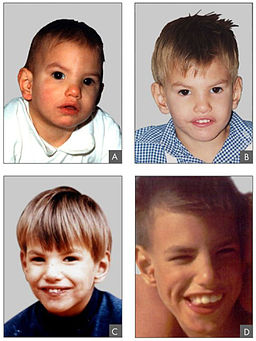
© (By Paola Cerruti Mainardi, via Wikimedia Commons)
Abnormal features in the hands and feet include partial webbing or joining together (fusing) of the fingers or toes. There may be a single line (crease) in the palm of the hand (there are normally two skin creases).
The affected newborn baby may be small and grow slowly. The affected child may have learning difficulties. There may be slow development of motor skills (eg, a delay in walking) and of speech and language.
Other features may include a hernia in the groin and separation of the muscles in the tummy. There is also an increased risk of heart defects and abnormalities in the brain, kidneys or gut (bowel).
Causes of cri du chat syndrome
Cri du chat syndrome is a chromosome problem caused by a missing piece of chromosome 5. The missing piece of the chromosome is the short (called 'p') arm of chromosome 5. Therefore cri du chat syndrome is said to be caused by deletion of chromosome 5p.
Most cases (around 80 in 100) are thought to occur as a result of damage to the chromosome during the development of the egg or sperm. It is thought that around 12 cases in 100 are caused by an unbalanced translocation, which is a chromosomal re-arrangement in the parent's genes.
How common is cri du chat syndrome?
Cri du chat syndrome is very rare. It affects about 1 in every 30,000 newborn babies.
How is cri du chat syndrome diagnosed?
Cri du chat syndrome can either be diagnosed before birth (prenatally) or after birth (postnatally).
Prenatal diagnosis
Diagnosis before birth may be made by ultrasound or by testing the baby's chromosomes during the pregnancy. See the separate leaflets called Amniocentesis, Chorionic Villus Sampling and Ultrasound Scan.
Postnatal diagnosis
Diagnosis after birth will be made by investigations if a baby has any features suggesting cri du chat syndrome. See the separate leaflet called Genetic Testing. The parents of a child with cri du chat syndrome should also have genetic counselling and testing to find out whether one parent has a change in chromosome 5.
Further tests will be needed to assess any features associated with cri du chat syndrome (eg, a skull X-ray and a magnetic resonance imaging (MRI) scan to assess any skull and face abnormalities or an ultrasound scan of the heart (echocardiogram) to assess any heart defects).
Treatment for cri du chat syndrome
Can cri du chat be cured?
There is no specific treatment for cri du chat syndrome. However, affected babies and children may need a great deal of physiotherapy and speech and language therapy.
Provision of early special schooling and a supportive home environment helps in development of social and intellectual ability. Surgical treatment may be needed to correct some abnormal features (for example, hernia) or any other associated features (for example, heart defects).
What is the prognosis for cri du chat syndrome?
The outlook (prognosis) depends on the severity of abnormal features. Learning difficulties and speech and language problems are common. However, most people with cri du chat syndrome survive well into adulthood.
About 1 in 10 babies born with cri du chat syndrome are severely affected and die within the first year of life. Intellectual disability is common.
Because of the head and face abnormalities, serious lung infection (pneumonia) is more common.
Understanding chromosomes and cell division
Chromosomes are found in the centre (nucleus) of a cell. They carry genetic information in the form of genes. 'Genetic' means that the condition is passed on through families by special codes called genes. Each cell of your body contains chromosomes which are made up of many genes.
In general, each cell in your body contains 46 chromosomes arranged in 23 pairs. One chromosome from each pair is inherited from your mother and the other is inherited from your father.
One of these chromosome pairs is known as the sex chromosomes because this pair determines our sex. Females have two of the same kind of sex chromosome (XX). Males have two different sex chromosomes (XY).
The Y chromosome contains the male determining genes. So, a normal female is 46, XX and a normal male is 46, XY. The other 22 pairs of chromosomes are numbered according to size with 1 being the longest pair and 22 being the shortest pair of chromosomes.
However, egg and sperm cells only have 23 chromosomes (1 chromosome from each pair). This is so that, when an egg and a sperm meet during conception, the child that is produced also has 46 chromosomes in each cell.
New body cells are produced for growth and repair by cells dividing, producing two 'daughter' cells. Each chromosome can duplicate an exact copy of itself so that each new cell that is formed has a full, identical set of chromosomes.
Rarely, there is a problem with the child's chromosomes. Possible problems include too many chromosomes, too few chromosomes or damage to one or more chromosomes. The abnormal chromosomes may mean that the baby cannot survive and so may cause a miscarriage.
However, babies with some chromosome abnormalities may survive but are affected by various medical problems (called a syndrome).
What causes cri du chat syndrome?
Cri du chat syndrome is a chromosome problem caused by a missing piece of chromosome 5. The missing piece of the chromosome is the short (called 'p') arm of chromosome 5. Therefore cri du chat syndrome is said to be caused by deletion of chromosome 5p.
Most cases are thought to occur as a result of damage to the chromosome during the development of the egg or sperm.
Patient picks for Genetic conditions

Children's health
Ehlers-Danlos syndrome
The Ehlers-Danlos syndromes (EDS) are a group of conditions that affect the stretchiness and strength of supporting tissues in the body, including skin, joints, blood vessels and internal organs. They vary in their impact from very mild through to very severe.
by Dr Rachel Hudson, MRCGP

Children's health
Turner syndrome
Turner syndrome is a genetic condition that only affects girls. The most characteristic features of the syndrome are being short, having certain physical features (detailed below), and ovaries that do not work properly. Although there is no cure, there are treatments that can help most girls with Turner syndrome lead relatively normal lives.
by Dr Colin Tidy, MRCGP
Frequently asked questions
What does 'Cri du chat' mean?
'Cri du chat' is a French term that translates to 'cry of the cat'. This name describes the high-pitched, cat-like cry that is characteristic of babies born with the syndrome.
Can people with cri du chat syndrome live into adulthood?
Yes, most individuals with cri du chat syndrome survive well into adulthood. The outlook depends on how severe the abnormal features are. However, about 1 in 10 babies with the syndrome are severely affected and may die within the first year of life.
Are there any physical differences in hands and feet associated with cri du chat syndrome?
Yes, babies with cri du chat syndrome can have abnormal features in their hands and feet. These may include partial webbing or fusing of fingers or toes. Additionally, they might have a single crease across the palm of their hand, whereas typically there are two.
How common is cri du chat syndrome?
Cri du chat syndrome is a very rare condition, affecting approximately 1 in every 30,000 newborn babies.
Is it possible for a baby to have the genetic deletion but not show symptoms of cri du chat syndrome?
Yes, not all babies who have a missing piece of the short arm of chromosome 5 will develop cri du chat syndrome. Some may present with only very mild abnormal features, or in some cases, no abnormal features at all.
Further reading and references
- Cri-du-Chat Syndrome; Online Mendelian Inheritance in Man (OMIM)
- Ajitkumar A, Jamil RT, Mathai JK; Cri Du Chat Syndrome.
- Traisrisilp K, Yanase Y, Ake-Sittipaisarn S, et al; Prenatal Sonographic Features of Cri-du-Chat Syndrome: A Case Report and Analytical Literature Review. Diagnostics (Basel). 2022 Feb 6;12(2):421. doi: 10.3390/diagnostics12020421.
- Nevado J, Bel-Fenellos C, Sandoval-Talamantes AK, et al; Deep Phenotyping and Genetic Characterization of a Cohort of 70 Individuals With 5p Minus Syndrome. Front Genet. 2021 Jul 30;12:645595. doi: 10.3389/fgene.2021.645595. eCollection 2021.
About the authorView full bio

Dr Hayley Willacy, FRCGP
General Practitioner, Medical Author
MBChB (1992), DRCOG, DFFP, MRCOG (Part 1) MRCGP (2007), DFSRH (2013), MSc - medical education (2020)
Dr Hayley Willacy was an NHS GP working in northwest England, who retired from clinical practice in 2022 after 30 years.
About the reviewerView full bio

Dr Colin Tidy, MRCGP
General Practitioner, Medical Author
MBBS, MRCGP, MRCP (Paediatrics), DCH
Dr Colin Tidy is an NHS Doctor, based in Oxfordshire.
Article history
Article also available in English, German, Spanish, French, Italian, Portuguese, Hindi, Hebrew, Arabic, and Swedish.
Next review due: 18 Nov 2028
20 Nov 2023 | Latest version
Join the conversation
Share your thoughts or experiences with others in our patient communities.

Ask, share, connect.
Browse discussions, ask questions, and share experiences across hundreds of health topics.

Feeling unwell?
Assess your symptoms online for free
Sign up to the Patient newsletter
Your weekly dose of clear, trustworthy health advice - written to help you feel informed, confident and in control.
By subscribing you accept our Privacy Policy. You can unsubscribe at any time. We never sell your data.
More in children's health
- Anger management
- Baby-led weaning
- BCG immunisation
- Bronchiolitis
- Croup
- Dyslexia
- Feeding your toddler
- Food poisoning in children
- Glycogen storage disorders
- Intussusception and volvulus in children
- Meningitis
- Polio and polio vaccine
- Retinoblastoma
- Rubella
- Safeguarding children
- Sickle cell disease
- Slipped capital femoral epiphysis
- Surviving adolescence
- Tear duct blockage in babies