Degeneração macular relacionada à idade
Última atualização 3 Apr 2025
Atende aos diretrizes editoriais
- BaixarBaixar
- Compartilhar
- Language
- Discussão
- Versão em Áudio
- Adicionar às fontes preferidas no Google
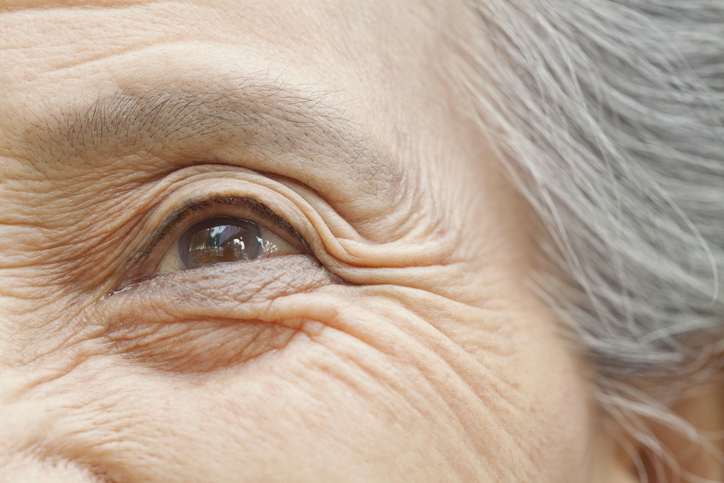
Age-related macular degeneration is an eye disease that is a leading cause of vision loss in older people in developed countries. Subtle abnormalities indicating changes in vision may occur in a person's forties or fifties. Distorted vision and vision loss usually become noticeable in a person's sixties or seventies and tend to worsen over time.
Descrição
Age-related macular degeneration is an eye disease that is a leading cause of vision loss in older people in developed countries. Subtle abnormalities indicating changes in vision may occur in a person's forties or fifties. Distorted vision and vision loss usually become noticeable in a person's sixties or seventies and tend to worsen over time.
Age-related macular degeneration mainly affects central vision, which is needed for detailed tasks such as reading, driving, and recognizing faces. The vision loss in this condition results from a gradual deterioration of light-sensing cells in the tissue at the back of the eye that detects light and colour (the retina). Specifically, age-related macular degeneration affects a small area near the center of the retina, called the macula, which is responsible for central vision. Side (peripheral) vision and night vision are generally not affected, but slow adjustment of vision to darkness (dark adaptation) and reduced dim light (scotopic) vision often occur in the early stages of the disease.
Researchers have described two major types of age-related macular degeneration, known as the dry form and the wet form. The dry form is much more common, accounting for 85 to 90 percent of all cases of age-related macular degeneration. It is characterised by a buildup of yellowish deposits called drusen beneath the retina and vision loss that worsens slowly over time. The most advanced stage of dry age-related macular degeneration is known as geographic atrophy, in which areas of the macula waste away (atrophy), resulting in severe vision loss. Dry age-related macular degeneration typically affects vision in both eyes, although vision loss often occurs in one eye before the other.
In 10 to 15 percent of affected individuals, the dry form progresses to the wet form of age-related macular degeneration. The wet form is characterised by the growth of abnormal, fragile blood vessels underneath the macula. These vessels leak blood and fluid, which damages the macula and makes central vision appear blurry and distorted. The wet form of age-related macular degeneration is associated with severe vision loss that can worsen rapidly.
Padrões de herança
The source lists the following possible inheritance patterns: Pattern unknown. More than one pattern can apply in different cases.
Related genes
Other names
Age-related maculopathy
DMRI
ARMD
Macular degeneration, age-related
Related patient information and medicines





Leitura adicional e referências
- Degeneração macular relacionada à idade; MedlinePlus, National Library of Medicine.
- Chen W, Stambolian D, Edwards AO, Branham KE, Othman M, Jakobsdottir J, Tosakulwong N, Pericak-Vance MA, Campochiaro PA, Klein ML, Tan PL, Conley YP, Kanda A, Kopplin L, Li Y, Augustaitis KJ, Karoukis AJ, Scott WK, Agarwal A, Kovach JL, Schwartz SG, Postel EA, Brooks M, Baratz KH, Brown WL; Complications of Age-Related Macular Degeneration Prevention Trial Research Group; Brucker AJ, Orlin A, Brown G, Ho A, Regillo C, Donoso L, Tian L, Kaderli B, Hadley D, Hagstrom SA, Peachey NS, Klein R, Klein BE, Gotoh N, Yamashiro K, Ferris Iii F, Fagerness JA, Reynolds R, Farrer LA, Kim IK, Miller JW, Corton M, Carracedo A, Sanchez-Salorio M, Pugh EW, Doheny KF, Brion M, Deangelis MM, Weeks DE, Zack DJ, Chew EY, Heckenlively JR, Yoshimura N, Iyengar SK, Francis PJ, Katsanis N, Seddon JM, Haines JL, Gorin MB, Abecasis GR, Swaroop A. Genetic variants near TIMP3 and high-density lipoprotein-associated loci influence susceptibility to age-related macular degeneration. Proc Natl Acad Sci U S A. 2010 Apr 20;107(16):7401-6. doi: 10.1073/pnas.0912702107. Epub 2010 Apr 12.
- Coleman HR, Chan CC, Ferris FL 3rd, Chew EY. Age-related macular degeneration. Lancet. 2008 Nov 22;372(9652):1835-45. doi: 10.1016/S0140-6736(08)61759-6.
- Curcio CA, Owsley C, Jackson GR. Spare the rods, save the cones in aging and age-related maculopathy. Invest Ophthalmol Vis Sci. 2000 Jul;41(8):2015-8. No abstract available.
- den Hollander AI, de Jong EK. Highly penetrant alleles in age-related macular degeneration. Cold Spring Harb Perspect Med. 2014 Nov 6;5(3):a017202. doi: 10.1101/cshperspect.a017202.
- Fritsche LG, Chen W, Schu M, Yaspan BL, Yu Y, Thorleifsson G, Zack DJ, Arakawa S, Cipriani V, Ripke S, Igo RP Jr, Buitendijk GH, Sim X, Weeks DE, Guymer RH, Merriam JE, Francis PJ, Hannum G, Agarwal A, Armbrecht AM, Audo I, Aung T, Barile GR, Benchaboune M, Bird AC, Bishop PN, Branham KE, Brooks M, Brucker AJ, Cade WH, Cain MS, Campochiaro PA, Chan CC, Cheng CY, Chew EY, Chin KA, Chowers I, Clayton DG, Cojocaru R, Conley YP, Cornes BK, Daly MJ, Dhillon B, Edwards AO, Evangelou E, Fagerness J, Ferreyra HA, Friedman JS, Geirsdottir A, George RJ, Gieger C, Gupta N, Hagstrom SA, Harding SP, Haritoglou C, Heckenlively JR, Holz FG, Hughes G, Ioannidis JP, Ishibashi T, Joseph P, Jun G, Kamatani Y, Katsanis N, N Keilhauer C, Khan JC, Kim IK, Kiyohara Y, Klein BE, Klein R, Kovach JL, Kozak I, Lee CJ, Lee KE, Lichtner P, Lotery AJ, Meitinger T, Mitchell P, Mohand-Said S, Moore AT, Morgan DJ, Morrison MA, Myers CE, Naj AC, Nakamura Y, Okada Y, Orlin A, Ortube MC, Othman MI, Pappas C, Park KH, Pauer GJ, Peachey NS, Poch O, Priya RR, Reynolds R, Richardson AJ, Ripp R, Rudolph G, Ryu E, Sahel JA, Schaumberg DA, Scholl HP, Schwartz SG, Scott WK, Shahid H, Sigurdsson H, Silvestri G, Sivakumaran TA, Smith RT, Sobrin L, Souied EH, Stambolian DE, Stefansson H, Sturgill-Short GM, Takahashi A, Tosakulwong N, Truitt BJ, Tsironi EE, Uitterlinden AG, van Duijn CM, Vijaya L, Vingerling JR, Vithana EN, Webster AR, Wichmann HE, Winkler TW, Wong TY, Wright AF, Zelenika D, Zhang M, Zhao L, Zhang K, Klein ML, Hageman GS, Lathrop GM, Stefansson K, Allikmets R, Baird PN, Gorin MB, Wang JJ, Klaver CC, Seddon JM, Pericak-Vance MA, Iyengar SK, Yates JR, Swaroop A, Weber BH, Kubo M, Deangelis MM, Leveillard T, Thorsteinsdottir U, Haines JL, Farrer LA, Heid IM, Abecasis GR; AMD Gene Consortium. Seven new loci associated with age-related macular degeneration. Nat Genet. 2013 Apr;45(4):433-9, 439e1-2. doi: 10.1038/ng.2578. Epub 2013 Mar 3.
- Hampton T. Genetic research provides insights into age-related macular degeneration. JAMA. 2010 Oct 13;304(14):1541-3. doi: 10.1001/jama.2010.1411. No abstract available.
- Jackson GR, Scott IU, Kim IK, Quillen DA, Iannaccone A, Edwards JG. Diagnostic sensitivity and specificity of dark adaptometry for detection of age-related macular degeneration. Invest Ophthalmol Vis Sci. 2014 Mar 10;55(3):1427-31. doi: 10.1167/iovs.13-13745.
- Neale BM, Fagerness J, Reynolds R, Sobrin L, Parker M, Raychaudhuri S, Tan PL, Oh EC, Merriam JE, Souied E, Bernstein PS, Li B, Frederick JM, Zhang K, Brantley MA Jr, Lee AY, Zack DJ, Campochiaro B, Campochiaro P, Ripke S, Smith RT, Barile GR, Katsanis N, Allikmets R, Daly MJ, Seddon JM. Genome-wide association study of advanced age-related macular degeneration identifies a role of the hepatic lipase gene (LIPC). Proc Natl Acad Sci U S A. 2010 Apr 20;107(16):7395-400. doi: 10.1073/pnas.0912019107. Epub 2010 Apr 12.
- Owsley C, McGwin G Jr, Clark ME, Jackson GR, Callahan MA, Kline LB, Witherspoon CD, Curcio CA. Delayed Rod-Mediated Dark Adaptation Is a Functional Biomarker for Incident Early Age-Related Macular Degeneration. Ophthalmology. 2016 Feb;123(2):344-351. doi: 10.1016/j.ophtha.2015.09.041. Epub 2015 Oct 30.
- Ratnapriya R, Chew EY. Age-related macular degeneration-clinical review and genetics update. Clin Genet. 2013 Aug;84(2):160-6. doi: 10.1111/cge.12206.
- Seddon JM, Silver RE, Kwong M, Rosner B. Risk Prediction for Progression of Macular Degeneration: 10 Common and Rare Genetic Variants, Demographic, Environmental, and Macular Covariates. Invest Ophthalmol Vis Sci. 2015 Apr;56(4):2192-202. doi: 10.1167/iovs.14-15841.
- Swaroop A, Chew EY, Rickman CB, Abecasis GR. Unraveling a multifactorial late-onset disease: from genetic susceptibility to disease mechanisms for age-related macular degeneration. Annu Rev Genomics Hum Genet. 2009;10:19-43. doi: 10.1146/annurev.genom.9.081307.164350.
- Thakkinstian A, McEvoy M, Chakravarthy U, Chakrabarti S, McKay GJ, Ryu E, Silvestri G, Kaur I, Francis P, Iwata T, Akahori M, Arning A, Edwards AO, Seddon JM, Attia J. The association between complement component 2/complement factor B polymorphisms and age-related macular degeneration: a HuGE review and meta-analysis. Am J Epidemiol. 2012 Sep 1;176(5):361-72. doi: 10.1093/aje/kws031. Epub 2012 Aug 5.
- Wong WL, Su X, Li X, Cheung CM, Klein R, Cheng CY, Wong TY. Global prevalence of age-related macular degeneration and disease burden projection for 2020 and 2040: a systematic review and meta-analysis. Lancet Glob Health. 2014 Feb;2(2):e106-16. doi: 10.1016/S2214-109X(13)70145-1. Epub 2014 Jan 3.
Participe da conversa
Compartilhe seus pensamentos ou experiências com outros em nosso comunidades de pacientes.

Pergunte, compartilhe, conecte-se.
Navegue por discussões, faça perguntas e compartilhe experiências em centenas de tópicos de saúde.
Inscreva-se no boletim informativo do Patient
Sua dose semanal de conselhos de saúde claros e confiáveis - escritos para ajudá-lo a se sentir informado, confiante e no controle.
Ao se inscrever, você aceita nossos Política de Privacidade. Você pode cancelar a inscrição a qualquer momento. Nunca vendemos seus dados.