Do 30-day fitness challenges actually work?
Peer reviewed by Dr Sarah JarvisLast updated by Emily Jane BashforthLast updated 1 Jun 2022
Meets Patient’s editorial guidelines
- DownloadDownload
- Share
- Language
- Discussion
- Audio Version
- Add to preferred sources on Google
30-day fitness challenges have rocketed in popularity over recent years, becoming more accessible thanks to social media and platforms such as YouTube. But is it possible to change your body in just 30 days and do these challenges offer other benefits?
What are 30-day fitness challenges?
30-day fitness challenges are exactly what they sound like - exercise regimes designed to last 30 days and get the ball rolling on a new, healthier lifestyle.
There are several types of fitness challenges that can seem appealing because they only last a month and promise major health and fitness benefits. They can vary in difficulty levels - some will become more challenging as time progresses, while others can just be for fun. They tend to vary in terms of how often you do the exercises - some might require daily routine sessions while others are just a couple of times a week with rest periods in between. Different challenges also target different muscle groups and areas of the body, such as legs, arms, or abdominal muscles.
Some 30-day fitness challenges include:
30-day flat abs challenge.
30-day beginner yoga challenge.
30-day squat challenge.
30-day strength workout.
Why do people like 30-day fitness challenges?
Fiona Hawker is a certified personal trainer and manager at Curves Gym. She explains how having a finite goal is a great way to focus, learn healthy habits, and get started on a fitness journey.
However, choosing the right type of 30-day fitness challenge is key if you want to see results. It's important to consider what it is that you hope to achieve in 30 days and where you are starting from.
Examples of 30-day fitness challenges
30-day burpee challenge
"Burpees are a fantastic exercise as they work your whole body, rather than just your legs or core. With burpees, you are doing a squat, a jump, and a press-up, so you are working your arms, legs, and core, and elevating your heart rate while you do it," says Hawker.
How to do a burpee:
Stand with your feet shoulder-width apart.
Place your arms straight by your sides.
Lower into a squat position before placing your hands on the floor.
Jump or step your legs back into a plank position, with arms straight, shoulders straight above your hands and your body in a straight line from head to toes
Jump or step your legs forward to return to a squat position.
Return to your original standing position.
Repeat.
An example of a 30-day burpee challenge is below.
Figure 1
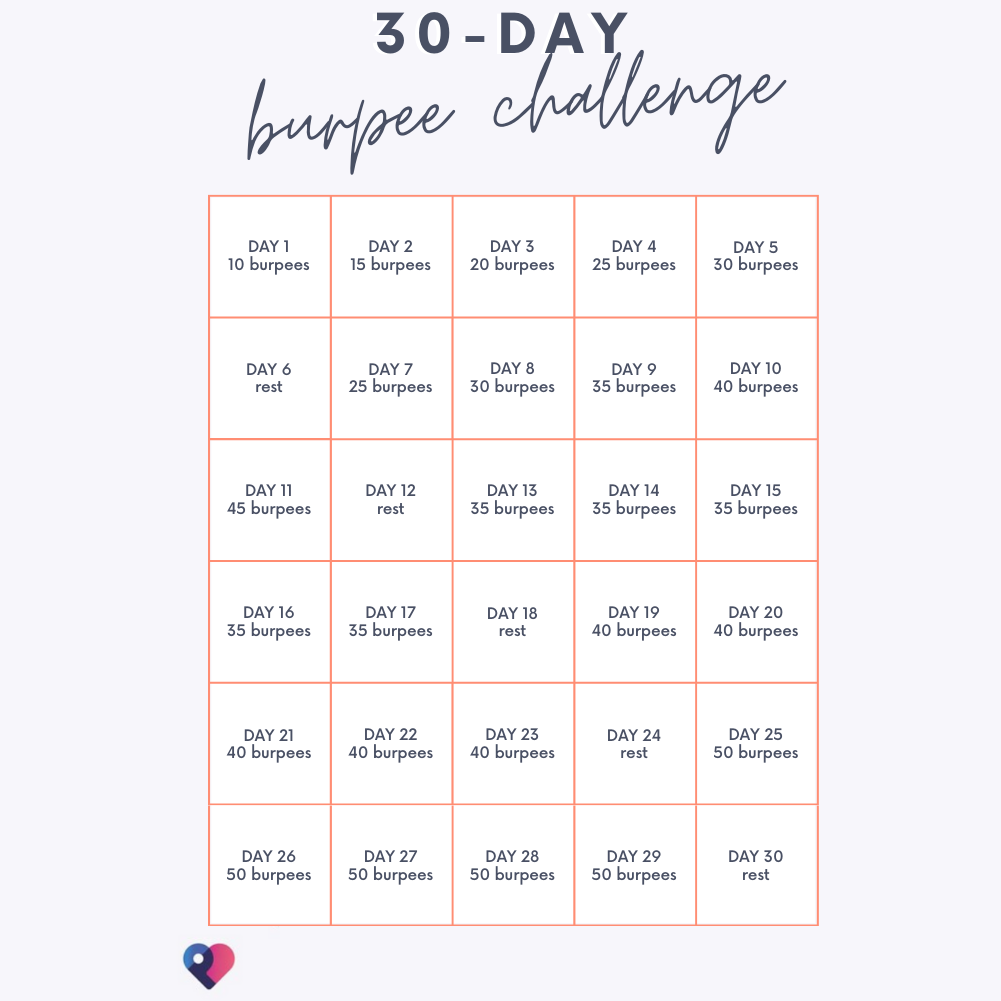
Maintaining good form is essential, if you are struggling to complete your burpees in one go you should split them up throughout the day.
Virtual distance challenges
Hawker says virtual challenges are great because they allow for flexibility to move at your own pace. Often these challenges allow you to walk, run, swim, or cycle a specific distance over the 30 days.
"For example, you might decide to virtually walk Hadrian's wall path (85 miles) in 30 days or virtually cycle the Pennine Way (268 miles). With these challenges, you have a specific distance to cover in the 30 days, so if you miss a day because something comes up, then it's OK; you can simply cover the distance on another day or add a little extra to the next few days."
Do 30-day fitness challenges work?
Whether or not 30-day fitness challenges work is a question many of us ask. How will your body feel once the challenge ends and where do you go from there?
Hawker says these challenges have potential to be effective if you stick with them and stay motivated. Undertaking a 30-day fitness challenge increases your activity levels at a gradual pace, elevates your heart rate and can provide gains in fitness and strength. Even if you do just 10 extra minutes of exercise per day, you are reaping the physical and well-being benefits.
A 30-day challenge alone isn't enough to see changes that will last for the rest of your life. In fact, research suggests it takes an average of 66 days for a new behaviour to become an ingrained habit. However, it can provide a stepping stone to making healthier lifestyle choices and a foundation for improved fitness.
"You will typically start to feel the benefits after 2-3 weeks. Completing a 30-day challenge is rewarding and can provide motivation to continue onto the next challenge."
Further benefits of 30-day fitness challenges can include:
Improved focus and determination.
Increased self-esteem.
Reduced stress and anxiety.
Increased productivity due to higher energy levels.
Better-quality sleep.
More structure to your everyday life.
Feelings of pride and achievement.
Companionship when doing challenges with friends.
Reduced risk of some diseases in the long term.
Are 30-day fitness challenges safe?
"To keep a 30-day challenge safe, you first need to think about your current fitness and activity levels," reminds Hawker.
"For example, if you are not a frequent runner already, trying to run 5k every day for 30-days is not sensible. Building up to it over the 30 days is more manageable. It is important to remember that the challenge should aim to push you a little but not cause injury. If you're starting from a low fitness base, apps such as the Couch to 5k (available from the App store or Google Play) might be more suitable for you.
As you progress further in the challenge, it can be tempting to continue pushing yourself, but you must remember the importance of rest days. Days off shouldn't be viewed as cheating or lazy - they are vital as they allow your body and muscles to recover.
"It is also important to ensure your workout routine is well balanced. Workouts focused on one exercise such as squats, walking or running can leave important muscles out," adds Hawker.
Can you actually transform your body in 30 days?
A lot of people embark on 30-day fitness challenges to lose weight, build muscle or otherwise change their physical appearance and improve their mental health. But you should be patient and not push yourself if you aren't seeing the results you hoped for straightaway.
Hawker says it takes a few weeks to start feeling the benefits of exercise, and around eight weeks to visibly notice the benefits. A 30-day challenge can kickstart the process but maintaining your activity levels afterwards will help you progress further.
"30 days can be enough time to see initial weight loss or fitness gains, but you can't work miracles in 30 days. These challenges are laying the foundation for better health and fitness, which includes adopting good habits, getting your mind and body focused on committing to a regular exercise plan, and setting yourself up for success."
What might be an alternative to a 30-day challenge?
30-day challenges aren't for everyone. Fortunately, there are other ways to improve your health and fitness without committing to a specific challenge.
Accountability, motivation, courage, and self-belief are needed to succeed at either a 30-day fitness challenge or a longer-term fitness plan.
Just because you aren't taking part in a 30-day fitness challenge doesn't mean you can't set a goal. Hawker suggests that, if you are already a member of a gym, talk to your coach and decide what your goal is for the next 30 days. You should write it down and check off each milestone you hit along the way. A personal trainer isn't a necessity. You can do this alone or buddy up so you and a friend can hold one another accountable.
Other ways of introducing more physical activity into your life can include using a fitness app that allows you to build balanced workouts and even access helpful meal plans. Apps can be good if you are new to exercise, as many can teach you the correct form for exercises and provide a log where you can keep track of your progress.
"Working towards exercise guidelines is a great way to ensure you are hitting the minimum activity levels for health. This means 150 minutes of moderate-intensity exercise per week with at least two strength-training full-body workouts," says Hawker.
Top tips for completing a 30-day fitness challenge
Have patience with yourself.
Set realistic expectations.
Listen to your body and stop when necessary.
Continue to nourish yourself in other ways (food, water, sleep).
Learn the correct form first to reduce the risk of injury.
Always warm up and cool down properly.
Make the workout challenge your own and incorporate exercises you enjoy.
Patient picks for Exercise and physical activity

Healthy living
What is the 6-6-6 walking challenge?
It might sound like something the devil himself invented, but the 6-6-6 walking challenge has origins that are far less sinister. It’s a recent fitness trend designed to encourage consistent, low-impact exercise. The concept promotes a structured walking routine that helps you stay active every day while improving your overall health in a sustainable way. Let’s take a closer look at what it involves - and whether it’s the right fit for you.
by Victoria Raw
Healthy living
Everything you need to know about the Hot Girl Walk
Hear us out - this isn’t what it sounds like. The Hot Girl Walk has nothing to do with how you look. It’s a trend that’s rooted in boosting confidence through intentional movement. The concept is simple - walk with purpose, practice positive self-affirmations, and focus on your mindset just as much as your steps. It’s less about appearances and more about feeling good in your own skin, and getting fitter. But while giving yourself a pep talk on a walk sounds appealing, what do the experts say about it?
by Victoria Raw
About the authorView full bio

Emily Jane Bashforth
Feature Writer
NCTJ
Emily is a Feature Writer with Patient, writing articles on a variety of topics relating to health and well-being.
About the reviewerView full bio

Dr Sarah Jarvis
Clinical Consultant
MA (Cantab), BM, BCh (Oxon), DRCOG, FRCGP, MBE
After training in medicine at Cambridge and Oxford, Dr Sarah Jarvis MBE became a GP.
Article history
The information on this page is peer reviewed by qualified clinicians.
Article also available in English, German, Spanish, French, Italian, Portuguese, Hindi, Hebrew, Arabic, and Swedish.
1 Jun 2022 | Latest version
Join the conversation
Share your thoughts or experiences with others in our patient communities.

Ask, share, connect.
Browse discussions, ask questions, and share experiences across hundreds of health topics.

Feeling unwell?
Assess your symptoms online for free
Sign up to the Patient newsletter
Your weekly dose of clear, trustworthy health advice - written to help you feel informed, confident and in control.
By subscribing you accept our Privacy Policy. You can unsubscribe at any time. We never sell your data.
More in healthy living
- Do naps count as sleep?
- Helping your child cope with stress and worry over Christmas
- How does Wegovy work for weight loss?
- How has working from home affected our mental health?
- How poor posture impacts more than just your back
- How to be happy: 12 everyday tips
- How to become more flexible
- How to get back into exercise after having a baby
- How to look after your liver during freshers’ week
- How to look after your mental health this winter
- How to resist the toughest cigarette cravings
- Is intermittent fasting a healthy way to lose weight?
- Is the vagus nerve the key to our mental health?
- Mounjaro weight loss injections: FAQs
- Not quite 'back to normal': a guide to post-pandemic family healing
- Problems caused by being underweight
- Spotting depression in your partner
- The most common reasons you're not losing weight
- What harm can conversion therapy cause and why isn't it banned?
- What to do if your weight is getting you down