O que acontece se você pegar gripe e COVID-19 ao mesmo tempo?
Revisado por Dr Sarah JarvisAutoria de Andrea DowneyPublicado originalmente 13 Nov 2020
Atende aos diretrizes editoriais
- BaixarBaixar
- Compartilhar
- Language
- Discussão
- Ask Patient
- Versão em Áudio
- Adicionar às fontes preferidas no Google
Milhares de pessoas em todo o Reino Unido estão vivendo com restrições mais rígidas contra a COVID-19 na tentativa de reduzir as taxas de infecção antes do inverno. Mas a cada ano, o inverno também traz um aumento nos casos de gripe, então o que acontece se você pegar a gripe e a COVID-19 ao mesmo tempo?
Escolhas de vídeos para Informações geraisBiblioteca de vídeos
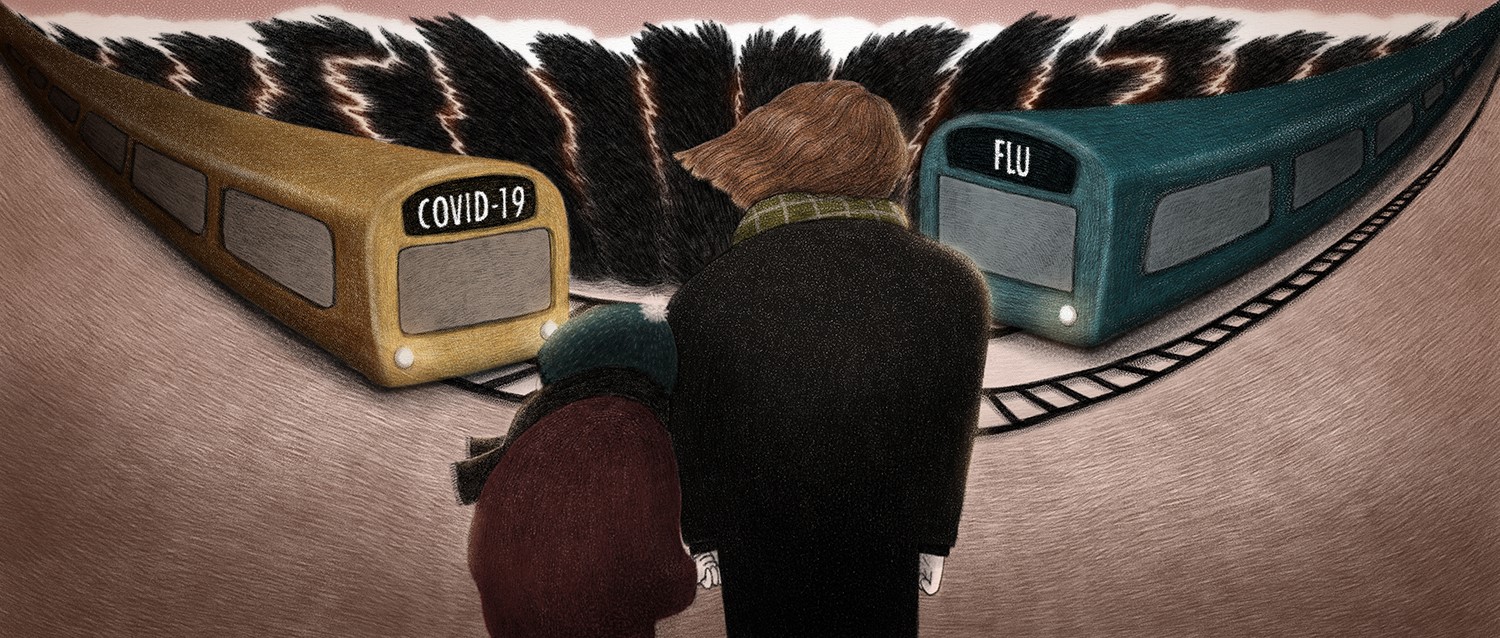
Feature illustrated by Pei-Hsin Cho.
Dr Robert Lambkin-Williams, a virologist for Virology Consult and Virustatic Shield, and Dr Ravi Tomar of Portland Medical explain whether you can catch both viruses at once and the risks if you do.
Double trouble
This year's flu season has the added complication of the coronavirus pandemic and having to distinguish between the symptoms of flu, colds and COVID-19. But can you catch multiple viruses at the same time? While it's quite rare, it is still possible to catch two respiratory viruses at once, Dr Lambkin-Williams says.
But as COVID-19, and our understanding of it, is still relatively new it's hard to say for certain how likely it is you can catch both the flu and COVID-19 viruses at once.
"There have been reports of patients who have contracted both gripe and COVID-19 at the same time, but we are not yet clear on how co-infection occurs," Dr Tomar adds. "More evidence is needed before we can fully understand this, and how possible it is to contract both viruses at once."
Last month Public Health England warned that people who had been infected with both flu and COVID-19 faced serious consequences.
O analysis of cases from January to April 2020 found people with both viruses are more than twice as likely to die as someone with coronavirus alone.
But Dr Tomar said more evidence is still needed. "The evidence comes from a study with small numbers, just 58 people, carried out in the UK at the start of the pandemic," he explains.
"Again, more evidence is needed before we really know how things pan out if you contract both viruses at once. But from what we do know, your symptoms will be more severe, and it may take you longer to get better."
Twice as bad?
It's difficult to say how you might feel if you do catch the flu and COVID-19 at the same time, again because of the limited evidence around it.
As we know, some people who have coronavirus are asymptomatic, meaning they don't have any symptoms at all, so you might not have severe symptoms if you catch flu and COVID-19.
But it's also possible you would feel much worse, Dr Lambkin-Williams says.
"You'll know if you've had flu viruses - sometimes it can floor you and other times you'll be relatively OK. If you have the two together it's entirely possible you would be much worse," he explains. "However, sometimes if we get two different viruses together, they have a fight amongst each other, and one will predominate and knock out the other one."
Dr Tomar adds that catching two viruses at once can make it harder for your immune system to fend off both at the same time.
"What we don’t know yet, is whether having flu or COVID-19 increases your chances of getting the other," he says. "You are likely to be more vulnerable, as viral infections damage tissue in your respiratory tract, making it harder for your body to fight off subsequent ones.
"Having inflamed lungs (which either disease can cause) also offers the opportunity for bacteria to take hold in there."
Fatores de risco
As with any illness, certain groups of people are more at risk.
The risk factors for catching the flu or COVID-19 are relatively similar. This includes the elderly and those who have underlying health conditions such as diabetes or respiratory conditions such as asma. People in those groups are therefore more susceptible to catching flu and COVID-19 at the same time.
"The groups most at risk of contracting flu and COVID-19 at the same time are those generally considered to be more susceptible to contracting respiratory diseases," Dr Tomar says.
"These are people over 65, pregnant people and those with certain health conditions such as diabetes, asthma and heart conditions."
The best protection
The best way to protect yourself from both viruses is to follow government guidelines on COVID-19 and to get your flu vaccination.
"The absolute best thing we can all do this year is to get the flu vaccine as that will help protect us and others around us too," Dr Lambkin-Williams says.
Dr Tomar agrees, adding that anyone who is eligible for a flu vaccine should book one to help reduce pressure on the NHS.
This year the government has ramped up its flu vaccination programme to include more people, including children in the first year of secondary school, in a bid to keep flu numbers down and hospital beds free for COVID-19 patients. 50-64 year-olds who don't have any other conditions that would make them eligible will also be invited for NHS vaccination at the end of 2020 if there are enough vaccines available.
"People who are particularly vulnerable to flu will be contacted by their GP and, if they are, they should take this seriously and get vaccinated. For these people, it's free on the NHS," Dr Lambkin-Williams adds.
Dr Tomar reminds us that it's also important to follow COVID-19 safety guidelines. "To best protect themselves from these viruses, people should continue to adhere to the government guidelines of maintaining social distancing, wearing a mask in confined spaces and following strict hygiene measures," he says.
Those who are able to should wear a face mask where required, including on public transport, in shops and in restaurants and pubs when not sitting at your table. Social distancing must be maintained and you should wash your hands or use antiviral gel often.
Depending on where you live, restrictions on who you can see and what venues are open will differ through the government's tier system, so make sure you're up to date on the guidance for your area.
If you do think you have COVID-19 you should self-isolate and agendar um teste as soon as possible. If your test is positive, you'll need to self-isolate for at least 10 days, and everyone you're in close contact with will need to self-isolate for 14 days from the last time they were in close contact with you.
Escolhas do paciente para Informações gerais

COVID-19
Por que é normal sentir ansiedade em relação ao futuro após a COVID
À medida que as restrições de lockdown começam a diminuir em todo o Reino Unido, especialistas em saúde mental estão percebendo um fenômeno emergente - ansiedade sobre a vida após o coronavírus. Então, como será a vida após a pandemia de COVID-19 e como você pode se preparar?
por Lydia Smith

COVID-19
Por que pessoas negras e asiáticas estão em maior risco de COVID-19?
Uma nova revisão nacional descobriu que pessoas negras e asiáticas têm mais chances do que pessoas brancas de morrerem por COVID-19. Para salvar vidas, médicos e pacientes precisam de orientações específicas para entender como e por que o vírus afeta as pessoas de diferentes etnias de maneiras distintas.
por Ellie Broughton
Sobre o autor
Autoria de

Andrea Downey
Sobre o revisorVer biografia completa

Dra. Sarah Jarvis
Consultora Clínica
MA (Cantab), BM, BCh (Oxon), DRCOG, FRCGP, MBE
Após se formar em medicina em Cambridge e Oxford, a Dra. Sarah Jarvis MBE tornou-se médica de clínica geral.
Histórico do artigo
Artigo também disponível em Inglês, Alemão, Espanhol, Francês, Italiano, Português, Hindi, Hebraico, Árabe, e Sueco.
13 Nov 2020 | Publicado originalmente
Escrito por:
Andrea Downey
Revisado por
Dra. Sarah Jarvis
Compartilhe seus pensamentos ou experiências com outros em nosso comunidades de pacientes.
Inscreva-se no boletim informativo do Patient
Sua dose semanal de conselhos de saúde claros e confiáveis - escritos para ajudá-lo a se sentir informado, confiante e no controle.
Ao se inscrever, você aceita nossos Política de Privacidade. Você pode cancelar a inscrição a qualquer momento. Nunca vendemos seus dados.