Foliculite
Revisado por Dr Philippa Vincent, MRCGPÚltima atualização por Dr Rosalyn Adleman, MRCGPÚltima atualização 18 Oct 2024
Atende aos diretrizes editoriais
- BaixarBaixar
- Compartilhar
- Language
- Discussão
- Versão em Áudio
Profissionais de Saúde
Os artigos de Referência Profissional são projetados para uso por profissionais de saúde. Eles são escritos por médicos do Reino Unido e baseados em evidências de pesquisa, diretrizes do Reino Unido e da Europa. Você pode encontrar o Foliculiteartigo mais útil, ou um dos nossos outros artigos de saúde.
Neste artigo:
Folliculitis is inflammation of the hair follicles.
Continue lendo abaixo
How common is folliculitis? (Epidemiology)
Prevalência
It is undoubtedly a relatively common condition in primary care. There are no reliable figures for community prevalence. It occurs in both sexes and all races. Superficial Staphylococcus aureus folliculitis is more common in children, whilst folliculitis of the beard area is more common in adult males.1
Folliculitis causes (aetiology)2
Voltar ao conteúdoIt can be caused by:
Bacterial infection:
S. aureus is the most common.
Pseudomonas spp. - occurring in outbreaks associated with hot tubs, paddling pools, etc. Causes intense pruritus, particularly in areas under a bathing suit (hot tub folliculitis).3 4
Gram-negative folliculitis affects patients with a history of long-term antibiotic therapy for acne:
Pathogens include Klebsiella spp., Enterobacter spp. e Proteus spp.5
Fungal infection:
Malassezia folliculitis (previously called pityrosporum folliculitis) causes itchy acneiform eruption on the upper back, upper arms, chest, neck, chin and face, affecting younger patients.
Other fungal folliculitis:
Due to Candida spp. e Trichophyton spp.
Commonly in men, as tinea barbae in the beard area.
May also be caused by contact with dogs/cattle/other animals.
Resembles bacterial infection but may have a clearly demarcated flaking edge of confluent erythema.
Infecção viral:
Herpetic folliculitis due to herpes simplex viruses (HSV); often in men who shave near oral cold sore lesions.
Varicella zoster and mollluscum contagiosum are commonly responsible for viral folliculitis.
Immune system:
Eosinophilic pustular folliculitis; sterile and intensely itchy eruption associated with HIV infection.
Eosinophilic folliculitis (a rare autoimmune disease, more common in Asian races).
Physical irritation - eg, traction folliculitis as a result of a hairstyle.6
Chemical irritation of the skin (less commonly) - eg, from oily overalls.
The condition is due to obstruction or flow disruption in pilosebaceous glands ± infection. Furuncles are a more deep-seated infection of the base of the hair follicle, characterised by inflammatory nodules and pus formation, which may result from folliculitis. They may develop into carbuncles.
There can be a mixed picture of skin infection with co-existence of areas of folliculitis, furuncles, carbuncles and boils.
Risk factors for folliculitis
Sports participation: mechanical trauma, exposure to environmental and infectious agents, and contact with the skin of other athletes.7
Uncut beard.
Shaving 'against the grain'.
Particularly thick hair.
Excessive friction from clothing.
Overly tight-fitting clothing.
Excessive sweating and hyperhidrosis.
High external humidity.
Pre-existing dermatitis.
Reduced host immunity - eg, poorly controlled diabetes, immunosuppression.
Nasal carriage of infecting strains of S. aureus.
Skin abrasion/wound/abscess.
Occluded skin - particularly for dermatological treatment with topical corticosteroids.
Continue lendo abaixo
Folliculitis symptoms
Voltar ao conteúdoIt may occur as a relatively trivial irritation - superficial folliculitis, or as a more deep-seated process involving the lower hair follicle. Often the cause of superficial folliculitis is unclear. The most common infecting organism is S. aureus.8
Deep folliculitis is more clinically significant and likely to result in scarring. These often start as a rash or a set of slowly evolving red lumps on the skin, usually on hairy areas.
The rash may be pain-free or cause irritation and pruritus.
There may be a desire to scratch.
If mild and left alone, the rash usually resolves without scarring.
Patients may notice small pustules at the centre of the lesions.
Commonly affected areas are the axilla, beard, face, scalp, thighs and inguinal regions.
Rash of folliculitis
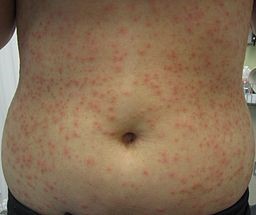
© James Heilman, MD, CC BY-SA 3.0, via Wikimedia Commons
Sinais
Check temperature and exclude signs of systemic toxicity.
The central hair shaft may not be easy to see if hair is fine and/or fair; a magnifying glass can help demonstrate its presence.
Erythematous papules form in a relatively regular, sometimes 'grid-like', pattern. Small pustules may be seen.
Deep folliculitis tends to cause more erythema, becoming more confluent between the lesions, with no noticeable surface pustules and intense irritation of the skin. It can cause scarring, keloid formation and hair loss.
Regional draining lymph nodes should be checked for adenitis, which is rare in simple or mild folliculitis. Folliculitis of the eyelash is known as a stye or hordeolum.
Folliculitis on the lower leg
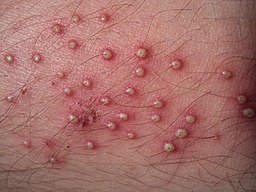
© Da pacem Domine, CC0, via Wikimedia Commons
Diagnóstico diferencial 29
Voltar ao conteúdoCommon differentials include:
Acne rosacea.
Pseuduofolliculitis barbae.
Lúpus or lupoid rashes.
Lupus miliaris disseminatus faciei: rare chronic inflammatory dermatosis with red-yellow-brown papules on the central face.
Reactive perforating collagenosis/perforating folliculitis.
Alopecia mucinosa.
Continue lendo abaixo
Investigations 2
Voltar ao conteúdoNone is usually needed.
If recurrent, send off swabs for culture from sites of staphylococcal carriage (family/fellow residents may need to be checked) and exclude diabetes mellitus.
If there is atypical response to therapy or episodes are recurrent, consider punch biopsy, Gram-staining of skin swabs/scrapings, scrapings for fungal culture or potassium hydroxide test.
Pustules can be deroofed with a scalpel and pus collected for Gram-staining and culture in severe or resistant cases.
If HSV folliculitis is suspected then it may be worth sending vesicopustular fluid for viral culture to confirm the diagnosis.
Skin biopsy shows different types of infiltrate in the walls and lumen of the hair follicle, dependent on cause.
Cytology is being used by dermatologists increasingly frequently in the differential diagnosis of folliculitis.10
Folliculitis treatment
Voltar ao conteúdoMedidas gerais
Avoid precipitating factors such as:
Inappropriate clothing.
High humidity.
Try to observe the following routine:
Use moisturising shaving products and clean shaving implements with surgical spirit.
Alternatively, reduce frequency of shaving and ensure shaving 'with the grain' (or grow a beard).
Maintain good skin hygiene with non-allergenic cleaning agents.
Use separate washing implements and towels from other members of the household.
Farmacológico
Consider treating nasal carriage of S. aureus with topical Fucidin® in those with recurrent folliculitis.
Mild, superficial folliculitis may resolve without treatment.
Topical antiseptics such as triclosan, clorhexidine or povidone-iodine may be used to treat and prevent superficial folliculitis.
For deeper folliculitis, topical or oral antibiotics are usually required; preferred agents are flucloxacillin, erythromycin or cephalosporins/mupirocin ointment.
In severe or recurrent cases, antibiotic therapy may be required for 4 to 6 weeks.
Other antibiotics may be used depending on culture results and the degree of clinical suspicion of alternative causative organisms - eg, pseudomonal folliculitis responds to oral ciprofloxacin.
Gram-negative folliculitis can be treated as for severe acne, with isotretinoin but use of isotretinoin is associated with major side-effects, including birth defects.11
Deep folliculitis caused by MRSA can be treated with vancomycin or linezolid.
Fungal infections are usually treated with topical azoles - eg, clotrimazole or oral ketoconazole.
Aciclovir or similar agents can be used to treat herpetic folliculitis.
Cirúrgico
Deep folliculitis can sometimes lead to the formation of carbuncles which may need incision and drainage.
Prognóstico
Voltar ao conteúdoNearly all cases will resolve or respond to therapy without sequelae. Cases affecting the immunocompromised and those that are deep or recurrent are more likely to lead to complications.
Complications of folliculitis
Voltar ao conteúdoRecurrence.
Scarring.
Keloid formation.
Development of furuncles and carbuncles.
Abscess formation.
Systemic illness secondary to spread of infection (rare but more likely in the immunocompromised).
Leitura adicional e referências
- Riain U; Recommended management of common bacterial skin infections, Prescriber, Volume 24, Issue 23-24, 2013.
- Stausholm KR, Spaun E, Koppelhus U; A Case of Therapy-Resistant Folliculitis due to Adrenal Insufficiency? Case Rep Dermatol. 2016 Oct 4;8(3):267-271. doi: 10.1159/000450698. eCollection 2016 Sep-Dec.
- Rubenstein RM, Malerich SA; Malassezia (pityrosporum) folliculitis. J Clin Aesthet Dermatol. 2014 Mar;7(3):37-41.
- Griffiths C et al; Rook's Textbook of Dermatology
- BMJ Best Practice Folliculitis; November 2021
- Mena KD, Gerba CP; Risk assessment of Pseudomonas aeruginosa in water. Rev Environ Contam Toxicol. 2009;201:71-115. doi: 10.1007/978-1-4419-0032-6_3.
- Segna KG, Koch LH, Williams JV; "Hot tub" Folliculitis from a nonchlorinated children's pool. Pediatr Dermatol. 2011 Sep-Oct;28(5):590-1. doi: 10.1111/j.1525-1470.2011.01315.x. Epub 2011 Mar 31.
- Gram-negative folliculitis; Dermnet NZ
- Akingbola CO, Vyas J; Traction alopecia: A neglected entity in 2017. Indian J Dermatol Venereol Leprol. 2017 Nov-Dec;83(6):644-649. doi: 10.4103/ijdvl.IJDVL_553_16.
- Nowicka D, Baglaj-Oleszczuk M, Maj J; Infectious diseases of the skin in contact sports. Adv Clin Exp Med. 2020 Dec;29(12):1491-1495. doi: 10.17219/acem/129022.
- Taylor T et al; Staphylococcus Aureus. StatPearls, July 2022.
- Sun KL, Chang JM; Special types of folliculitis which should be differentiated from acne. Dermatoendocrinol. 2017 Sep 27;9(1):e1356519. doi: 10.1080/19381980.2017.1356519. eCollection 2017.
- Durdu M, Ilkit M; First step in the differential diagnosis of folliculitis: cytology. Crit Rev Microbiol. 2013 Feb;39(1):9-25. doi: 10.3109/1040841X.2012.682051. Epub 2012 May 29.
- Choi JS, Koren G, Nulman I; Pregnancy and isotretinoin therapy. CMAJ. 2013 Mar 19;185(5):411-3. doi: 10.1503/cmaj.120729. Epub 2013 Jan 7.
Continue lendo abaixo
Histórico do artigo
As informações nesta página são escritas e revisadas por clínicos qualificados.
Next review due: 17 Oct 2027
18 Oct 2024 | Última versão

Pergunte, compartilhe, conecte-se.
Navegue por discussões, faça perguntas e compartilhe experiências em centenas de tópicos de saúde.

Sentindo-se mal?
Avalie seus sintomas online gratuitamente