Roundworms
Peer reviewed by Dr Colin Tidy, MRCGPLast updated by Dr Toni Hazell, FRCGPLast updated 10 Feb 2023
Meets Patient’s editorial guidelines
- DownloadDownload
- Share
- Language
- Discussion
- Audio Version
- Add to preferred sources on Google
Roundworms (also called nematodes) are worms with a long round body. They vary in length from several millimetres to up to two metres. Roundworms are common in warm tropical countries and most infections seen in the UK will have been acquired abroad. Children are more often affected than adults. Treatment is usually very effective but wiping out (eradication of) roundworm infections has proved to be very difficult.
At a glance
Roundworms are parasites that live in humans, usually in the gut.
About 60 types of roundworm can infect humans.
Roundworm eggs and young worms live in soil and get into the body through hands or skin.
Symptoms vary by type of roundworm and many people have no symptoms.
Some possible symptoms include high temperature, tiredness, tummy pains, and cough.
Roundworms are treated with medication like mebendazole.
Good hygiene and avoiding contaminated food can help prevent roundworm infections.
Can humans get roundworms?
Roundworm ascaris lumbricoides
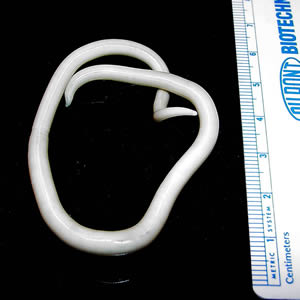
About 60 types (species) of roundworm can live in (are parasites of) humans. They usually live in the human gut. However, some species can travel from the gut to live in different parts of the body.
Roundworm eggs and tiny young worms (larvae) live in the soil. They most commonly get into the body when a person gets them on his or her hands and then transfers them to the mouth. Some can also get into the body through the skin.
Examples of roundworms
Ascaris lumbricoides (also called human roundworm), which is the most common roundworm infection, and affects as many as one billion people worldwide.
Hookworm infections.
Guinea worm disease (dracunculiasis).
Filariasis, which is caused by thread-like filarial nematodes (roundworms) in the family Filarioidea (also known as filariae). There are eight known filarial nematodes which use humans as the host. These are divided into three groups:
Lymphatic filariasis - caused by the worms Wuchereria bancrofti, Brugia malayi, and Brugia timori.
Cutaneous filariasis - caused by Loa loa (the African eye worm), Mansonella streptocerca and Onchocerca volvulus.
Body cavity filariasis - caused by the worms Mansonella perstans and Mansonella ozzardi.
Threadworm (pinworm) - see the separate leaflet called Threadworms for more detail.
Trichuriasis (whipworm).
Trichinellosis.
Angiostrongyliasis.
Strongyloidiasis.
Toxocariasis.
Gnathostomiasis.
Anisakiasis.
Cutaneous larva migrans is a skin infection that causes a rash. It can be caused by the larvae of various nematodes that get into the skin.
The number of roundworm infections throughout the world is generally increasing but varies according to levels of poverty, natural disasters and human conflicts. The spread of infection is also increasing in line with increased travel and mobility. In areas where roundworms are common, children can be continuously infected. As some worms die and are passed out in the stools (faeces), others may be growing to take their place.
Where do roundworms come from?
The life cycle of roundworms varies between types (species).
Soil and water supplies may become contaminated with roundworm eggs in areas of poor sanitation. Many roundworms have a complicated life cycle that includes both main hosts (large mammals such as humans or pigs) and intermediate hosts (small animals such as snails). Therefore, some roundworm infections occur as a result of eating uncooked contaminated food.
The eggs may survive for years in moist soil. In the soil the eggs develop into tiny young worms (larvae). Larvae can get into the human gut if you eat them with contaminated food. They pass into the bloodstream and are carried to other parts of the body - such as the lungs.
Larvae develop further and then often travel back to the gut, where the larvae then grow into adult worms. If you have worms in your gut, the female worm lays many tiny eggs. You pass these out with the stools (faeces).
Roundworm symptoms
The symptoms depend on the types (species) of roundworm causing the infection. Many affected people have no symptoms. Heavy roundworm infection in children can cause nutritional problems resulting in poor growth and poor general well-being.
Some affected people may develop one or more of the following:
High temperature (fever).
Tiredness.
Allergic rash (urticaria).
Abdominal (tummy) pains.
Feeling sick (nausea), being sick (vomiting) and/or diarrhoea.
Nerve problems.
Cough, wheeze, fever and coughing up blood (haemoptysis) - this combination of symptoms due to roundworm larvae is called Löffler's syndrome and gets better by itself within two weeks.
The larvae in the lungs can sometimes cause symptoms such as wheeze, cough and other chest problems.
Other symptoms are specific to the different species of roundworm. For example, onchocerciasis can cause eye lesions, which may cause total loss of vision.
Occasionally, roundworms cause a severe illness. For example, large numbers of worms can cause a blockage in the gut. In some people, roundworms cause serious infections to the liver or pancreas, or serious allergy symptoms.
Roundworm treatment
Control of roundworm infections is based on treatment with medication, improved sanitation and health education. Treatments usually work well but wiping out (eradication of) roundworm infections from tropical countries presents a major challenge. However, some eradication programmes (notably for guinea worm disease) have been effective in reducing the burden of infection.
How to get rid of roundworms
Mebendazole is the usual medicine used for children aged over 1 year, and for adults who are not pregnant or breastfeeding. It comes as a tablet or drink. You take a dose twice a day for three days. (Note: mebendazole is recommended in UK guidelines for treatment from the age of 1 year. However, strictly speaking, it is not licensed for use in children younger than 2 years of age and so specialist advice should be sought for children in this age group.)
Other medicines such as albendazole, levamisole, and ivermectin are used in countries where roundworms are common. They are not often used in the UK unless under the advice of a specialist.
Diethylcarbamazine or ivermectin is used for people with infection with filariasis.
For pregnant or breastfeeding women and newborn babies - your doctor will advise.
Abdominal (tummy) pain, nausea or loose stools (diarrhoea) may briefly get worse with treatment but will then improve.
Can roundworms be prevented?
Hygiene
In countries where roundworms are common, roundworms may be prevented by eating only cooked food and by avoiding green vegetables and salads. It is best if children do not play in areas of poor sanitation, or where human stool (faeces) is used as fertiliser. Always wash hands before eating or preparing food, and after going to the toilet or changing nappies.
Medication
If there is a high risk of infection, taking preventative medicine may be advised. For example, if you stay in an area known to be contaminated, or if you travel abroad to at-risk areas.
Patient picks for Travel related infections

Travel and vaccinations
Typhoid and paratyphoid fever
Typhoid and paratyphoid fever are infections caused by related but different strains of germs (bacteria). The two diseases are similar, and are both called enteric fevers, although paratyphoid is less severe. They are usually caught through the intake (ingestion) of contaminated food or water. These infections are most common in countries with poor sanitation. Common initial symptoms are high temperature (fever) and headache but more serious problems can develop if not treated. Treatment with antibiotic medication usually works well. Without treatment, about 1 in 5 people with typhoid die, although paratyphoid is not usually fatal. Careful hand washing and drinking bottled water can help to prevent you from getting typhoid. You should also boil, cook or peel food before eating it while in areas where typhoid is common. Vaccines can also help to prevent typhoid, so it is sensible to be vaccinated before you travel to an area where the risk of typhoid is significant.
by Dr Colin Tidy, MRCGP

Travel and vaccinations
Zika virus
Zika virus was a rare illness before 2015 when a sudden outbreak in Brazil became the subject of international headlines. However, it has been at a relatively low level since 2018. You can catch Zika virus if you are bitten by an affected mosquito. Zika virus is usually a very mild illness. However, it is possibly the cause of birth defects in babies born to mothers who have the infection in pregnancy. It may also cause other complications. Concern about the possible link of these conditions with Zika virus led the World Health Organization (WHO) to declare it a public health emergency of international concern. Research on the prevention of Zika virus is ongoing.
by Dr Hayley Willacy, FRCGP
Frequently asked questions
What is Löffler's syndrome?
Löffler's syndrome is a combination of symptoms including a cough, wheeze, fever, and sometimes coughing up blood. These symptoms can occur when roundworm larvae are in the lungs. It typically resolves on its own within two weeks.
What specific symptoms can different types of roundworms cause?
While many symptoms are general, some roundworm species cause very specific issues. For instance, onchocerciasis, a type of filariasis, can lead to eye lesions that may result in total loss of vision.
Can roundworm infections lead to serious health problems?
Yes, occasionally roundworms can cause severe illness. A large number of worms might cause a blockage in the gut. In some individuals, roundworms can lead to serious infections of the liver or pancreas, or trigger severe allergic reactions.
How are roundworm infections controlled globally?
Controlling roundworm infections worldwide relies on a combination of treatment with medication, improvements in sanitation infrastructure, and health education to prevent spread. While treatments are generally effective, completely eradicating these infections in tropical countries remains a significant challenge. However, some specific eradication programs, like for guinea worm disease, have successfully reduced the burden of infection.
Why are some roundworm medicines not commonly used in the UK?
Medicines like albendazole, levamisole, and ivermectin are often used in countries where roundworm infections are widespread. In the UK, however, these medications are not frequently used unless specifically advised by a specialist doctor.
What are the common side effects of roundworm treatment?
During treatment for roundworms, you might briefly experience an increase in abdominal (tummy) pain, nausea, or loose stools (diarrhoea). These side effects usually improve quickly after the initial phase of treatment.
What are intermediate hosts in the roundworm life cycle?
Intermediate hosts are smaller animals, such as snails, that play a role in the complex life cycle of some roundworm species. They are distinct from main hosts like humans or large mammals, which typically host the adult worms.
Further reading and references
- About Parasites; Centers for Disease Control and Prevention
- Parasites A-Z; Centers for Disease Control and Prevention
- Bethony J, Brooker S, Albonico M, et al; Soil-transmitted helminth infections: ascariasis, trichuriasis, and hookworm. Lancet. 2006 May 6;367(9521):1521-32.
- Roundworm; NICE CKS, March 2018 (UK access only)
About the authorView full bio
Updated by

Dr Toni Hazell, FRCGP
MBBS, BSc, FRCGP, DFSRH, Dip GU med, DRCOG, DCH (London, UK, 2000)
Dr. Toni Hazell qualified from St. Mary’s Hospital Medical School and did her VTS at Northwick Park Hospital.
About the reviewerView full bio

Dr Colin Tidy, MRCGP
General Practitioner, Medical Author
MBBS, MRCGP, MRCP (Paediatrics), DCH
Dr Colin Tidy is an NHS Doctor, based in Oxfordshire.
Join the conversation
Share your thoughts or experiences with others in our patient communities.

Ask, share, connect.
Browse discussions, ask questions, and share experiences across hundreds of health topics.

Feeling unwell?
Assess your symptoms online for free
Sign up to the Patient newsletter
Your weekly dose of clear, trustworthy health advice - written to help you feel informed, confident and in control.
By subscribing you accept our Privacy Policy. You can unsubscribe at any time. We never sell your data.