Cri du chat syndrome
Revisado por Dr Colin Tidy, MRCGPÚltima atualização por Dr Hayley Willacy, FRCGP Última atualização 20 Nov 2023
Atende aos diretrizes editoriais
- BaixarBaixar
- Compartilhar
- Language
- Discussão
- Versão em Áudio
Cri du chat syndrome is a chromosome problem caused by a missing piece of chromosome 5. The syndrome is called cri du chat (French for cry of the cat) because affected babies often have a high-pitched cry.
Not all babies with the missing piece of chromosome 5 will develop cri du chat syndrome. Cri du chat syndrome may cause a variety of abnormalities, especially affecting the head and face. Other features may include learning difficulties and slow growth and development.
There is no specific treatment. However, physiotherapy, speech and language therapy, and surgical treatment for some abnormal features may be needed. Many affected children will survive well into adulthood. However, those babies severely affected may die within the first year of life.
Neste artigo:
Vídeos selecionados para Condições genéticas
Continue lendo abaixo
What is cri du chat syndrome?
Cri-du-chat is a rare condition caused by a defect in the genes. A piece of the short arm of chromosome 5 is missing or deleted. The number and severity of symptoms shown will depend on how much is missing from the chromosome. Another name for Cri-du-chat is 5p syndrome because '5p' means the short arm of chromosome 5.
Symptoms of cri du chat syndrome
Voltar ao conteúdoNot all babies with a missing short arm of chromosome 5 will develop cri du chat syndrome. Some will have only very mild abnormal features or have no abnormal features at all.
There are a number of clinical features of cri du chat syndrome, which include:
The baby has a cry which is high-pitched and has been described as sounding like a cat. Cri-du-chat means cry of the cat in French. The mewing cry becomes less obvious with increasing age.
Sucking and feeding difficulties are common in the first year of life.
Features in the baby's head may include a small head (microcephaly), small jaw (micrognathia) and wide-set eyes.
Abnormal, distinctive facial features that include downward slant to the eyes, low or abnormally shaped ears and skin tags in front of the ear. There may be an extra fold of skin over the inner corner of the eye (epicanthic fold).
Cri du chat
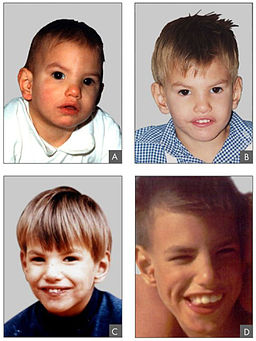
© (By Paola Cerruti Mainardi, via Wikimedia Commons)
Abnormal features in the hands and feet include partial webbing or joining together (fusing) of the fingers or toes. There may be a single line (crease) in the palm of the hand (there are normally two skin creases).
The affected newborn baby may be small and grow slowly. The affected child may have learning difficulties. There may be slow development of motor skills (eg, a delay in walking) and of speech and language.
Other features may include a hernia in the groin and separation of the muscles in the tummy. There is also an increased risk of heart defects and abnormalities in the brain, kidneys or gut (bowel).
Continue lendo abaixo
Causes of cri du chat syndrome
Voltar ao conteúdoCri du chat syndrome is a chromosome problem caused by a missing piece of chromosome 5. The missing piece of the chromosome is the short (called 'p') arm of chromosome 5. Therefore cri du chat syndrome is said to be caused by deletion of chromosome 5p.
Most cases (around 80 in 100) are thought to occur as a result of damage to the chromosome during the development of the egg or sperm. It is thought that around 12 cases in 100 are caused by an unbalanced translocation, which is a chromosomal re-arrangement in the parent's genes.
How common is cri du chat syndrome?
Voltar ao conteúdoCri du chat syndrome is very rare. It affects about 1 in every 30,000 newborn babies.
Continue lendo abaixo
How is cri du chat syndrome diagnosed?
Voltar ao conteúdoCri du chat syndrome can either be diagnosed before birth (prenatally) or after birth (postnatally).
Diagnóstico pré-natal
Diagnosis before birth may be made by ultrasound or by testing the baby's chromosomes during the pregnancy. See the separate leaflets called Amniocentesis, Chorionic Villus Sampling and Ultrasound Scan.
Diagnóstico pós-natal
Diagnosis after birth will be made by investigations if a baby has any features suggesting cri du chat syndrome. See the separate leaflet called Genetic Testing. The parents of a child with cri du chat syndrome should also have genetic counselling and testing to find out whether one parent has a change in chromosome 5.
Further tests will be needed to assess any features associated with cri du chat syndrome (eg, a skull X-ray e um exame de ressonância magnética (RM) to assess any skull and face abnormalities or an ultrasound scan of the heart (echocardiogram) to assess any heart defects).
Treatment for cri du chat syndrome
Voltar ao conteúdoCan cri du chat be cured?
There is no specific treatment for cri du chat syndrome. However, affected babies and children may need a great deal of physiotherapy and speech and language therapy.
Provision of early special schooling and a supportive home environment helps in development of social and intellectual ability. Surgical treatment may be needed to correct some abnormal features (for example, hernia) or any other associated features (for example, heart defects).
What is the prognosis for cri du chat syndrome?
Voltar ao conteúdoThe outlook (prognosis) depends on the severity of abnormal features. Learning difficulties and speech and language problems are common. However, most people with cri du chat syndrome survive well into adulthood.
About 1 in 10 babies born with cri du chat syndrome are severely affected and die within the first year of life. Intellectual disability is common.
Because of the head and face abnormalities, serious lung infection (pneumonia) is more common.
Understanding chromosomes and cell division
Voltar ao conteúdoChromosomes are found in the centre (nucleus) of a cell. They carry genetic information in the form of genes. 'Genetic' means that the condition is passed on through families by special codes called genes. Each cell of your body contains chromosomes which are made up of many genes.
In general, each cell in your body contains 46 chromosomes arranged in 23 pairs. One chromosome from each pair is inherited from your mother and the other is inherited from your father.
One of these chromosome pairs is known as the sex chromosomes because this pair determines our sex. Females have two of the same kind of sex chromosome (XX). Males have two different sex chromosomes (XY).
The Y chromosome contains the male determining genes. So, a normal female is 46, XX and a normal male is 46, XY. The other 22 pairs of chromosomes are numbered according to size with 1 being the longest pair and 22 being the shortest pair of chromosomes.
However, egg and sperm cells only have 23 chromosomes (1 chromosome from each pair). This is so that, when an egg and a sperm meet during conception, the child that is produced also has 46 chromosomes in each cell.
New body cells are produced for growth and repair by cells dividing, producing two 'daughter' cells. Each chromosome can duplicate an exact copy of itself so that each new cell that is formed has a full, identical set of chromosomes.
Rarely, there is a problem with the child's chromosomes. Possible problems include too many chromosomes, too few chromosomes or damage to one or more chromosomes. The abnormal chromosomes may mean that the baby cannot survive and so may cause a miscarriage.
However, babies with some chromosome abnormalities may survive but are affected by various medical problems (called a syndrome).
What causes cri du chat syndrome?
Voltar ao conteúdoCri du chat syndrome is a chromosome problem caused by a missing piece of chromosome 5. The missing piece of the chromosome is the short (called 'p') arm of chromosome 5. Therefore cri du chat syndrome is said to be caused by deletion of chromosome 5p.
Most cases are thought to occur as a result of damage to the chromosome during the development of the egg or sperm.
Escolhas do paciente para Condições genéticas

Saúde infantil
Distúrbios de armazenamento de glicogênio
Glycogen storage disorders are a group of inherited diseases. They result from a problem with one of the proteins (known as enzymes) involved in the conversion of glucose to glycogen, or the breakdown of glycogen back into glucose. They mostly tend to affect your liver and muscles. Most are diagnosed in childhood. Symptoms include weakness, tiredness and low blood sugar levels. Newer treatment possibilities provide hope for an improved outlook (prognosis). Most people with a glycogen storage disorder respond well to treatment. However, type II (infantile Pompe's disease) can be difficult to treat and can affect life expectancy.
by Dr Roger Henderson, MBBS
Saúde infantil
síndrome de Down
A síndrome de Down (também conhecida como síndrome de Down) é um problema genético de cromossomos. Alguém com síndrome de Down tem uma cópia extra do cromossomo 21 nas células do corpo. Isso causa as características típicas da condição. Todas as pessoas com síndrome de Down têm algum grau de deficiência intelectual. Elas também têm um risco aumentado de ter vários outros problemas médicos. A síndrome de Down pode ser detectada antes do nascimento (pré-natal) ou após o nascimento (pós-natal). Não pode ser curada, mas tratamento e apoio podem ajudar alguém com síndrome de Down a levar uma vida ativa. Vários grupos de aconselhamento e apoio estão disponíveis para pessoas com síndrome de Down, suas famílias e cuidadores, como a Associação de Síndrome de Down (veja Leitura Adicional abaixo para link do site).
por Dr. Colin Tidy, MRCGP
Leitura adicional e referências
- Cri-du-Chat Syndrome; Herança Mendeliana Online no Homem (OMIM)
- Ajitkumar A, Jamil RT, Mathai JK; Cri Du Chat Syndrome.
- Traisrisilp K, Yanase Y, Ake-Sittipaisarn S, et al; Prenatal Sonographic Features of Cri-du-Chat Syndrome: A Case Report and Analytical Literature Review. Diagnostics (Basel). 2022 Feb 6;12(2):421. doi: 10.3390/diagnostics12020421.
- Nevado J, Bel-Fenellos C, Sandoval-Talamantes AK, et al; Deep Phenotyping and Genetic Characterization of a Cohort of 70 Individuals With 5p Minus Syndrome. Front Genet. 2021 Jul 30;12:645595. doi: 10.3389/fgene.2021.645595. eCollection 2021.
Continue lendo abaixo
Histórico do artigo
As informações nesta página são escritas e revisadas por clínicos qualificados.
Próxima revisão prevista para: 18 Nov 2028
20 Nov 2023 | Última versão

Pergunte, compartilhe, conecte-se.
Navegue por discussões, faça perguntas e compartilhe experiências em centenas de tópicos de saúde.

Sentindo-se mal?
Avalie seus sintomas online gratuitamente
Inscreva-se no boletim informativo do Patient
Sua dose semanal de conselhos de saúde claros e confiáveis - escritos para ajudá-lo a se sentir informado, confiante e no controle.
Ao se inscrever, você aceita nossos Política de Privacidade. Você pode cancelar a inscrição a qualquer momento. Nunca vendemos seus dados.