Milia
Revisado por Dr Hayley Willacy, FRCGP Última atualização por Dr Philippa Vincent, MRCGPÚltima atualização 18 Apr 2023
Atende aos diretrizes editoriais
- BaixarBaixar
- Compartilhar
- Language
- Discussão
- Versão em Áudio
- Adicionar às fontes preferidas no Google
Milia are very small, raised, pearly-white or yellowish bumps on the skin. They are most often seen on the skin around the cheeks, nose, eyes and eyelids, forehead and chest. However, they can occur anywhere on the body. Milia are very common in newborn babies but can affect people of any age. In babies, milia clear by themselves and no treatment is needed. In other people, they may take longer to clear. In persistent cases, treatment may be suggested.
Em resumo
Milia are small, raised, pearly-white or yellowish bumps on the skin.
They are tiny skin cysts filled with a protein called keratin.
Milia are common in newborn babies, usually disappearing by 12 weeks.
In children and adults, milia often clear by themselves without treatment.
You should not try to squeeze or treat milia yourself, as this can cause scarring or infection.
If persistent or widespread, a skin specialist can offer removal treatments.
Preventing sun damage and correctly using steroid creams may reduce some types of milia.
Neste artigo:
Escolhas de vídeos para Erupções cutâneas
Continue lendo abaixo
O que são milia?
A milium is a small, raised bump on the skin. It is a type of tiny skin cyst filled with a protein called keratin.
Many are usually found together and so they are called milia (the plural of milium).
What do milia look like?
Voltar ao conteúdoMília em um recém-nascido
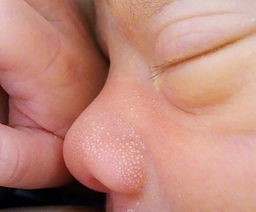
© Serephine, CC0, via Wikimedia Commons
As can be seen in the picture, milia are usually each about 1 or 2 millimetres across and are pearly-white or yellowish. They appear to be small white bumps on the face.
They are most often seen on the skin around the cheeks, nose, eyes and eyelids, forehead and chest but they can occur anywhere on the body.
Continue lendo abaixo
Types and causes of milia
Voltar ao conteúdoThere are different types of milia.
Neonatal milia
These are milia that are seen in young babies soon after they are born. They are very common and are usually found around the nose area but may also occur on the scalp, cheeks, upper body and inside the mouth. They are thought to arise from sweat glands that aren't fully developed or mature. Around half of all babies develop neonatal milia. In fact, because they are so common, they are actually considered as normal in newborn babies - often they are called "milk spots" although they are nothing to do with milk. They usually disappear by 12 weeks of age.
Mília primária
These are milia that can occur in both children and adults. They occur in an area of skin that has otherwise been normal without any previous damage or injury.
Mília secundária
These are milia that develop in an area of skin, anywhere on the body, that has previously been damaged or injured. For example, after a burn or a blistering rash. The milia develop as the skin heals and it is thought that damage to the sweat glands may be an underlying cause. Secondary milia also sometimes develop after some skin creams have been used.
Milia en plaque
Milia of this type are extremely rare. The milia develop on an inflamed, raised patch of skin known as a plaque which may be several centimetres across. The cause of milia en plaque is not fully understood. It usually occurs behind the ears, on an eyelid or on the cheeks or jaw area. This type of milia tends to particularly affect middle-aged women.
Milia eruptiva múltipla
The milia appear in crops, or patches, of milia that develop over a period of weeks or months. The crops usually appear on the face, the upper arms and the upper trunk. Milia of this type are also extremely rare.
Sintomas de milia
Voltar ao conteúdoMilia do not usually cause any symptoms but,they can occasionally become itchy.
Continue lendo abaixo
How are milia diagnosed?
Voltar ao conteúdoMilia are usually diagnosed by their typical appearance and generally no investigations are needed. However, occasionally, if the diagnosis is uncertain or if milia en plaque are suspected, a skin biopsy might be recommended.
During a skin biopsy, a small piece of skin is removed so that it can be examined under a microscope. There are different ways that a skin biopsy can be carried out. For example, by shaving away a small piece of skin or by using a special instrument to punch a tiny hole in the skin.
How long do milia last?
Voltar ao conteúdoMilia are harmless and, in most cases, they will eventually clear by themselves. In babies, they clear after a few weeks. However, in some people, milia can persist for months or longer. Secondary milia are sometimes permanent.
Tratamento de milia
Voltar ao conteúdoBecause they normally clear by themselves, milia do not usually need any treatment. However, some people find them unsightly and so opt for treatment to remove milia.
Milia removal
Milia may be removed using a fine needle and then squeezing, or pricking, out the contents. No anaesthetic is needed. However, it is not recommended to squeeze or try to treat milia yourself. This can lead to skin damage and scarring or infection.
If milia become very widespread and persistent, various other treatments may be suggested, usually by a skin specialist (a dermatologist). They include:
Crioterapia: a type of treatment that freezes skin lesions. Where a patch of skin has changed in appearance, it is known as a skin lesion.
Tratamento a laser.
Dermabrasion: a procedure that removes the topmost layers of the affected skin.
Chemical peeling: a treatment where a chemical is applied to the face to burn off skin lesions.
In the rare type of milia called milia en plaque, certain creams such as isotretinoína or tretinoin are sometimes suggested as treatment, or the antibiotic tablet, minocycline.
Can milia be prevented?
Voltar ao conteúdoMost milia cannot be avoided, particularly neonatal milia. The risk of developing secondary milia development can be reduced by avoiding excessive sun exposure, only using steroid creams for the length of time they are prescribed and regularly exfoliating and cleansing the skin to remove dead skin cells.
Escolhas do paciente para Erupções cutâneas

Saúde da pele, unhas e cabelos
Pitiríase rósea
Pitiríase rósea é uma erupção autolimitada, ou seja, desaparece por conta própria sem qualquer tratamento. Embora a erupção possa ser bastante dramática, a doença é muito leve. Afeta mais comumente jovens adultos, mas pode afetar todas as idades.
por Dra. Hayley Willacy, FRCGP

Saúde da pele, unhas e cabelos
doença de Bowen
A doença de Bowen é uma forma muito precoce de câncer de pele. Ela causa uma ou mais pequenas manchas de pele vermelha e escamosa. Ocorre quando células cancerígenas da pele crescem na camada externa da pele, mas não se espalham mais profundamente na pele ou para outras partes do corpo. Como essas células cancerígenas permanecem na camada externa da pele, elas não causam problemas sérios por si mesmas. No entanto, com o tempo, há uma chance de que essas células possam se desenvolver em um tipo diferente de câncer de pele, que pode causar problemas. Portanto, a doença de Bowen é geralmente tratada para evitar que isso aconteça. Um acompanhamento próximo é necessário após o tratamento para verificar qualquer retorno (recorrência) da doença de Bowen.
por Dr. Doug McKechnie, MRCGP
Perguntas frequentes
Can I remove milia at home?
It is not recommended to squeeze or try to treat milia yourself, as this can lead to skin damage, scarring, or infection. While a fine needle can be used to remove them in a clinical setting, self-removal is not advised.
Are milia contagious?
No, milia are not contagious. They are small skin cysts filled with keratin and are not spread from person to person.
What is the difference between primary and secondary milia?
Primary milia develop on skin that has not been previously damaged or injured, and can occur in both children and adults. Secondary milia, on the other hand, develop in an area of skin that has been damaged, for example, after a burn, blistering rash, or use of certain skin creams, as the skin heals.
If milia are usually harmless, why would anyone want to remove them?
While milia do not usually cause any physical symptoms and often clear by themselves, some people find them unsightly and therefore choose to have them removed for cosmetic reasons.
What kind of specialist would treat persistent milia?
If milia become very widespread and persistent, a skin specialist, known as a dermatologist, may suggest various treatments.
Can certain creams cause milia?
Yes, secondary milia can sometimes develop after some skin creams have been used.
What are the long-term effects of milia?
Milia are harmless and generally clear by themselves, often within a few weeks for babies. In some cases, milia can persist for months or longer. Secondary milia can sometimes be permanent.
Leitura adicional e referências
- O'Connor NR, McLaughlin MR, Ham P; Pele do recém-nascido: Parte I. Erupções cutâneas comuns. Am Fam Physician. 1 de janeiro de 2008;77(1):47-52.
- Milium, milia; DermNet NZ
Continue lendo abaixo
Sobre o autorVer biografia completa

Dra. Michelle Wright, MRCGP
Médico Generalista, Autor Médico
MB, ChB, MRCGP, DCH, DRCOG
A Dra. Michelle Wright se formou em 1997 no Reino Unido e trabalhou como médica de clínica geral em Londres antes de se mudar para a Suíça. Ela é autora da EMIS desde 2007.
Sobre o revisorVer biografia completa

Dr Hayley Willacy, FRCGP
Médico Generalista, Autor Médico
MBChB (1992), DRCOG, DFFP, MRCOG (Part 1) MRCGP (2007), DFSRH (2013), MSc - medical education (2020)
A Dra. Hayley Willacy era uma médica do NHS atuando no noroeste da Inglaterra, que se aposentou da prática clínica em 2022 após 30 anos.
Histórico do artigo
As informações nesta página são escritas e revisadas por clínicos qualificados.
Next review due: 16 Apr 2028
18 Apr 2023 | Última versão
15 Mar 2012 | Publicado originalmente
Escrito por:
Dra. Michelle Wright, MRCGP

Pergunte, compartilhe, conecte-se.
Navegue por discussões, faça perguntas e compartilhe experiências em centenas de tópicos de saúde.

Sentindo-se mal?
Avalie seus sintomas online gratuitamente
Inscreva-se no boletim informativo do Patient
Sua dose semanal de conselhos de saúde claros e confiáveis - escritos para ajudá-lo a se sentir informado, confiante e no controle.
Ao se inscrever, você aceita nossos Política de Privacidade. Você pode cancelar a inscrição a qualquer momento. Nunca vendemos seus dados.