
What is gastric sleeve surgery?
Peer reviewed by Dr Krishna Vakharia, MRCGPAuthored by Amberley DavisOriginally published 8 Feb 2023
Meets Patient’s editorial guidelines
- DownloadDownload
- Share
- Language
- Discussion
- Audio Version
- Add to preferred sources on Google
Gastric sleeve surgery is the most common type of weight loss surgery in the UK. We explain what happens during this surgery and explore the benefits, considerations, and risks involved.
Is weight loss surgery the right fit?
If you're interested in weight loss surgery, you first need to know if you qualify. In the UK and USA, this type of surgery - also called bariatric surgery - is reserved for the very obese and those endangered by life-threatening, obesity-related conditions, such as type 2 diabetes and high blood pressure.
In the UK, you may qualify for weight loss surgery on the NHS if:
You have a body mass index (BMI) of 40 or above
Or you have a BMI between 35 and 40 and an obesity-related condition that might improve with weight loss.
You've tried all other weight loss methods.
If your doctor agrees that this could be a good option for you, there are still plenty of things to consider. Weight loss surgery is a major operation, and this brings several health risks and long-term consequences.
What's more, when it comes to weight loss surgery, one size certainly doesn't fit all. There are several types of surgeries available and finding the right option for you will involve consultations and agreements between you and your doctor.
However, if you do decide to go ahead with surgery, it could transform or even save your life. There's evidence that surgery produces greater results for weight loss and improvement in related conditions than non-surgical treatment methods1.
In this article, we explore gastric sleeve surgery - also called sleeve gastrectomy - in detail. But this is just one surgical option for weight loss.
Other common types of weight loss surgery include:
Gastric band surgery - where a band is placed around your stomach so that it takes less food to fill it before you feel full.
Gastric bypass - where a section near the top of your stomach is stapled and connected to your small intestine, missing out the rest of the stomach, so that it takes less food to make you feel full.
Biliopancreatic diversion - where again the same part of your stomach is stapled but this time is connected further along the small intestine. This means you can eat even less food, but the risk of side effects is higher.
What is gastric sleeve surgery?
In gastric sleeve surgery, around 70-80% of your stomach is removed, leaving you with a much smaller 'sleeve' of a stomach - a narrow tube that takes a lot less food to fill. This means two things:
You cannot eat as much as you could before surgery - because your stomach can hold less food.
You will feel full from eating much sooner and for a longer period of time than you did before surgery - because significant levels of ghrelin, the hormone associated with hunger, have also been lost with the removed section of stomach2.
Gastric sleeve surgery
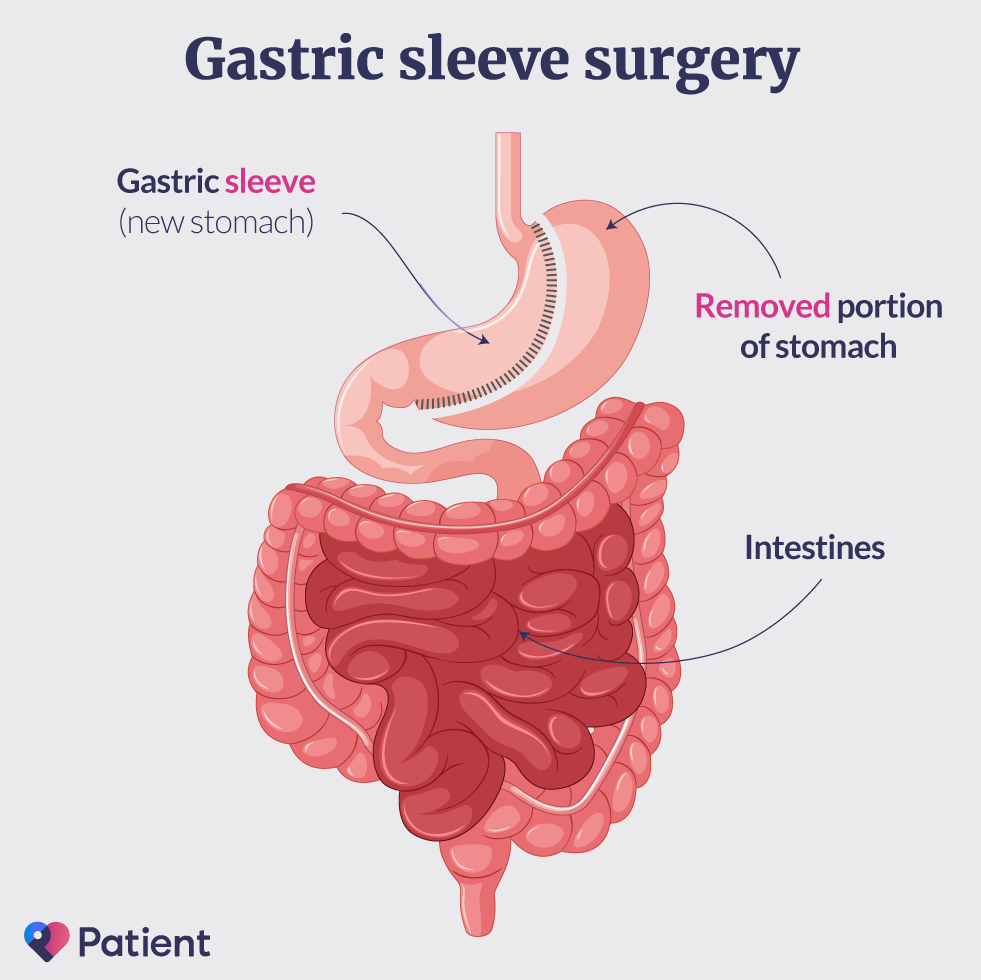
Here are the main stages of the procedure:
Your surgeon will make small cuts in your abdomen and insert a laparoscope - a long, thin tube with a light, camera, and surgical tools attached to it.
Using this instrument, the surgeon will remove most of one side of your stomach leaving a thin and long gastric tube.
This tube stays connected to your oesophagus above and the first part of your intestine below.
What is a gastric sleeve?
The term gastric sleeve is simply the name given to your newly created smaller stomach. Also sometimes called the gastric tube, this gastric sleeve is around the shape and size of a banana.
Benefits of gastric sleeve surgery
You could achieve up to 70% excess weight loss3 - although results can vary greatly depending on how well you follow a healthy diet and lifestyle after surgery.
It may also bring about remission of type 2 diabetes4 - research shows around 8 out of 10 people can go into remission with their diabetes following gastric sleeve surgery.
Feeling fuller for longer after eating can make it a bit easier to stick to your diet plan.
You continue to absorb nutrients in the usual way - this is unlike after a gastric bypass.
This surgery is relatively easier and quicker for surgeons compared with other types of weight loss surgery - it is a one-part procedure that could take around an hour to complete.
This procedure is minimally invasive - this means that the surgical cuts are small and few, which helps you recover faster.
If it doesn't result in the desired weight loss, you can then choose to under-go a gastric bypass.
Is gastric sleeve surgery safe?
Gastric sleeve surgery is considered to be relatively safe, but like all major surgical procedures it is not without risks.
Serious complications that can occur after any surgery include:
Haemorrhage - bleeding inside the body or from the surgical wound.
Irregular heartbeat - surgery may affect your heartbeat and could lead to atrial fibrillation.
Deep vein thrombosis - increased risk of blood clots forming in your leg veins.
Pulmonary embolism - increased risk of blood clots travelling to your lungs.
Pneumonia - pain from surgery can lead to shallow breathing which may lead to an infected lung.
Gastric sleeve surgery also runs the risk of these specific side-effects:
Gastric leaks - where stomach fluid leaks from the cut and sewn-up line in your stomach.
Stenosis - where a section of your gastric sleeve closes, causing an obstruction.
Heartburn or acid reflux (GORD) - where the smaller stomach pushes stomach acid up through your oesophagus. However, weight loss itself often resolves these issues.
Vitamin deficiencies - where you find it harder to absorb the vitamins you need because the part of your stomach that’s removed helps with this absorption. Everyone needs to take vitamin supplements post-surgery to help prevent this.
Your healthcare expert should discuss the likelihood of these risks with you in detail and answer any questions you might have.
Other considerations of gastric sleeve surgery
While a gastric sleeve ranks high for weight loss, it's slightly less effective than a gastric bypass - in terms of the average amount of excess weight you lose and overall health improvements5. However, a gastric bypass is a more complex procedure with its own list of pros and cons.
After surgery, you also have to commit to some long-term lifestyle changes. If the procedure is to be successful, you need to follow the lifestyle and eating habits that you agreed to with your surgeon and dietitian pre-surgery. You will also need to take nutrient supplements in order to reduce your chances of vitamin deficiencies.
Is gastric sleeve surgery reversible?
This surgery is irreversible - your stomach can't be changed back to its original size. A gastric sleeve requires you to commit to permanent changes in your diet and lifestyle. However, if even with these commitments you find that you're not losing as much weight as you need, gastric bypass surgery is an option.
Post surgery wellbeing
How much weight you lose will largely depend on how well you stick to your post-surgery lifestyle changes. But if you do manage to keep on track, a gastric sleeve can give you the control back in your life to reach and maintain a healthy weight through your diet6.
Being back in control of your physical wellbeing can also do wonders for your mental wellbeing, happiness levels, and overall quality of life7.
Further reading
Patient picks for Weight loss treatments and surgery
Treatment and medication
What are weight loss injections and are they safe?
Weight loss injections have been used by celebrities like Amy Schumer, Meghan Trainor, and Rebel Wilson - but are they really an option for everyone? The UK government is expanding access to weight loss jabs to some people to reduce obesity-related illnesses. This would mean that some so-called skinny-jabs - such as Wegovy - could be given at your local doctor's clinic rather than at a hospital. Here we look at which weight loss injections are already available, which may soon be, and what having the jabs entails.
by Victoria Raw
Treatment and medication
Are protein shakes good for weight loss?
Protein shakes have experienced a surge in popularity recently, with many people now drinking them daily to aid their journeys to improved fitness and better health. But what benefits do they offer, and can you drink protein shakes for weight loss?
by Emily Jane Bashforth
About the authorView full bio

Amberley Davis
Senior writer
BA (Hons), CPD
Amberley is a senior writer with Patient and has written extensively on a range of health and wellbeing topics.
About the reviewerView full bio

Dr Krishna Vakharia, MRCGP
Chief Medical Officer for Health, Optum UK
MBChB, MRCGP(2013), BMedSci (hons), DFSRH, DRCOG, PGDipDerm (Distn)
Dr Krishna Vakharia is an NHS GP. She is also a regular examiner for the postgraduate Diploma in Practical Dermatology at Cardiff University as well as being the Chief Medical Officer for health at Optum UK.
Article history
The information on this page is peer reviewed by qualified clinicians.
Article also available in English, German, Spanish, French, Italian, Portuguese, Hindi, Hebrew, Arabic, and Swedish.
8 Feb 2023 | Originally published
Authored by:
Amberley DavisPeer reviewed by
Dr Krishna Vakharia, MRCGP
Join the conversation
Share your thoughts or experiences with others in our patient communities.

Ask, share, connect.
Browse discussions, ask questions, and share experiences across hundreds of health topics.

Feeling unwell?
Assess your symptoms online for free
Sign up to the Patient newsletter
Your weekly dose of clear, trustworthy health advice - written to help you feel informed, confident and in control.
By subscribing you accept our Privacy Policy. You can unsubscribe at any time. We never sell your data.
More in treatment and medication
- 15 questions to ask before having surgery
- Are protein shakes good for weight loss?
- Art therapy: creative ways to boost your mental health
- Can a pharmacist prescribe antibiotics?
- Chemical found in cannabis could be more effective than painkillers
- Empowering the next generation: St John Ambulance and the Young Responders campaign
- Hay fever: how your pharmacist can help
- How to prepare for surgery: pre-op checklist
- How to prevent muscle loss on Mounjaro
- How to stop taking Mounjaro or switch to an alternative
- How weight loss surgery changed my life: Gemma's story
- Is it really reflux? Why you might be mis-prescribed PPIs
- Puberty blockers: what the evidence says, and why scientists are still studying them
- Unconventional healing: the rise of alternative therapies
- Wegovy pill: how does the new weight-loss tablet work?
- What are weight loss injections and are they safe?
- What factors are causing antimicrobial resistance?
- What is red light therapy? Benefits and risks
- What to expect from your pharmacy consultation
- What you need to know before you take erectile dysfunction medication