Calázio
Eyelid cyst
Revisado por Dr Colin Tidy, MRCGPÚltima atualização por Dr Philippa Vincent, MRCGPLast updated 4 Set 2024
Atende aos diretrizes editoriais
- BaixarBaixar
- Compartilhar
- Language
- Discussão
- Versão em Áudio
- Add to preferred sources on Google
Um calázio é um pequeno cisto que se forma na pálpebra quando uma glândula sebácea fica bloqueada ou inflamada. Geralmente é indolor e afeta principalmente a pálpebra superior.
Neste artigo:
Video picks for Problemas nas pálpebras
Pontos principais
A chalazion is a small, painless lump (cyst) on the upper eyelid that forms when an oil gland gets blocked. It is not an infection, however it can become infected.
Most clear up on their own over a few weeks or months. Using a warm compress for 5-10 minutes, 3-4 times a day, and gently massaging the eyelid can help it heal faster.
If the chalazion doesn’t go away or keeps coming back, an eye specialist can treat it with a small steroid injection or minor surgery to remove it.
Continue lendo abaixo
What is a chalazion?
Eye with upper eyelid chalazion
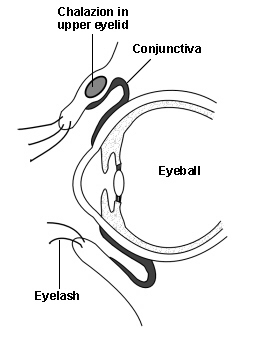
A chalazion is a small (2-8 mm) swelling in the eyelid. It arises due to inflammation causing a reaction known as a "granuloma" - this is a swelling filled with white blood cells and other tissue. It is common and sometimes called a meibomian cyst or tarsal cyst. A chalazion is more common on the upper eyelid. It is possible to have several at once, in more than one eyelid. It is not the same as a stye.
Calázio
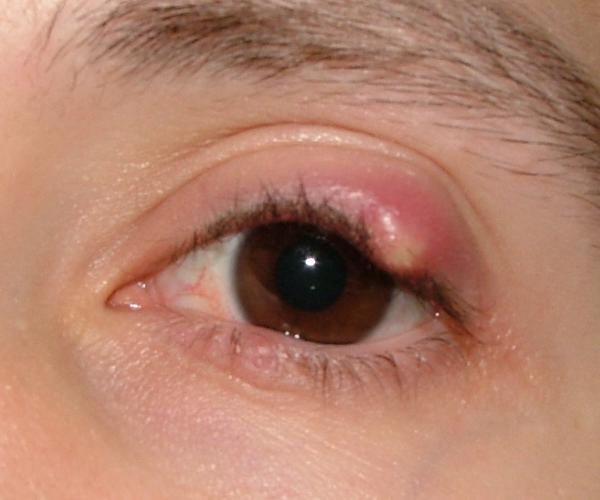
© Kotek1986. Tsca.bot, CC BY-SA 3.0, via Wikimedia Commons
Chalazion vs Stye
A chalazion is caused by a blockage of a gland in the eyelid, whereas a stye is due to an infected eyelash follicle.
What is a chalazion?
Stye vs Chalazion vs Hordeolum
A hordoleum is another word for a stye. These can be internal (an infection of the Meibomian gland) or external (an infection of the eyelash follicle) A chalazion is not an infection but is an inflammation. Sometimes it can be difficult to tell the difference between an internal hodoleum (stye) and an inflamed chalazion but the treatment for them both is the same.
Chalazion causes
Voltar ao conteúdoThere are tiny glands just under the inner surface of the eyelid, called meibomian glands. These make an oily fluid called meibum to help lubricate the eye.
If the gland becomes blocked then the meibum cannot escape into the tears. It may expand into a swelling and leak into the eyelid tissue. This becomes inflamed. Over time, inflammation causes a lump (or granuloma) to form in the eyelid. This is a firm, solid lump that remains for a long time. This lump is the chalazion.
Chalazion is more common in people who have an eye condition known as blepharitis, or skin conditions such as eczema, because in these conditions the meibum tends to be thicker so the gland is more easily blocked.
It is most commonly found in adults between the ages of 30 and 50.
Consulte os folhetos separados chamados Terçol e Blefarite para mais detalhes.
Continue lendo abaixo
Chalazion symptoms
Voltar ao conteúdoThe usual symptom is a small lump which develops on an eyelid.
It often is red and the surrounding area might be a little swollen.
Sometimes it causes mild pain or irritation, particularly if it has just started - this usually settles.
It sometimes gets infected and then becomes more swollen, red and painful.
Sight is not affected, although very occasionally it can be big enough to be noticeable at the edge of the vision.
Chalazion treatment
Voltar ao conteúdoNo treatment may be necessary as up to half of people get better without any treatment. This can take between two and six months but if the chalazion is not causing any problems, it is best just to watch and wait. Further treatment options include:
Warm compresses can help to reduce discomfort and also may disperse the chalazion. A clean flannel that has been in hot water should be held gently but firmly against the closed eye for 5-10 minutes, 3-4 times a day. The flannel cools quickly so should be warmed again regularly. This warmth and slight pressure may be enough to soften the contents of the fluid-filled swelling (cyst), helping it drain more easily. (The water should be hot but comfortable and not scalding.)
Antibiotic ointments, drops and medicines are not recommended as they do not make any difference - the contents of the cyst are infection-free. If the chalazion does become infected, antibiotic drops can sometimes be helpful.
Massage of the cyst after using a hot compress can encourage the cyst to drain. To do this, gently massage with a clean finger or cotton bud, in the direction of the eyelashes.
Cleaning the eyelid twice per day removes grease and dead skin cells that may contribute to cysts forming. A weak solution of baby shampoo in warm water is ideal and a cotton bud can be used to clean the eyelids with this.
Uma pequena operação is an option if it is troublesome or persistent. A referral to an ophthalmologist is needed and the operation is usually done under local anaesthetic, although children and some adults may not tolerate this and may require general anaesthetic. The eyelid is numbed. A small cut is then made on the inside of the eyelid to release the contents of the cyst and it is scraped out. After surgery antibiotic drops or ointment are commonly prescribed.
An injection of a steroid directly into the chalazion is another type of treatment which is less invasive and can be successful.
Continue lendo abaixo
Existem complicações?
Voltar ao conteúdoMost chalazia cause no problems. A cyst can become infected.
Rarely, this infection can spread to involve the whole eyelid and tissues surrounding the eye. The eyelid may be very swollen and red. It might be difficult to open the eye and there may be a lot of pain and a febre (temperatura alta). This type of complication is called orbital cellulitis and it is important to seek urgent medical advice, usually in an emergency department of a hospital. Treatment of orbital cellulitis is with antibiotics, usually into a vein (intravenously) via a drip, in hospital.
Isso vai acontecer de novo?
Voltar ao conteúdoA chalazion usually only occurs once. However, some people are prone to developing them and they may recur. It is sometimes possible to prevent a chalazion developing by using a hot compress on the eyelids (described above) and massaging the eyelids each morning.
Perguntas frequentes
Voltar ao conteúdoWhat triggers a chalazion?
A chalazion is often triggered by a blocked oil gland in the eyelid. This can happen after a stye or due to conditions like blepharitis, oily skin, or poor eyelid hygiene.
Are chalazia contagious?
No, chalazia are not contagious. They form when an oil gland in the eyelid becomes blocked, not from an infection that can spread to others.
Can a chalazion be dangerous?
A chalazion is not usually dangerous and often clears on its own. However, if it becomes very large, painful, or affects your vision, it’s best to see a doctor for advice.
Will the NHS remove a chalazion?
Yes, the NHS can remove a chalazion if it doesn’t go away on its own or keeps coming back. Minor surgery may be offered if warm compresses and other treatments haven’t worked.
Patient picks for Problemas nas pálpebras

Saúde ocular
Blefarite
Blefarite significa inflamação das pálpebras. Ela faz com que os olhos fiquem irritados e as pálpebras podem ficar inchadas e vermelhas. Pode ser uma condição incômoda e recorrente sem uma cura definitiva. A visão raramente é afetada.
por Dr. Doug McKechnie, MRCGP

Saúde ocular
Ectrópio
Ectrópio é uma condição em que parte ou toda a pálpebra inferior se vira para fora, afastando-se do olho. Existem várias causas, mas a causa mais comum é um efeito de envelhecimento da pálpebra que ocorre em algumas pessoas mais velhas. Uma operação simples geralmente pode resolver o problema.
por Dr. Colin Tidy, MRCGP
Leitura adicional e referências
- Meibomian cyst (chalazion); NICE CKS, abril de 2024 (acesso apenas no Reino Unido)
- Carlisle RT, Digiovanni J; Differential Diagnosis of the Swollen Red Eyelid. Am Fam Physician. 2015 Jul 15;92(2):106-12.
Continue lendo abaixo
About the authorView full bio

Dr Philippa Vincent, MRCGP
Médico Generalista, Autor Médico
MB BS, Bsc, MRCGP (2000), DCH, DFSRH, DRCOG
Dra Philippa Vincent is an NHS GP working in North London.
About the reviewerView full bio

Dr Colin Tidy, MRCGP
Médico Generalista, Autor Médico
MBBS, MRCGP, MRCP (Paediatrics), DCH
Dr Colin Tidy é um médico do NHS, baseado em Oxfordshire.
Histórico do artigo
As informações nesta página são escritas e revisadas por clínicos qualificados.
Próxima revisão prevista: 3 de setembro de 2027
4 Set 2024 | Última versão

Pergunte, compartilhe, conecte-se.
Navegue por discussões, faça perguntas e compartilhe experiências em centenas de tópicos de saúde.

Sentindo-se mal?
Avalie seus sintomas online gratuitamente
Inscreva-se no boletim informativo do Patient
Sua dose semanal de conselhos de saúde claros e confiáveis - escritos para ajudá-lo a se sentir informado, confiante e no controle.
By subscribing you accept our Política de Privacidade. Você pode cancelar a inscrição a qualquer momento. Nunca vendemos seus dados.