Teste de fita de urina
Revisado por Dr Doug McKechnie, MRCGPÚltima atualização por Dr Philippa Vincent, MRCGPÚltima atualização 4 Jun 2024
Atende aos diretrizes editoriais
- BaixarBaixar
- Compartilhar
- Language
- Discussão
- Versão em Áudio
- Adicionar às fontes preferidas no Google
Um teste de fita reagente de urina analisa a urina usando uma tira de papel especial que é mergulhada em uma amostra de urina. O resultado fica disponível quase imediatamente. Às vezes, é chamado de teste rápido de urina.
Em resumo
A urine dipstick test quickly checks for abnormal substances in your urine.
It involves dipping a treated strip into a urine sample, with results in minutes.
You provide a "midstream" urine sample in a sterile pot.
The test can check for things like blood, protein, glucose, or signs of infection.
Results may indicate conditions such as diabetes, kidney issues, or urinary tract infections.
Abnormal results may lead to further lab tests on your urine sample.
Neste artigo:
Escolhas de vídeos para Exames de urina e bexiga
Urine contains waste chemicals from all of the millions of chemical reactions that go on in the body all the time.
However, in some conditions, chemicals that shouldn't normally be present in urine get through the filtering systems in the kidneys and pass into the urine. Normally these chemicals would be dealt with by the kidneys and return to the blood stream.
Urine dipstick tests can be used to see if those chemicals are present.
Continue lendo abaixo
What is a urine dipstick test?
A urine dipstick test is the quickest way to test urine. It involves dipping a specially treated paper strip into a sample of urine. This can be done during an appointment with a health professional.
The results are usually available within 60-120 seconds. The sample doesn't need to be sent to a laboratory for a urine dipstick test although if the test is abnormal, the sample may be sent to a laboratory for further tests.
What do you need to do for a urine dipstick test?
Voltar ao conteúdoA sample of urine will need to be provided in a sterile container. Ideally the urine should be produced straight into the pot. Peeing into another container and then transferring it stops it being a sterile sample so is not recommended.
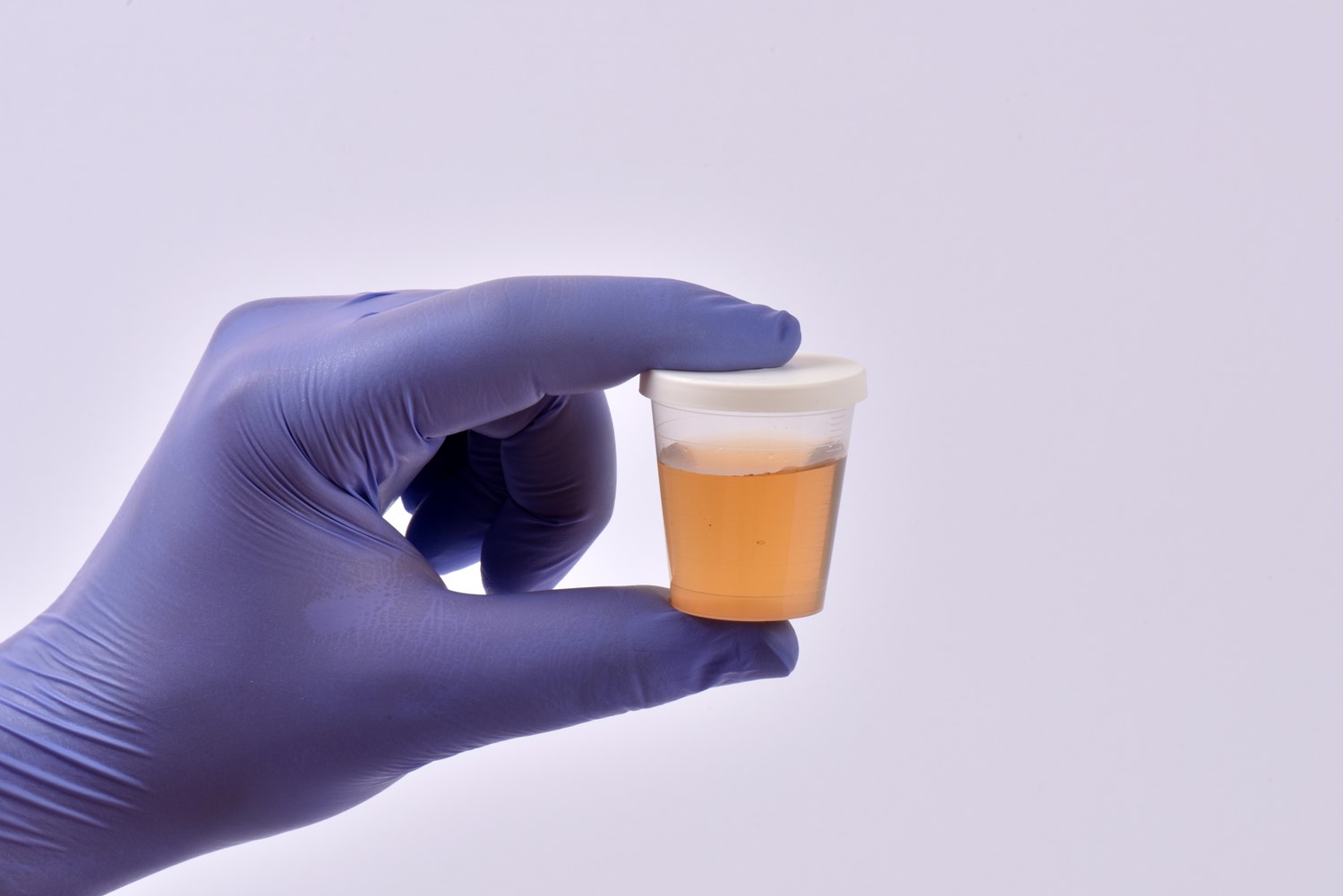
The best sample is one which is called a amostra de urina do jato médio (MSU). This means starting to pee, then passing the open pot into the stream of urine and then taking it away again when enough urine has been collected. The lid should then be replaced tightly on the pot and then both hands and the pot washed carefully.
Continue lendo abaixo
How is a urine dipstick test done?
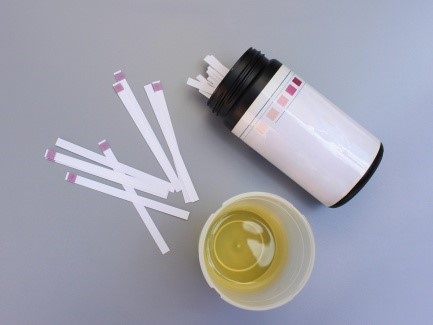
Voltar ao conteúdoA health professional will use a urine testing strip to test the urine. There are several different kinds of urine testing strips that test for different things in the urine. The strip has squares on it that change colour in the presence of certain substances.
The strip will then be compared to a chart on the side of the urine testing strip package. Often the more intense the colour change, the more of the substance there is in the urine.
How to read a urine dipstick
Voltar ao conteúdoSome urine dipsticks test for just one or two of the abnormalities below. Others test for many of these substances.
To read the dipstick, this involves:
Taking a urine sample as above.
Dipping one of the sticks into the sample, making sure all the test zones on the stick are submerged.
Removing the stick, tapping to remove excess urine and holding it horizontally so urine doesn't drip.
After the relevant time (usually between 30 seconds and 2 minutes), holding the dipstick up against the colour chart on the dipstick bottle.
Each test will be colour-coded and there will be several different shades of that colour. A darker shade indicates that there is more of the relevant substance - blood, glucose etc - in the urine.
Recording the result.
Continue lendo abaixo
Why is a urine dipstick test done?
Voltar ao conteúdoA urine dipstick test is done for lots of different reasons, such as:
A routine check during pregnancy to check for glucose, protein or signs of bacteria.
To screen for diabetes.
If a infecção urinária is suspected.
To look for sangue na urina (haematuria).
It may be done in people with some types of abdominal or back pain to look for kidney or bladder problems.
The first thing that a health professional will do is look at the urine. Normal urine varies in colour from colourless to dark yellow. Various things can affect the way urine looks, from how much fluid has been drunk to what has been eaten recently. The smell can also vary widely and is not a good gauge of illness.
What are the results of a urine dipstick test?
Voltar ao conteúdoA urine dipstick test can look for the following:
Sangue
Blood is not normally found in the urine.
It may be present if there is an infection.
It can be due to significant underlying disease, such as cancer, in the bladder or kidney.
In women, it may be due to contamination if menstruating at the time of doing the sample.
Will usually need to be confirmed by sending the sample for a full laboratory test, as the dipstick test can show a false positive.
Proteína
Protein is normally found in the urine in tiny amounts but these tiny amounts are usually too small to be picked up on a urine dipstick test.
Protein may be found in larger amounts if there is an infection.
It can be seen as one of the signs of pré-eclâmpsia na gravidez.
It can be the first sign of kidney disease and is also used as a measure of the severity of kidney disease.
Glicose
Glucose, a type of sugar, is not normally found in the urine.
It can be found in the urine if someone has poorly controlled diabetes or as the first sign of diabetes.
It can also be found in people with particular types of kidney disease, even without diabetes.
There is a rare condition called familial renal glycosuria where glucose is found in the urine without diabetes - this is an inherited condition.
People with type 2 diabetes who are taking a medicine called an SGLT2 inhibitor (such as canagliflozina, dapagliflozina ou empagliflozina) can have glucose in the urine due to the fact that these medicines help to reduce blood sugar, partly by reducing the amount of glucose reabsorbed into the system via the kidneys. Glucose in the urine whilst taking one of these medicines is normal.
Corpos cetônicos
Ketones are chemicals made by the body when it's breaking down fat for energy. This happens when starving and the body has used up all, or nearly all, of its stores of sugar (glucose). This is normal.
Ketones are not usually found in the urine otherwise.
Ketones may be present in diabetes which is not well controlled; levels of glucose in the blood are usually also very high in this scenario. In someone with diabetes, particularly type 1 diabetes, ketones in the urine can indicate a condition called diabetic ketoacidosis. This is a serious emergency and requires urgent treatment in hospital.
Ketones may also be present in women who are pregnant.
Ketones can be a sign of dehydration.
Bilirrubina e urobilinogênio
Bilirubin and urobilinogen are chemicals produced by the liver. They are not normally found in the urine.
If bilirubin is found in the urine it usually means there's a problem with the liver.
Small amounts of urobilinogen may be found in the urine but large amounts suggest a problem with the liver or with glóbulos vermelhos being destroyed too quickly.
Leukocyte esterase and nitrite
These are both tests for the presence of infection.
Leukocyte esterase test looks for a reaction that only happens if there are lots of white cells in the urine. White cells get into the urine when there is an infection.
Nitrite is not normally found in the urine but will appear there if there are lots of bacteria in the urine.
Nitrite test can be negative even if there are lots of bacteria in the urine if the urine hasn't been in the bladder for long.
Urine dipstick tests are very accurate at excluding infection but are less reliable for predicting infection - there are more false positive results.
The urine dipstick test also measures how concentrated the urine is and how acidic it is.
Escolhas do paciente para Exames de urina e bexiga
Exames e investigações
Corpos cetônicos na urina
Os corpos cetônicos são produzidos quando o corpo queima gordura como combustível. Normalmente, esses corpos cetônicos são completamente decompostos (metabolizados), de modo que há muito poucos corpos cetônicos na urina. Se, por qualquer motivo, o corpo não conseguir obter glicose suficiente para energia, ele passará a usar as gorduras do corpo, causando um aumento nos corpos cetônicos no organismo. Isso resulta em mais corpos cetônicos na urina.
por Dr. Surangi Mendis, MRCGP
Exames e investigações
Coleta de urina de meio de fluxo
Uma amostra de urina de meio de fluxo (MSU ou MSSU) é geralmente testada para verificar infecção, embora em alguns casos, uma doença diferente da infecção possa ser diagnosticada com base parcialmente no que é observado em uma MSU.
por Dra. Rachel Hudson, MRCGP
Perguntas frequentes
Does a urine dipstick test hurt?
No, a urine dipstick test is not painful. It involves providing a urine sample, which is then tested by dipping a paper strip into it. There are no needles or invasive procedures during the test itself.
Can I prepare for a urine dipstick test?
The main preparation is to be ready to provide a midstream urine sample. This involves starting to urinate, then collecting a portion of the urine in a sterile pot, and then finishing urination. Ensuring you have enough fluid in your system to provide a sample is helpful.
How quickly will I get the results from a urine dipstick test?
The results from a urine dipstick test are usually available very quickly, typically within 60-120 seconds, as the health professional can read the colour changes on the strip almost immediately.
What if my urine dipstick test shows an abnormality?
If the urine dipstick test shows an abnormal result, the urine sample may be sent to a laboratory for further, more detailed tests. For example, if blood is detected, it usually needs confirmation by a full laboratory test because a dipstick can sometimes show a false positive.
Can diet or medication affect my urine dipstick test results?
Yes, certain factors can influence results. For example, some people with type 2 diabetes taking SGLT2 inhibitor medication will normally have glucose in their urine. Also, the general appearance and smell of urine can be affected by how much fluid you've drunk or what you've eaten recently.
If I am menstruating, will this affect the test?
Yes, if you are menstruating when you provide a urine sample, blood may be present in the sample due to contamination. This can lead to a positive result for blood on the dipstick test.
Leitura adicional e referências
- BMC Urology; The urine dipstick test useful to rule out infections. A meta-analysis of the accuracy
Continue lendo abaixo
Sobre o autorVer biografia completa

Dr Philippa Vincent, MRCGP
Médico Generalista, Autor Médico
MB BS, Bsc, MRCGP (2000), DCH, DFSRH, DRCOG
Dra Philippa Vincent é um médico do NHS trabalhando no norte de Londres.
Sobre o revisorVer biografia completa

Dr Doug McKechnie, MRCGP
Redator Médico
MA, MBBS, MSc, DRCOG, MRCP(UK), MRCGP(2021), FHEA
O Dr. Doug McKechnie é um médico do NHS que trabalha em Londres. Ele trabalha em tempo integral na prática clínica e também é o Vice-Líder do módulo de Prática Clínica e Profissional na Faculdade de Medicina da University College London.
Histórico do artigo
As informações nesta página são escritas e revisadas por clínicos qualificados.
Next review due: 3 Jun 2027
4 Jun 2024 | Última versão

Pergunte, compartilhe, conecte-se.
Navegue por discussões, faça perguntas e compartilhe experiências em centenas de tópicos de saúde.

Sentindo-se mal?
Avalie seus sintomas online gratuitamente
Inscreva-se no boletim informativo do Patient
Sua dose semanal de conselhos de saúde claros e confiáveis - escritos para ajudá-lo a se sentir informado, confiante e no controle.
Ao se inscrever, você aceita nossos Política de Privacidade. Você pode cancelar a inscrição a qualquer momento. Nunca vendemos seus dados.